Loading
Drastically Improve Your Chess
Upgrade to a FileSonic Premium account and download at incredible speed!

This is default featured post 1 title

Go to Blogger edit html and find these sentences.Now replace these sentences with your own descriptions.This theme is Bloggerized by Lasantha Bandara - Premiumbloggertemplates.com.

This is default featured post 2 title

Go to Blogger edit html and find these sentences.Now replace these sentences with your own descriptions.This theme is Bloggerized by Lasantha Bandara - Premiumbloggertemplates.com.

This is default featured post 3 title

Go to Blogger edit html and find these sentences.Now replace these sentences with your own descriptions.This theme is Bloggerized by Lasantha Bandara - Premiumbloggertemplates.com.

This is default featured post 4 title

Go to Blogger edit html and find these sentences.Now replace these sentences with your own descriptions.This theme is Bloggerized by Lasantha Bandara - Premiumbloggertemplates.com.

This is default featured post 5 title

Go to Blogger edit html and find these sentences.Now replace these sentences with your own descriptions.This theme is Bloggerized by Lasantha Bandara - Premiumbloggertemplates.com.

Most In-depth Study ( Must Have )
Showing posts with label Championships. Show all posts

Saturday, April 17, 2010

Anand reached Sofia for the World Chess Championship 2010

The latest information from the WCC in Sofia

Viswanathan Anand is already in Sofia for the World Chess Championship match. There is confirmation from Hilton Hotel in Sofia that all rooms of Anand's team are already inhabited. The defending World Chess Champion has not informed the organizers for the hour of the arrival, as he wanted to escape journalists at the airport and keep his seconds secret to the last moment.
The special curtain that prevents visual contact players->audience and allows the chess fans to see the scene is also in Sofia. It costs about 2500 eur and has size 11x11 meters.
The playing hall is already prepared and it was inspected by the India ambassador in Bulgaria. You can find the visual presentation at the photo gallery

More details from the opening ceremony

A few days ago Chessdom informed about the video and music presentations at the opening ceremony. Today during the press conference our journalists learned that the drawing of colors will be performed with special white and black kings in the style of the Second Bulgarian Kingdom, the first one to enter the pre-renaissance period in Europe.


Indian embassador
The inspection by the Indian embassador, at the photo he is on the scene of the WCC match.

Article Source : Chessdom

Attack The King - A Complete Chess Portal
If you liked the article kindly Digg it, Stumble it, Add to Technorati, bookmark it and please consider Subscribing by Email  and have articles delivered right to your inbox! OR Subscribe to Attack the King Feed in a Fead Reader of your choice OR Subscribe to SMS Alerts & Get Article Headlines & Updates delivered to your Mobile Phone for free.

Friday, April 16, 2010

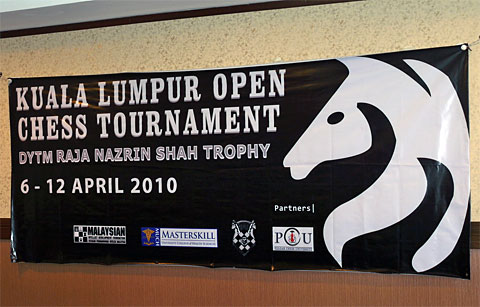
Impressions from the Third Kuala Lumpur Open with spine-chilling Videos

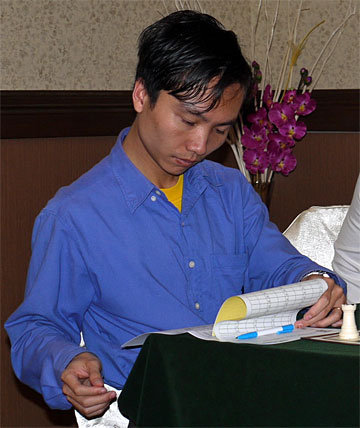
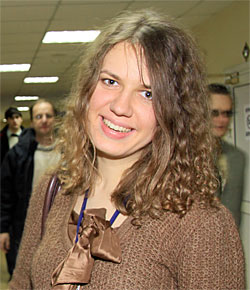
We recently reported on this event, won by the 16-year-old "wonder-girl from China", and shared the video reports produced by our colleagues at Europe Echecs with you. Today we bring you regular pictorial impressions from the event in the capital and largest city of Malaysia. They were shot by our roving reporter WGM Yana Melnikova, to whose report we have added some spine-chilling videos.

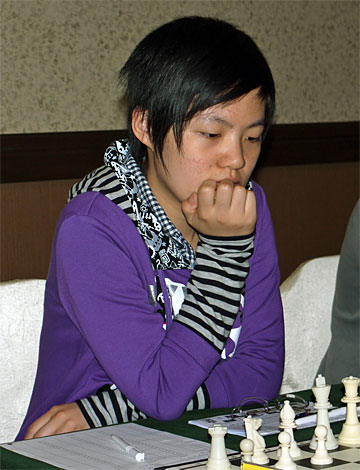
As previously reported 16-year-old wonder-girl GM Hou Yifan was crowned champion of the Third Kuala Lumpur Open Chess Tournament 2010, which concluded at Hotel Olympic Sports on Monday. The Chinese girl became richer with the first prize of RM 10,000 (Malaysia Ringgits = US $3,100 or €2,300) and the glittering DYTM Raja Nazrin Shah Trophy.

Final top ranking after nine rounds

Rk. Ti. Name
FED
Rtg
Pts.
 TB1 
 TB2 
 TB3 
1 GM Hou Yifan
CHN
2570
7.5
52.0
48.0
43.5
2 GM Nguyen Anh Dung
VIE
2464
7.0
53.0
49.0
44.5
3 GM Mchedlishvili Mikheil
GEO
2634
7.0
52.5
48.5
43.5
4 GM Megaranto Susanto
INA
2527
6.5
54.0
49.5
44.5
5 GM Luther Thomas
GER
2559
6.5
51.5
48.0
43.0
6 IM Swapnil S. Dhopade
IND
2442
6.5
49.5
45.5
41.0
7 GM Dzhumaev Marat
UZB
2525
6.5
49.0
45.5
41.5
8 IM Khamrakulov Dzhurabek
UZB
2509
6.5
49.0
44.5
39.5
9 IM Ashwin Jayaram
IND
2446
6.5
48.0
44.0
40.0
10 GM Cao Sang
HUN
2557
6.0
51.5
46.5
41.5
11 GM Rahman Ziaur
BAN
2558
6.0
51.0
47.0
42.5
12 GM Iuldashev Saidali
UZB
2511
6.0
51.0
46.0
41.0
13 FM De Ramos Julius Joseph
PHI
2314
6.0
50.5
47.5
42.0
14 GM Murshed Niaz
BAN
2413
6.0
47.5
44.5
40.5
15 IM Irwanto Saidikin
INA
2414
6.0
47.5
43.5
39.5
16 FM Chan Nicholas
MAS
2398
6.0
45.0
41.0
37.0
17 IM Duong The Anh
VIE
2425
6.0
44.5
40.5
36.5
18
Laksana Agusta
INA
0
6.0
44.0
40.0
36.0
19 IM Yap Kim Steven
PHI
2416
6.0
39.5
35.5
31.5
20 IM Prathamesh Sunil Mokal
IND
2403
6.0
39.0
35.5
31.5

Impressions from the Third Kuala Lumpur Open

By WGM Yana Melnikova


Straight winner: 16-year-old GM Hou Yifan with 7.5/9 points

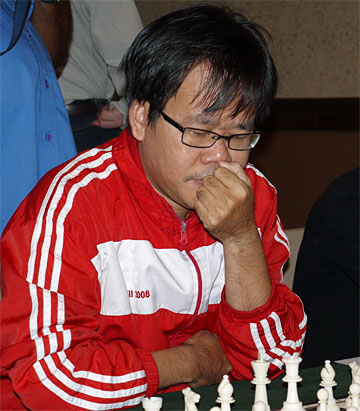
Second: GM Nguyen Anh Dung, VIE, 2464, 7.0/9 points


Third: GM Mikheil Mchedlishvili, GEO, 2634, 7.0/9 points


Fourth: GM Susanto Megaranto, INA, 2527, 6.5 points


Fifth: GM Thomas Luther, GER, 2559 6.5/9 points


Twelfth: GM Saidali Iuldachev, UZB, 2511 6.0/9 points

15th: IM Sadikin Irwanto, INA, 2414, 6.0/9 points


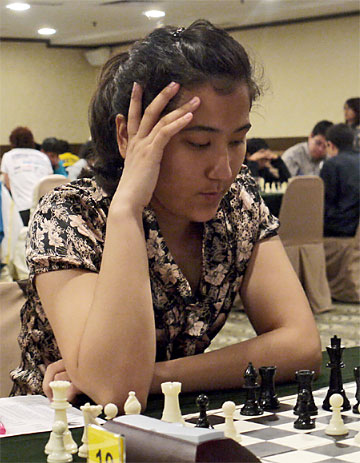
45th: WIM Nafisa Muminova, UZB, 2338, 5.0/9 points


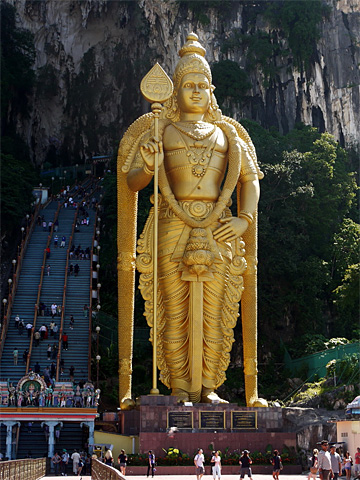
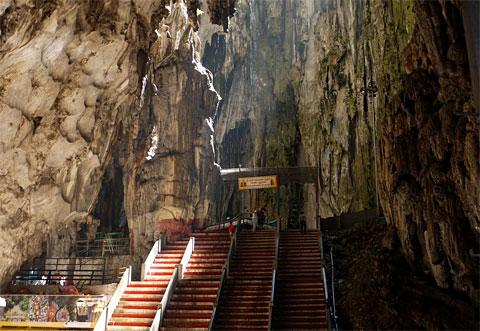
At the entrance to Batu Caves, a Hindu Murugan statue


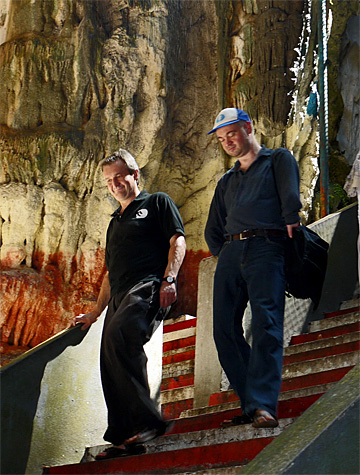
IM Aleksandar Wohl, AUS and GM Thomas Luther in Batu Caves

Batu Caves is a limestone hill with a series of cave temples eight miles from Kuala Lumpur
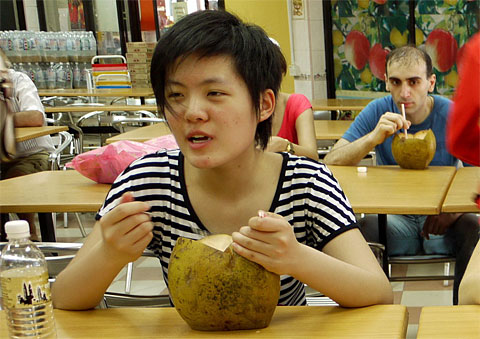
A coconut milk refreshment pause for Hou Yifan and Mikheil Mchedlishvili

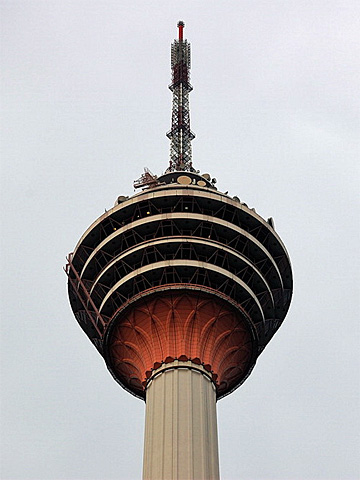
The Kuala Lumpur Tower or Menara Kuala Lumpur
The KL Tower, completed in 1994, is 421 m (1,381 ft) tall, making it the eighteenth tallest freestanding tower in the world. The upper area contains a revolving restaurant, providing diners a beautiful view of the city. The tower also acts as the Islamic falak observatory to look for the crescent moon to mark the beginning of Muslim month of Ramadhan.
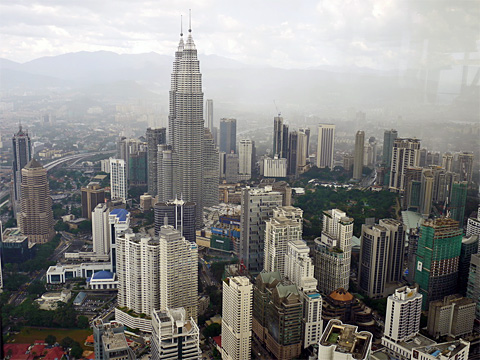
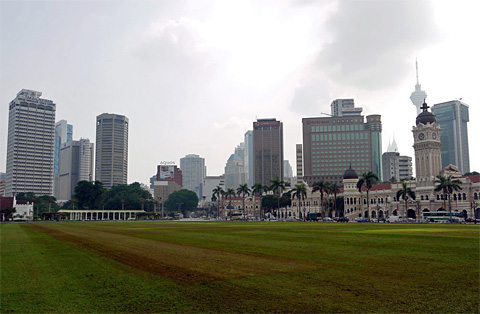
Spectacular: a view of the city and the Petronas building from the KL Tower

The city viewed from ground level (with the KL tower in the background on the right)

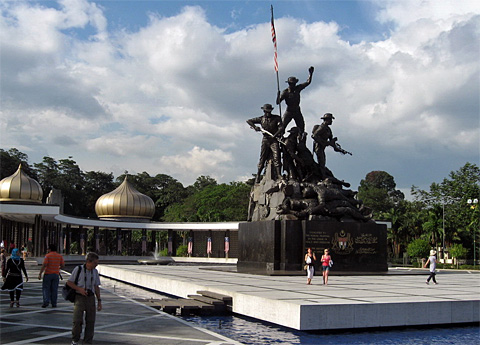
the Tugu Negara, or National Monument
Tugu Negara is a sculpture that commemorates those who died in Malaysia's struggle for freedom, principally against the Japanese occupation during World War II. The monument depicts a group of soldiers holding the Malaysian national flag aloft. Every year on July 31, Hari Pahlawan (Heroes Day), the Prime Minister and heads of military and the police pay their respects to the fallen heroes by laying garlands at the monument.
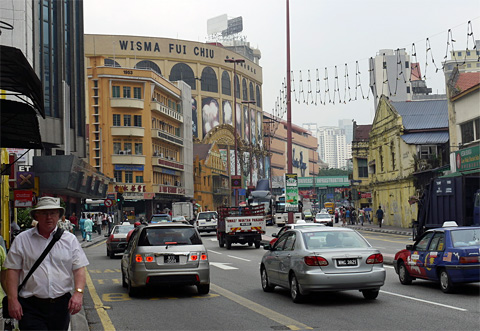
China Town in Kuala Lumpur

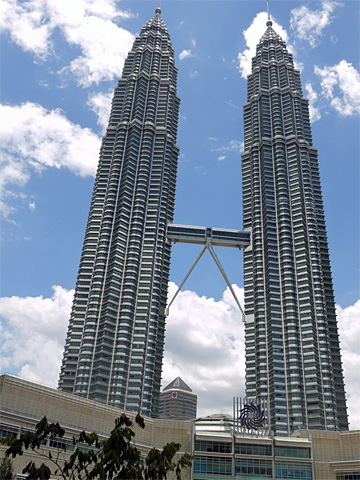
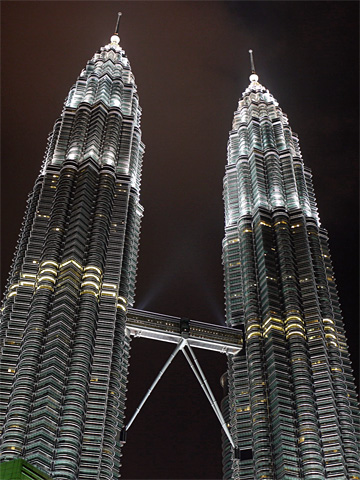
Menara Berkembar Petronas – the famous Petronas Twin Towers
The Petronas Towers were the world's tallest buildings from 1998 to 2004 (when their height was surpassed by Taipei 101). The towers remain the tallest twin buildings in the world. The 88-floor structures are constructed largely of reinforced concrete, with a steel and glass facade designed to resemble motifs found in Islamic art. Another Islamic influence on the design is that the cross section of the towers is based on a Rub el Hizb (albeit with circular sectors added to meet office space requirements).

The Skybridge of the Petronas Towers
The towers feature a skybridge between the two towers on 41st and 42nd floors, 170 m (558 ft) above the ground and 58 m (190 ft) long. It is not firmly attached to the main structure, but is instead designed to slide in and out of the towers to prevent it from breaking during high winds. The skybridge acts as a safety device, so that in the event of a fire or other emergency in one tower, tenants can evacuate by crossing the skybridge to the other tower.
The Petronas Towers have other uses as well – watch at your own peril...

About the photographer
WGM Yana Melnikova, Russia, is:
  • a graduate of the N. Bauman Moscow State Technical University, management faculty;
  • an organizers of chess events for the Moscow Chess Federation;
  • a member of German chess club Bad Konigshofen;
  • a Woman Grandmaster since 2005.

Links


Article Source : Chessbase

Attack The King - A Complete Chess Portal
If you liked the article kindly Digg it, Stumble it, Add to Technorati, bookmark it and please consider Subscribing by Email  and have articles delivered right to your inbox! OR Subscribe to Attack the King Feed in a Fead Reader of your choice OR Subscribe to SMS Alerts & Get Article Headlines & Updates delivered to your Mobile Phone for free.

Youth rules at the Budapest Spring Festival

Youth rules at the Budapest Spring Festival
Like most of Europe, Budapest had a very persistent winter, and blocks of ice could still be seen floating down the Danube. However, Spring is well and truly there, and is celebrated in Budapest with its traditional Spring Festival of Arts with outstanding theatre, music, dance, and art exhibitions. And the Spring Chess Festival marked by a large number of boys and girls. Pictorial report.

Budapest Spring Festival

By Diana Mihajlova


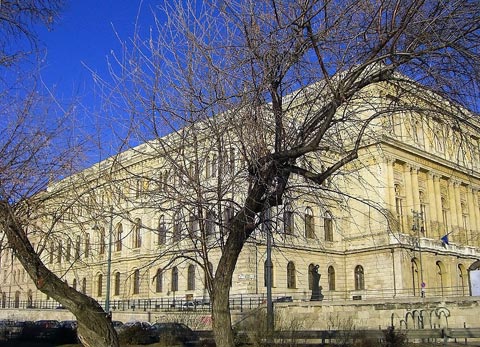
The Hungarian Academy of Sciences
Well into April, and the bare branches in front of the Hungarian Academy of Sciences seem unaware. However, despite appearances to the contrary, Spring is well and truly upon us, celebrated in Budapest with its traditional Spring Festival of Arts with outstanding theatre, music, dance, and art exhibitions.
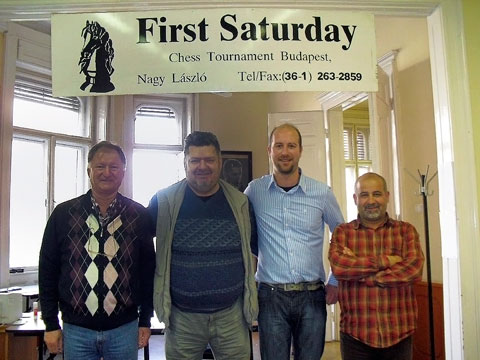
Chess in Budapest has its own Spring Festival, organised by Laszlo Nagy, the famed organiser of the First Saturday tournaments. It is a yearly event and this year it ran from March 19 to 28. That the youngsters are filling the chess playing halls is no longer a surprise, but this year’s Budapest Spring Festival was especially marked by a large number of boys and girls. Could it they have been inspired by their compatriot, 14-year-old Richard Rapport – the newest and youngest Hungarian GM?
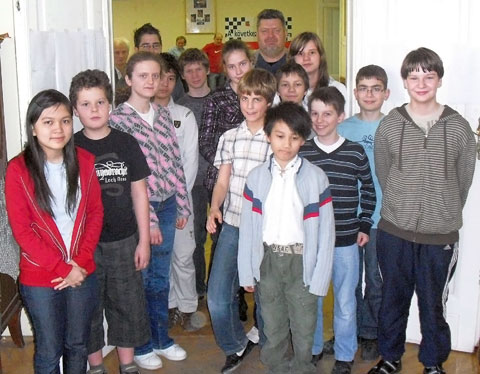
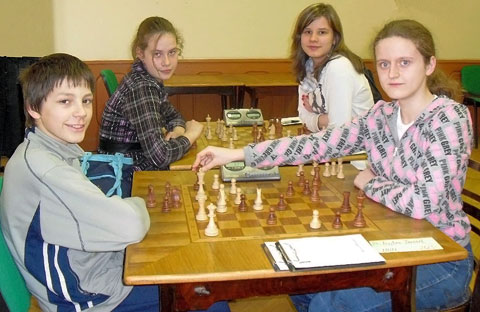
Youngsters rule the chess world. A few of the junior players with organiser Laszlo Nagy seen behind. Almost one third of the participants were under 14.
Warming up before a round – Csaba Tesik (2159), Melinda Varga (1840), Boglarka Bea (2012) and Zsuzsana Kabai (2086). And on the opposite end of the spectrum, let’s not forget the tireless seniors such as:

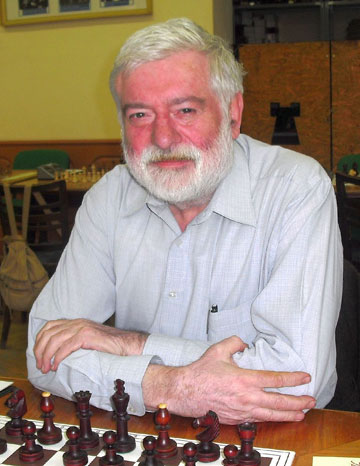
Lajos Borda (2076), a very active player in the Hungarian chess circuit

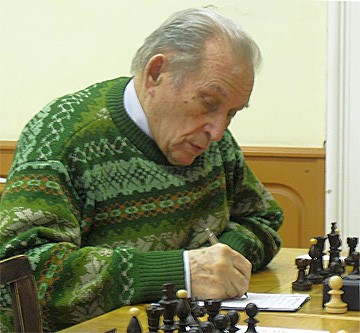
Dr Lajos Kelemen, 84, sets the example for his younger counterparts,
while regularly playing in national tournaments as well as the First Saturdays.

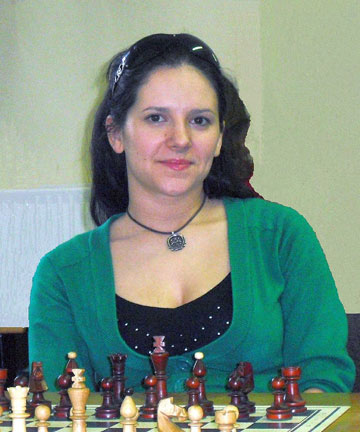
WIM Lili Toth (HUN 2198) found some time to fit a chess tournament in her busy schedule while she studies and trains to become a lawyer. Her result of 5.0/9 was not bad, considering the little time she has to dedicate to chess training.
Although the Spring Festival is mainly a ‘local affair’, it also attracts quite a number of players from abroad.

An Irishman and an Englishman in Budapest: Antony Breen (IRL, 1719) and Tristan Cox (ENG, 2106).

Glen Charleshouse (ENG, 2203), with his 6.0/9 should take back fond memories of the Spring Festival.

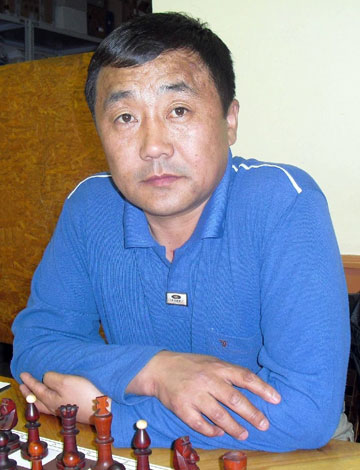
Janjaadorj Munkhbayar, international arbiter from Mongolia
Janjaadorj Munkhbayar is an international arbiter from Mongolia, but had somehow eluded a FIDE rating. He arrived at the tournament as an unrated player, but his 4.5/9 means he will return home with a handsome 2252 rating points.
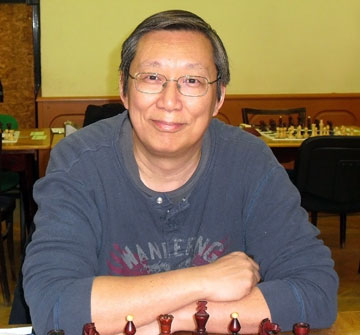
Michael Yip (CAN, 2017) temporarily residing in Budapest; scored 5.0/9 and a 2240 performance, which is good for a further +30 rating points. His smile says it all.
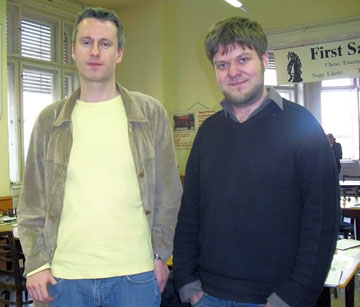
Halis Altin, Cem Altin and Halit Dogan, in the photo with organizer, Laszlo Nagy, came from Istanbul, Turkey. They sampled Budapest for the first time on the occasion of the Spring Festival and hope to return for some of the First Saturday tournaments as well.
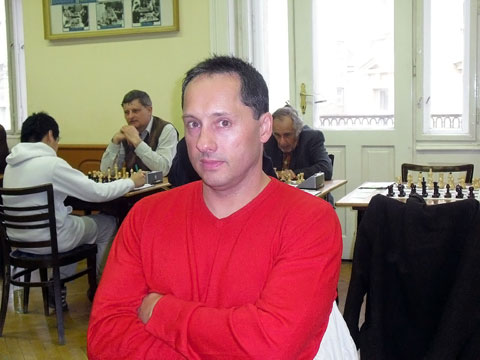
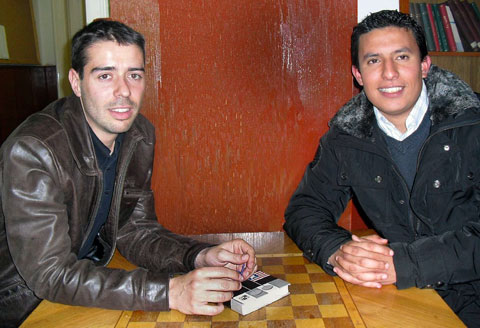
FM Louis Sanchez (FRA, 2234) and IM Ismael Karim (MOR, 2368) are friends travel to many tournaments as well as share a flat in Malaga, Spain. Louis won third place with 7.0/9 and Ismael trailed just a few places behind with 6.0/9. Ismael is currently involved in the final stages of the organisation of a big international tournament in Marrakech, Morocco – 26 June – 1 July 2010. In one of the most picturesque locations, with a 4000 Euro first prize and a number of invited titled players, it promises to be a tournament worth considering in your chess calendar.
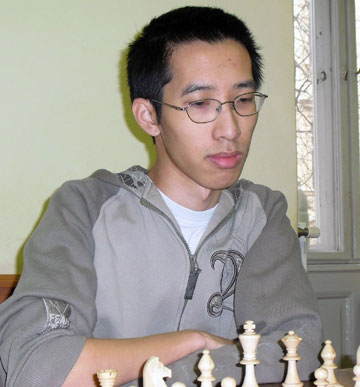
IM Nhat Minh To (2422) is Vietnamese but plays under Hungarian flag. With 2422 he was the highest seed, but this time had to be content with fifth place.
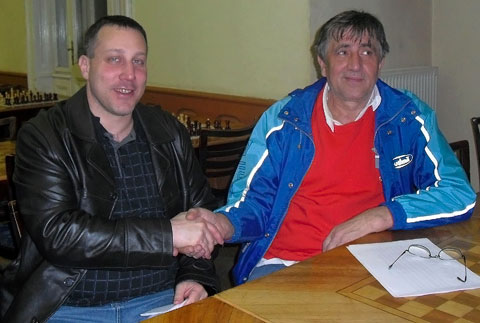
The winners: 1st place IM Emil Szalanczy (HUN 2280) (on the right), 7.5/9 and 2nd place IM Dr Evarth Kahn (HUN 2231), 7.0/9.
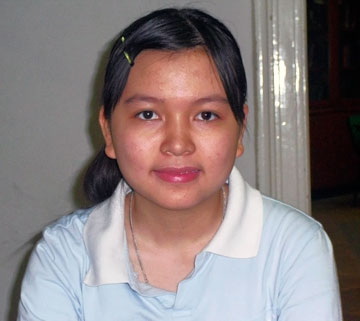
WFM Thi Mai Hung Nguyen (VIE, 2224), came in seventh and won the women’s prize with 6/9. She plays regularly in the First Saturday tournaments where she is making great progress. Last month she made her first WIM norm.

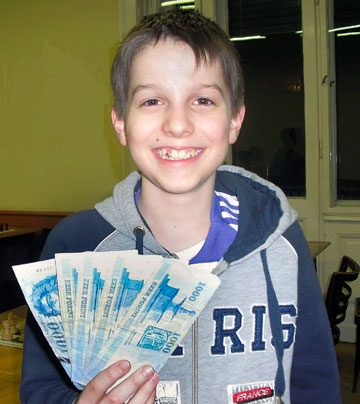
Balasz Csonka (HUN, 2163) with his prize money for sixth place; 6.0/9 and a 2290 performance.
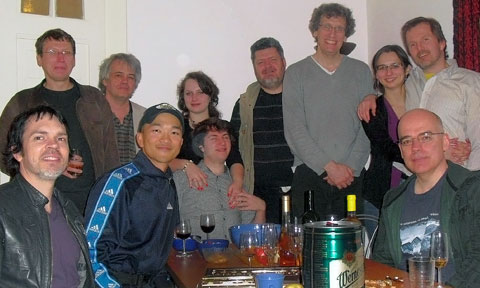
The Spring Festival ended just a couple of days before the start of the regular First Saturday tournament of April. Among the new chess arrivals in Budapest were IM Iweta Rajlich and her husband IM Vasik Rajlich, the creator of Rybka. They are expecting their first baby and Iweta thought that the First Saturday would be a good chance for a last tournament before a chess break. They marked their visit to Budapest, where they lived for several years before returning to Iweta’s native Poland, by throwing a generous party for participants and friends.
From left, sitting: Nick Adams (USA), FM Takashi Iwamoto (USA), FM Erik Kislik (USA), FM Mark Lyell (ENG); standing: Thomas Heyl (GER), IM Endre Vegh (HUN), Agnes Hollo (HUN), IO Laszlo Nagy (HUN), FM Juergen Brustkern (GER), IM Iweta Rajlich (POL) and IM Vasik Rajlich (USA).

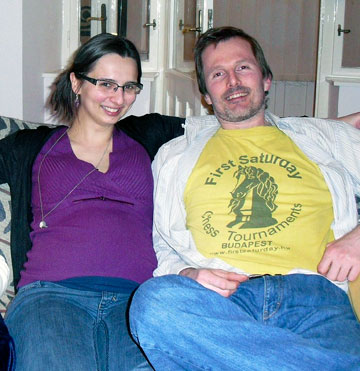
The hosts, and future parents, IMs Iweta and Vasik Rajlich
To the obvious question by guests: ‘When is Rybka 4 arriving?’, Vasik would only give a mysterious: ‘Soon’. Hoping to get more, I asked: ‘Before or after the baby?’. ‘Oh, much before the baby.’
Well then, since the baby is due in July... 

Article Source : Chessbase

Attack The King - A Complete Chess Portal
If you liked the article kindly Digg it, Stumble it, Add to Technorati, bookmark it and please consider Subscribing by Email  and have articles delivered right to your inbox! OR Subscribe to Attack the King Feed in a Fead Reader of your choice OR Subscribe to SMS Alerts & Get Article Headlines & Updates delivered to your Mobile Phone for free.

European Chess Solving Championship Puzzles

Problem solving is a parallel world next to the regular chess scene. Many OTB players will find the ideas and execution daunting, but the twomove, threemove, helpmate and other varieties of problems have their own addictive beauty. Last weekend the annual European Chess Solving Championship took place at Sunningdale, England. Guess who made a clean sweep of the prizes.
Problems, problems, problems

By Steve Giddins

What with a collapsing economy, Wayne Rooney's dodgy ankle, and the Hobson's Choice that is an impending general election, a casual observer might think that we Brits have more than enough problems as it is. But we are gluttons for punishment. Here amongst the British chess community, we cannot get enough of problems, especially of the twomove, threemove, helpmate and other varieties.
Over the weekend of 9-12 April, the British Chess Problem Society was proud to host the latest annual European Chess Solving Championship, which took place at Sunningdale, just a couple of miles from the world-famous golf course. Some 55 competitors, representing 13 countries, came together for a weekend devoted to chess problems, and in particular, the solving thereof. It is the first time in 20 years that such a major international problem solving event has been held in Britain, and it was possible largely thanks to the sponsorship of Winton Capital Management, who have supported British solving most generously over the past few years.
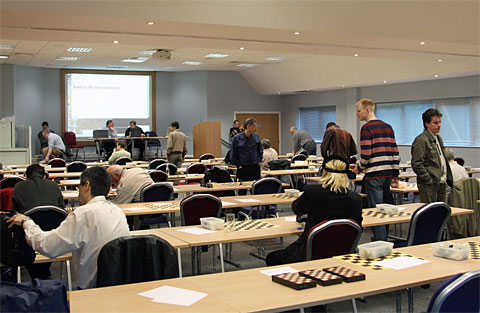
The competition involves something akin to a set of exams. The competitors sit in a room, armed only with a chess set and what Hercules Poirot called their "little grey cells", and have to work out the solutions to a whole series of chess problems, the difficulty of which varies from the hard to the veritably fiendish. Six time-limited rounds test the solvers' ability to deal with twomovers, three-movers, moremovers, endgame studies,  helpmates and selfmates. Points are awarded for finding not only the key moves, but also all of the relevant variations.
The first round is twomovers, three of which have to be solved in 20 minutes. If you think that should be easy, try them yourself (all solutions at the end of this report):
E H Baird, Pictorial World, 1892
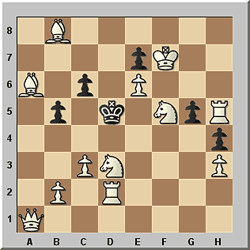
White to play – Mate in two
W Bruch, Stratagems , 2000
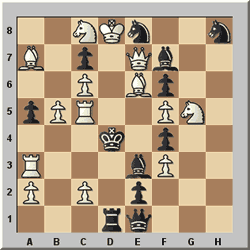
White to play – Mate in two
I Suvorov, 1st place, Russian Team Champs, 1992
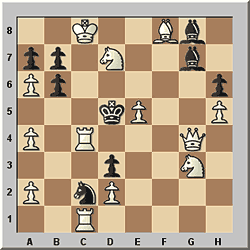
White to play – Mate in two
After that gentle warm-up, round two required the solvers to crack three three-movers, in one hour. My favourite amongst these was the following, which has more variations than Kasparov's database:
C J R Sammelius - 1st Pr Memorial P Koetscheid, 1964
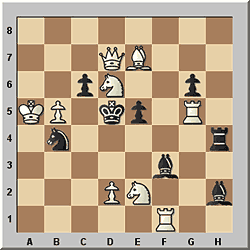
White to play – Mate in three
If you find the above problem a little tough to solve, let me offer you a hint: the white knight on d6 really ought to have its picture in the dictionary, under "workhorse"!
Round three is the longest round of all, 90 minutes in which to solve three endgame studies. The following battle of the heavy pieces was the most difficult of the selection:
M Gromov, 5th Pr Schakhmatnaya Nedelya, 2003
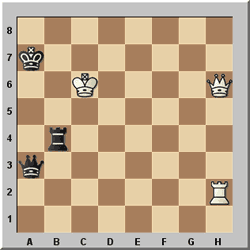
White to play and win
After that battering, the competitors were given the remainder of Saturday off for good behaviour. At this halfway point in the event, Great Britain A were sweeping all before them. Their team of Nunn, Mestel, McNab and Friedgood led the overall standings, by a healthy 12.5 points from Poland, whilst John Nunn led the individual race, three points clear of the reigning world champion, Piotr Murdzia of Poland. By the time the contest reconvened on Sunday morning, the spirits of many competitors had been dampened by the news of the Polish air crash, and Sunday's solving began with a minute's silence in memory of those killed.
Round four was helpmates, one of those genres which always seem to puzzle the OTB player. In a helpmate, Black moves first, and cooperates in helping White to mate him in the number of moves specified. Most modern helpmates have more than one intended solution; the next example has no fewer than four, all of which had to be found to secure full marks:
M & R Tomasevic, 7th pl. tt Liga Problemista, 1984
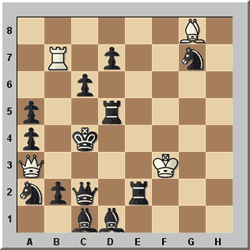
Black to play – Helpmate in two, four solutions
Round five is moremovers, i.e. direct mates in four or more moves. I was most impressed by the following:
A Pankratiev – 1st pr L'Echiqier Belge, 1983
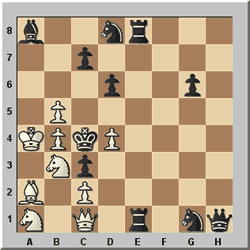
White to play – Mate in six
Once again, you may find this pretty difficult to solve, so here is a clue: it is no coincidence that Black has four pieces that can go to e4!
The final round is selfmates, in which White must force a reluctant Black to mate the white king. These are probably the type of problem that causes most difficulty to solvers, especially those coming from an OTB background. The last of the selfmates used at Sunningdale, a selfmate in six by Gamnitzer, defeated all but two of the 55 solvers, so I will not ask you to solve it here. However, it can be found below, with solution, as can all of the problems used at Sunningdale, and I would urge all readers to take a look at it, as it is quite brilliant. As an easier example of a selfmate, here is the first of those used at Sunningdale:
V Smirnov – 3rd HM, Stratagems, 1999
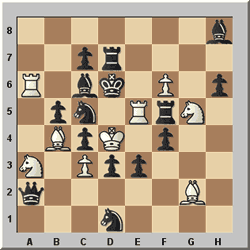
White to play – Selfmate in two
When all the papers had been marked, and the final scores totted up, it was a double home triumph. Despite a spirited fightback by the Polish team, Great Britain A had hung onto a narrow lead, and won with 204.5 points, to the Poles' 202, with Serbia a further ten points back in third place. In the individual contest, ChessBase's favourite boffin, Dr John Nunn, won the gold medal with 80.5, ahead of Poland's Piotr Murdzia on 77 and Eddy van Beers of Belgium on 76.25. The junior championship went to Murdzia's Polish teammate Kacper Pioron, who also occupied fourth place overall, and looks like a star of the future.
At the bottom of this report, you will find a file containing all of the problems used in the event, with full solutions. Even (in fact, especially) if you are not a chess problem fan, I would urge you to take a look through the problems. Some of them are quite beautiful, and, I can assure you, they are a lot more interesting than looking for a TN on move 37 of the Marshall or Petroff!
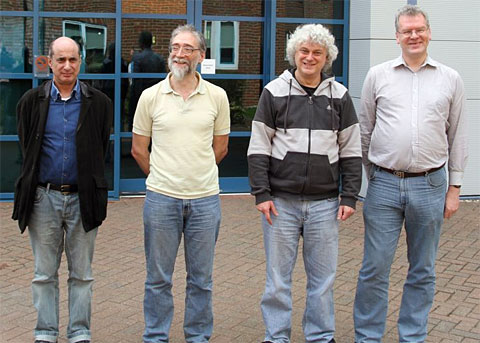
The winning Great Britain A team: David Friedgood, Jonathan Mestel, John Nunn and Colin McNab. Between them, the four are holders of three OTB grandmaster titles, three doctorates in mathematics, two solving GM titles, three world solving championships, four OTB British championships, three OTB Scottish championships, three OTB South African Championships, and well in excess of 20 British solving championships – don't you just hate some people?
Only second, for once, but still smiling. With five world titles (inter alia) to his name, Piotr Murdzia of Poland is just about the most successful solver since the invention of... solving!
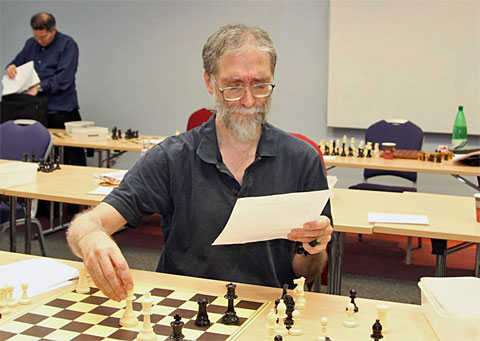
Double Grandmaster (OTB and Solving) Jonathan Mestel, casting a sceptical-looking eye over the solution of the second endgame study.
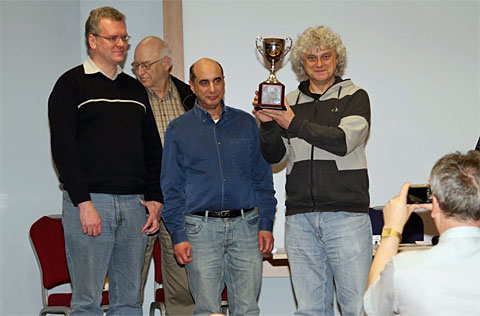
Three of the winning Great Britain team (Jonathan Mestel had to leave early) receive their trophy and medals. Joining them, second from left, is Uri Avner, President of the Permanent Commission for Chess Composition, which regulates the problem and study world, organises world championships, awards titles for composing and solving, etc.
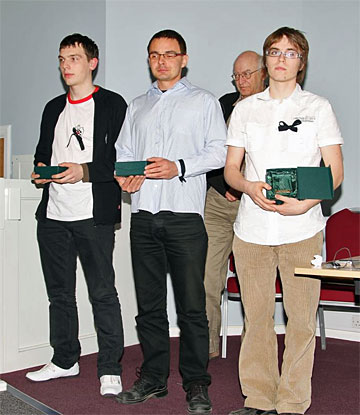
Despite Saturday's distressing plane crash news, the youthful Polish team fought back hard on the second day, and almost stole the gold medals. (l to r): Kacper Piorun, Piotr Murdzia and Piotr Gorski (not pictured: Bogusz Piliczewski).
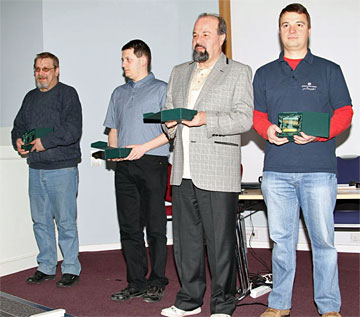
The bronze medals went to the powerful Serbian team: (l to r):  Milan Velimirovic, Vladimir Pidinic, Marjan Kovacevic and Bojan Vukcovic.
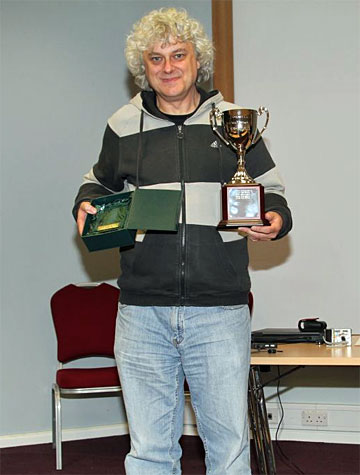
"My cups runneth over". John Nunn, with the individual trophy and gold medal.
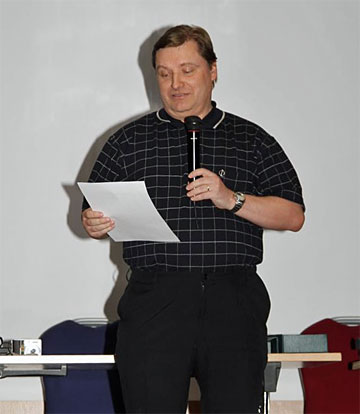
Dr Pavel Kamenik, of the Czech Republic, was the Tournament Director. As well as selecting the problems for the event, invigilating the solving, recording the results, etc. he had the unenviable task of marking each of the 55 handwritten sets of solutions from each round – a total of 330 sheets over two days!
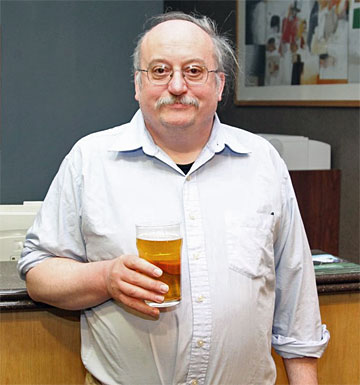
Pavel was assisted as second marker by Brian Stephenson of England, seen here fortifying himself with some essential vitamin B intake.
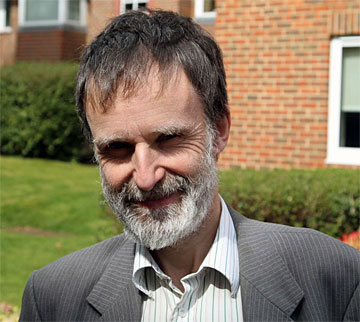
Christopher Jones is one of the world's most prolific composers of helpmates. As well as assisting with the controlling of the event, he also composed the second problem used in the helpmate round. Can you solve it?
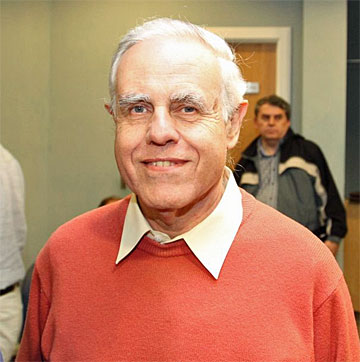
John Rice is one of the doyens of the problem world, a prolific and highly-acclaimed composer. He also edits The Problemist, the official magazine of the BCPS.
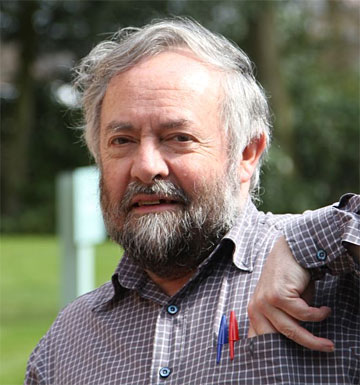
Paul Valois of England was the principal organiser of the whole event. In his spare time, he is an indefatigable researcher in the nation's newspaper archives, from which he has unearthed literally thousands of forgotten chess problems.
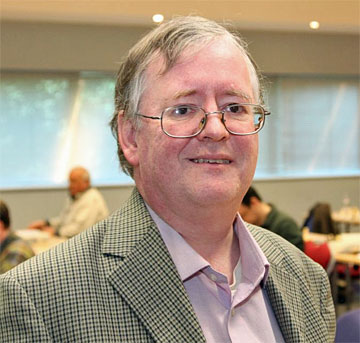
And finally, your correspondent, who really enjoys problems and problem solving competitions.

Links


Article Source : Chessbase

Attack The King - A Complete Chess Portal
If you liked the article kindly Digg it, Stumble it, Add to Technorati, bookmark it and please consider Subscribing by Email  and have articles delivered right to your inbox! OR Subscribe to Attack the King Feed in a Fead Reader of your choice OR Subscribe to SMS Alerts & Get Article Headlines & Updates delivered to your Mobile Phone for free.

Don't forget to subscribe to the thread for tracking replies