Problem solving is a parallel world next to the regular chess scene. Many OTB players will find the ideas and execution daunting, but the twomove, threemove, helpmate and other varieties of problems have their own addictive beauty. Last weekend the annual European Chess Solving Championship took place at Sunningdale, England. Guess who made a clean sweep of the prizes.
Problems, problems, problems
 By Steve Giddins
What with a collapsing economy, Wayne Rooney's dodgy ankle, and the Hobson's Choice that is an impending general election, a casual observer might think that we Brits have more than enough problems as it is. But we are gluttons for punishment. Here amongst the British chess community, we cannot get enough of problems, especially of the twomove, threemove, helpmate and other varieties.
Over the weekend of 9-12 April, the British Chess Problem Society was proud to host the latest annual European Chess Solving Championship, which took place at Sunningdale, just a couple of miles from the world-famous golf course. Some 55 competitors, representing 13 countries, came together for a weekend devoted to chess problems, and in particular, the solving thereof. It is the first time in 20 years that such a major international problem solving event has been held in Britain, and it was possible largely thanks to the sponsorship of
Winton Capital Management, who have supported British solving most generously over the past few years.
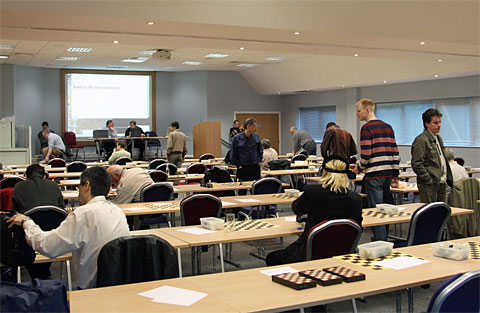
The competition involves something akin to a set of exams. The competitors sit in a room, armed only with a chess set and what Hercules Poirot called their "little grey cells", and have to work out the solutions to a whole series of chess problems, the difficulty of which varies from the hard to the veritably fiendish. Six time-limited rounds test the solvers' ability to deal with twomovers, three-movers, moremovers, endgame studies, helpmates and selfmates. Points are awarded for finding not only the key moves, but also all of the relevant variations.
The first round is twomovers, three of which have to be solved in 20 minutes. If you think that should be easy, try them yourself (all solutions at the end of this report):
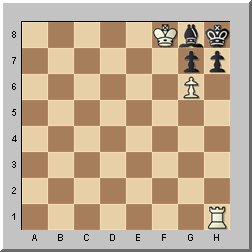
E H Baird, Pictorial World, 1892
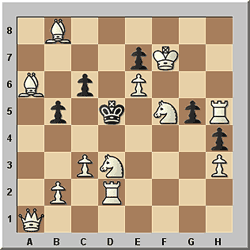
White to play – Mate in two
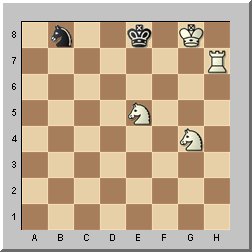
W Bruch, Stratagems , 2000
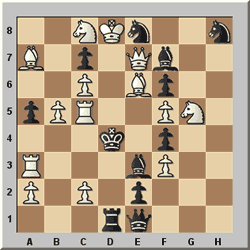
White to play – Mate in two
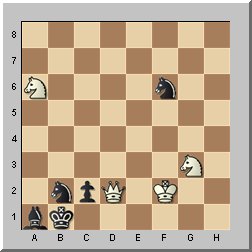
I Suvorov, 1st place, Russian Team Champs, 1992
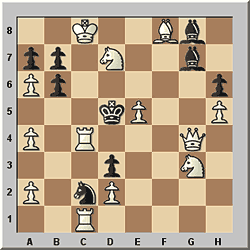
White to play – Mate in two After that gentle warm-up, round two required the solvers to crack three three-movers, in one hour. My favourite amongst these was the following, which has more variations than Kasparov's database:
C J R Sammelius - 1st Pr Memorial P Koetscheid, 1964
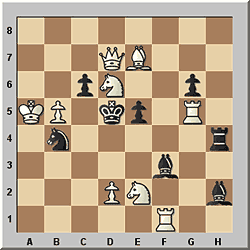
White to play – Mate in three If you find the above problem a little tough to solve, let me offer you a hint: the white knight on d6 really ought to have its picture in the dictionary, under "workhorse"!
Round three is the longest round of all, 90 minutes in which to solve three endgame studies. The following battle of the heavy pieces was the most difficult of the selection:
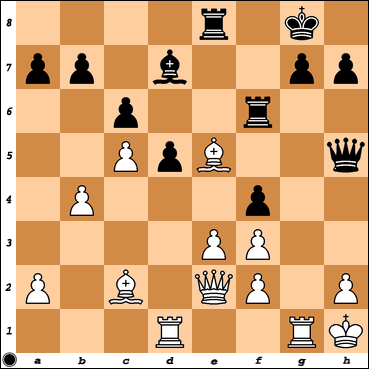
M Gromov, 5th Pr Schakhmatnaya Nedelya, 2003
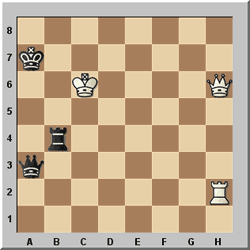
White to play and win
After that battering, the competitors were given the remainder of Saturday off for good behaviour. At this halfway point in the event, Great Britain A were sweeping all before them. Their team of Nunn, Mestel, McNab and Friedgood led the overall standings, by a healthy 12.5 points from Poland, whilst John Nunn led the individual race, three points clear of the reigning world champion, Piotr Murdzia of Poland. By the time the contest reconvened on Sunday morning, the spirits of many competitors had been dampened by the news of the Polish air crash, and Sunday's solving began with a minute's silence in memory of those killed.
Round four was helpmates, one of those genres which always seem to puzzle the OTB player. In a helpmate, Black moves first, and cooperates in helping White to mate him in the number of moves specified. Most modern helpmates have more than one intended solution; the next example has no fewer than four, all of which had to be found to secure full marks:
M & R Tomasevic, 7th pl. tt Liga Problemista, 1984
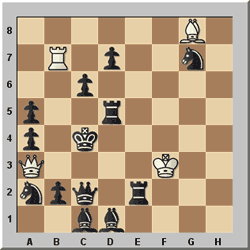
Black to play – Helpmate in two, four solutions
Round five is moremovers, i.e. direct mates in four or more moves. I was most impressed by the following:
A Pankratiev – 1st pr L'Echiqier Belge, 1983
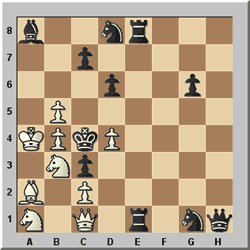
White to play – Mate in six Once again, you may find this pretty difficult to solve, so here is a clue: it is no coincidence that Black has four pieces that can go to e4!
The final round is selfmates, in which White must force a reluctant Black to mate the white king. These are probably the type of problem that causes most difficulty to solvers, especially those coming from an OTB background. The last of the selfmates used at Sunningdale, a selfmate in six by Gamnitzer, defeated all but two of the 55 solvers, so I will not ask you to solve it here. However, it can be found below, with solution, as can all of the problems used at Sunningdale, and I would urge all readers to take a look at it, as it is quite brilliant. As an easier example of a selfmate, here is the first of those used at Sunningdale:
V Smirnov – 3rd HM, Stratagems, 1999
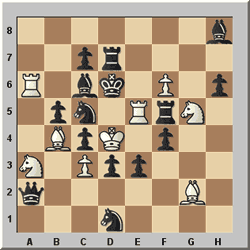
White to play – Selfmate in two When all the papers had been marked, and the final scores totted up, it was a double home triumph. Despite a spirited fightback by the Polish team, Great Britain A had hung onto a narrow lead, and won with 204.5 points, to the Poles' 202, with Serbia a further ten points back in third place. In the individual contest, ChessBase's favourite boffin, Dr John Nunn, won the gold medal with 80.5, ahead of Poland's Piotr Murdzia on 77 and Eddy van Beers of Belgium on 76.25. The junior championship went to Murdzia's Polish teammate Kacper Pioron, who also occupied fourth place overall, and looks like a star of the future.
At the bottom of this report, you will find a file containing all of the problems used in the event, with full solutions. Even (in fact, especially) if you are not a chess problem fan, I would urge you to take a look through the problems. Some of them are quite beautiful, and, I can assure you, they are a lot more interesting than looking for a TN on move 37 of the Marshall or Petroff!
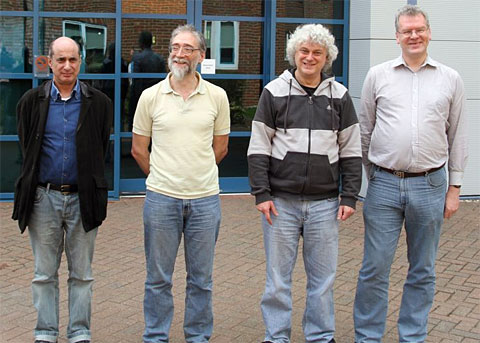
The winning Great Britain A team: David Friedgood, Jonathan Mestel, John Nunn and Colin McNab. Between them, the four are holders of three OTB grandmaster titles, three doctorates in mathematics, two solving GM titles, three world solving championships, four OTB British championships, three OTB Scottish championships, three OTB South African Championships, and well in excess of 20 British solving championships – don't you just hate some people?
Only second, for once, but still smiling. With five world titles (inter alia) to his name, Piotr Murdzia of Poland is just about the most successful solver since the invention of... solving!
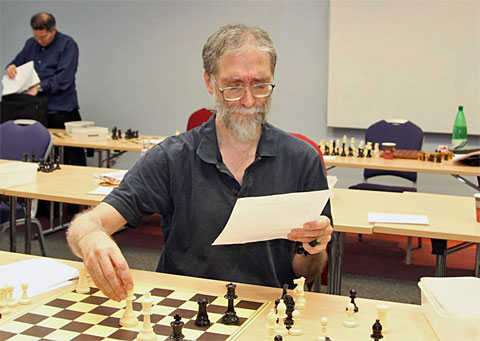
Double Grandmaster (OTB and Solving) Jonathan Mestel, casting a sceptical-looking eye over the solution of the second endgame study.
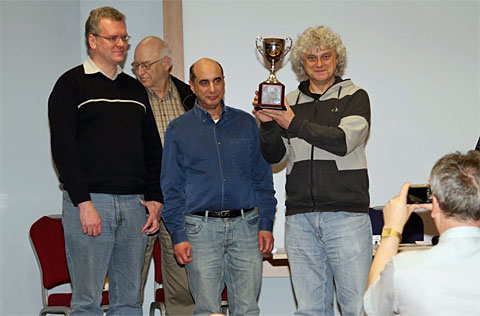
Three of the winning Great Britain team (Jonathan Mestel had to leave early) receive their trophy and medals. Joining them, second from left, is Uri Avner, President of the Permanent Commission for Chess Composition, which regulates the problem and study world, organises world championships, awards titles for composing and solving, etc.
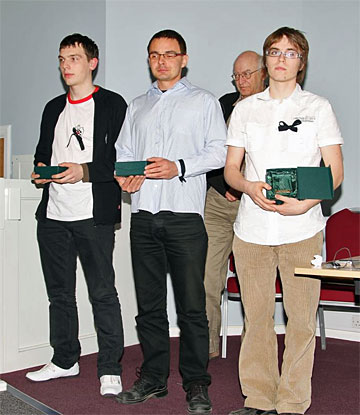
Despite Saturday's distressing plane crash news, the youthful Polish team fought back hard on the second day, and almost stole the gold medals. (l to r): Kacper Piorun, Piotr Murdzia and Piotr Gorski (not pictured: Bogusz Piliczewski).
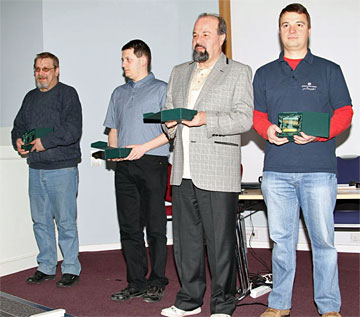
The bronze medals went to the powerful Serbian team: (l to r): Milan Velimirovic, Vladimir Pidinic, Marjan Kovacevic and Bojan Vukcovic.
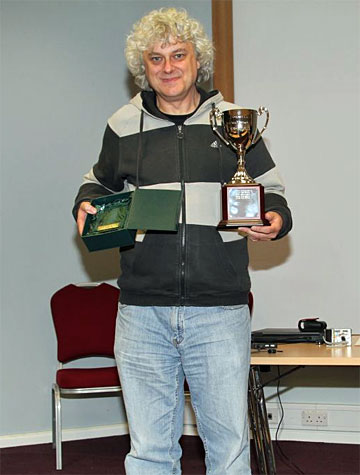
"My cups runneth over". John Nunn, with the individual trophy and gold medal.
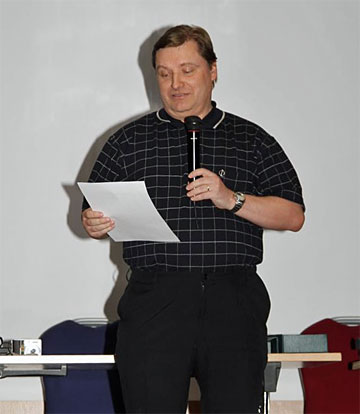
Dr Pavel Kamenik, of the Czech Republic, was the Tournament Director. As well as selecting the problems for the event, invigilating the solving, recording the results, etc. he had the unenviable task of marking each of the 55 handwritten sets of solutions from each round – a total of 330 sheets over two days!
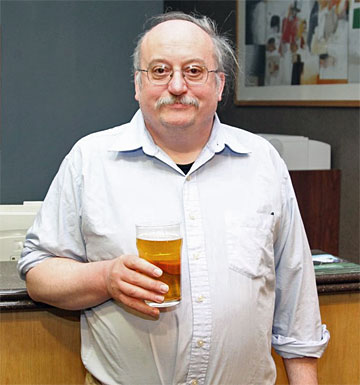
Pavel was assisted as second marker by Brian Stephenson of England, seen here fortifying himself with some essential vitamin B intake.
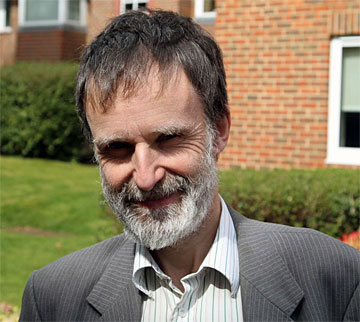
Christopher Jones is one of the world's most prolific composers of helpmates. As well as assisting with the controlling of the event, he also composed the second problem used in the helpmate round. Can you solve it?
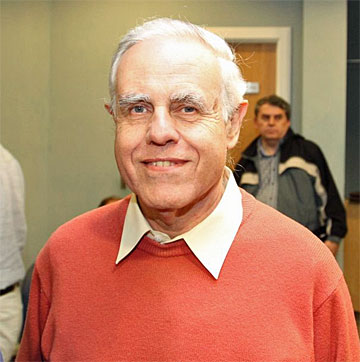
John Rice is one of the doyens of the problem world, a prolific and highly-acclaimed composer. He also edits The Problemist, the official magazine of the BCPS.
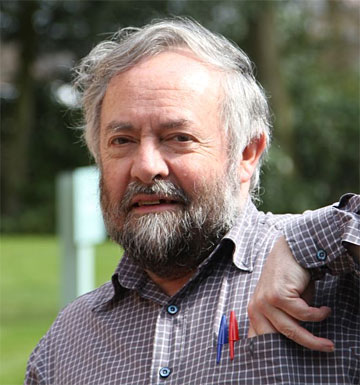
Paul Valois of England was the principal organiser of the whole event. In his spare time, he is an indefatigable researcher in the nation's newspaper archives, from which he has unearthed literally thousands of forgotten chess problems.
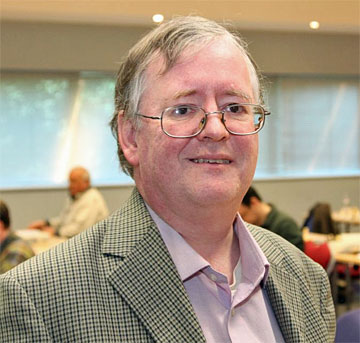
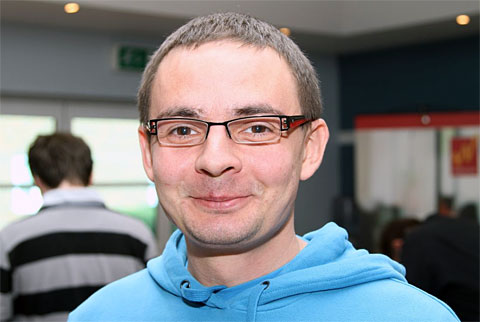
And finally, your correspondent, who really enjoys problems and problem solving competitions.
Links
If you liked the article kindly Digg it, Stumble it, Add to Technorati, bookmark it and please consider
Subscribing by Email and have articles delivered right to your inbox! OR
Subscribe to Attack the King Feed in a Fead Reader of your choice OR Subscribe to
SMS Alerts & Get Article Headlines & Updates delivered to your Mobile Phone for free.