Loading
Drastically Improve Your Chess
Upgrade to a FileSonic Premium account and download at incredible speed!

This is default featured post 1 title

Go to Blogger edit html and find these sentences.Now replace these sentences with your own descriptions.This theme is Bloggerized by Lasantha Bandara - Premiumbloggertemplates.com.

This is default featured post 2 title

Go to Blogger edit html and find these sentences.Now replace these sentences with your own descriptions.This theme is Bloggerized by Lasantha Bandara - Premiumbloggertemplates.com.

This is default featured post 3 title

Go to Blogger edit html and find these sentences.Now replace these sentences with your own descriptions.This theme is Bloggerized by Lasantha Bandara - Premiumbloggertemplates.com.

This is default featured post 4 title

Go to Blogger edit html and find these sentences.Now replace these sentences with your own descriptions.This theme is Bloggerized by Lasantha Bandara - Premiumbloggertemplates.com.

This is default featured post 5 title

Go to Blogger edit html and find these sentences.Now replace these sentences with your own descriptions.This theme is Bloggerized by Lasantha Bandara - Premiumbloggertemplates.com.

Most In-depth Study ( Must Have )
Showing posts with label Tips For learning Chess. Show all posts

Saturday, December 6, 2008

Chess Basics | A Few Things to Keep in Mind

This article is actaually a contuination of the article "Chess - The Rules & Basic Ideas Behind the Game" intended to novice players. In this article we will be discussing some thumb rules that be kept in mind while.So lets not waste time & dive straight into it.

"Play the opening like a book, the middlegame like a magician, and the endgame like a machine." - Rudolf Spielmann


In General:

When you see a good move, sit on your hands and see if you can find a better one. – Siegbert Tarrasch

There are exceptions to every general principle and law in chess. Knowing when you can violate them is one of the hallmarks of a strong player.

Memory should never be a substitute for thought.

Even when a move seems forced, it is worth taking a few moments to see if there might be a better alternative.

If a move is absolutely forced, don't waste time calculating it. Make the move and calculate the ramifications on your opponent's time.

Given the choice of two moves, if you calculate that the first move is clearly losing, and the other is vague and complex, the second move should be played without prolonged calculation. You can calculate the consequences on your opponent's time.

Don't play a game or even a move if you don't feel like trying your best.

Attack pinned pieces with pieces worth less than them; never take a pinned piece unless it leads to some sort of tactic or advantage, or you cannot maintain the pin.

Putting out your hand when you offer a draw is presumptuous; always put it out after the draw is agreed upon, not before.

Rooks need open and semi-open files. Don't let your opponent control open files with his Rooks.

When capturing with pawns, it is correct most of the time to capture toward the center. If the result is doubled pawns, this is correct even a higher percentage of the time.

If you worry about your opponent's rating or play to the level of your competition, then don't look at his rating until after the game.

If something is happening on your board that is strange or you don't understand, stop the clock and get the tournament director.

In a Swiss tournament, the most important rounds are the first and the last.

In chess, if you learn to consistently (each move) do the little things: take your time, count the material effect of your move, and check for basic tactics, you will soon find that these are not so little!

Move every piece once before you move every piece twice unless there is a clear reason to do so.

In the opening, if you can drive a Knight out of the center by attacking it with a pawn, it is usually correct to do so.

If you get way ahead in material, it is more important to use all your pieces, kill your opponent's counterplay, and safeguard your King, than it is to try and get further ahead.

Having the 'Bishop Pair' - two Bishops when your opponent does not - is worth about half a pawn.

Don't put your Knight in front of your c-pawn in double d-pawn openings.

Don't move your f-pawn until you have castled or your opponent's Queen is off the board.

Don't pin the opponent's King's Knight to the Queen before the opponent has castled.

Develop the Bishop on the side you wish to castle before the other Bishop.

When looking for tactics - for either player - look for Checks, Captures, and Threats, in that order - for both players.

Stay flexible. Always be ready to transform one type of advantage to another, or to switch from tactical to positional play.

Be especially careful after you've made a mistake. It often happens that one mistake soon leads to another. The realization that something has gone wrong can be a big distraction and lead to a loss of concentration.

Never, ever assume that your opponent has no threats, even in the most lopsided positions.

Bold, imaginative play, presenting your opponent all sorts of continuous problems, is likely to be well rewarded.

Short-term solutions to long-term problems on the chessboard rarely succeed.

Presenting your opponent with practical difficulties in over the board play, is just as important as obtaining an objective advantage.

Concentrate. Keep your attention on the board. Don’t let your mind wander and don’t you wander either. Don’t leave the board unless necessary.

Use your time to think of specifics and to find the best move. Use your opponent’s time to think in generalities and of future possibilities. Always make sure you use your opponent’s time productively.

Play to win in as few moves as necessary. Don’t waste time gobbling up your opponent’s pawns when you’re well ahead. Go for the safest and most efficient mate.

If you blunder, don’t resign. Sit back and figure out how to give your opponent trouble. Go down fighting.

Respect all opponents, but fear none.

What distinguishes masters and experts from intermediates and novices, is their specialized ability to think effectively about chess positions.

Until you reach at least master level, playing as error-free as possible is MUCH more effective and important than playing brilliantly, and will win a lot more games for you. One critical error will usually cost you more than a dozen brilliant moves will gain for you. Remember, the first step to mastery, is the elimination of errors.

To improve your chess game, combine STUDY AND PLAY; study and play, study and play, study and play…

As you improve, you will learn the value of – and develop skill in exploiting – first pieces, then pawns, and finally squares.

Always play "touch-move" and never take back a move. It is against the rules of chess and is detrimental to your improvement.

Avoid having a favorite piece.

Learn chess notation, then record and review your games.

Review all your games. This is how you learn to find & eradicate the mistakes from your play.

Play stronger players frequently, and learn from them. After a loss, ask them to go over the game and point out your mistakes. Playing stronger players strengthens your chess.

Remain calm and alert throughout a chess game. Take mental breaks to ease the tension.

Focus on playing your best, rather than on winning. The wins will follow.

Enjoy your wins and learn from your losses. Learn at least one lesson from each loss. You will learn more from one loss than a dozen wins. Defeats are the greatest teachers.

After losing a game, especially against a much stronger player, ask them to review the game with you and show you where you went wrong.

Record each move carefully. The only exception is when you are in time trouble. In that case, at least try to check off each move as it is played. Write down each move before you actually play it on the board, and each of your opponent’s moves before you make your response, even obvious ones.

Always play touch-move, and call it if your opponent touches a piece. Do not hold a piece in your hand while thinking.

Focus on the game in front of you, not the one next to you. Good concentration is one of the keys to success in chess.

Don’t talk to your opponent and don’t allow him to talk to you.

Don’t play chess between rounds of a tournament. This saps your mental energy. Go for a walk instead.

Don’t eat a heavy meal before playing. Keep your energy level up by snacking on healthy items like fruit or fruit juice. Avoid junk food or anything with too much sugar.

If you blunder, don’t immediately resign, and don’t play as if you’re going to lose. Fight on as if the fate of the world depends on it. Quite often after you make a blunder, your opponent will relax and let his guard down, and then make an even bigger blunder himself. If you blunder, take a few minutes to compose yourself and get your head back into the game. Instead of playing aimlessly, as if the game is hopelessly lost, take a few minutes to evaluate the position and figure out a strategy to maximize your chances. Present your opponent with as many problems and difficulties as possible, and make him earn the win. There’s always a best course of action, even when lost. Make sure you find it.

Expect to win, whenever the opportunity arises – opening, middlegame, or endgame. Win by attack or win by attrition, but win. Remember that checkmate is the goal.

To find the best moves, and avoid becoming intimidated or overconfident, play the position on the board, not the opponent.

Stay calm, relaxed, and focused during each game. Tension and panic rout logical thought.

When even or ahead, play hard. When behind, play harder.

Use time wisely. Think and plan on your opponent’s time during the game. Avoid time trouble. When in time trouble, try to think and play calmly.

Do not relax and become overconfident and careless when ahead. Apply the “killer instinct” throughout the game.

Keep the normal value of the pieces in mind (queen=9, rook=5, bishop=3+, knight=3, and pawn=1), but remember that these values vary according to the position, mobility, and potential of the pieces. Whether attacking or defending, count the number and consider the values of both attackers and defenders on a target piece, pawn or square before exchanging or occupying, to insure against losing material.

Superior force usually wins, so stay even or ahead in material throughout the game (except for gambits, combinations or sacrifices to force checkmate or a winning endgame).

Chess is not Solitaire. Sound chess begins with respect for your opponent’s ideas, moves, threats, plans and ability.

Determine the purpose of each move by your opponent. Ask yourself, “What is the THREAT?” and “What has CHANGED in the position?” after each of your opponent’s moves. Concentrate on offense and attacking, but recognize and answer all threats.

To win a game of chess, you must first not lose it. Avoid mistakes, such as leaving pieces en prise (unguarded) or exposing your king. Before each of your moves, ask yourself, “DOES THIS MOVE IMPROVE MY POSITION?” and “IS THIS MOVE SAFE?” Avoiding mistakes is the beginning of improvement in chess. THINK before you move!

Don’t play the first good move you see. Look around for an even better one.

The two most common (and often fatal) mistakes in chess are moving too fast and overlooking opponent’s threats. Sit on your hands until ready to move.

If your opponent is in time trouble, don’t rush your moves. Take some time to find surprising moves that force your opponent to think.

Don’t play a move you know is unsound unless you’re busted. In that case, you have nothing to lose, so look for a sucker punch.

Don’t be afraid of higher rated opponents. They have more to lose than you do. Have some fun and go for the kill.

Take no prisoners. Draw only if you must. If offered a draw, make sure you understand what it will mean if you accept it. In general, don’t accept a draw unless you’re losing.

If you touch a piece and your opponent calls you on it, put the piece back on the board and search for the best move for it. Don’t hold the piece in your hand while thinking.

Be aggressive, but play soundly. Don’t take unnecessary chances.

Make sure EVERY move has a purpose.

If you know your opponent’s style, take advantage of it. But in the final analysis, play the board, not the person.

Don’t check needlessly. Check only when it accomplishes something useful.

Answer all threats, but do so while trying to improve your position and/or posing a counter-threat.

Never play a risky move, hoping the opponent won’t see it, unless you’re already lost and have nothing to lose.

The goal in chess is to play the best move in every position.

Winning at chess basically consists of creating and exploiting opponent’s weaknesses.

Understanding, not memory, is the essential key to chess success. The chess player who understands why will consistently defeat the player who only knows how. Play by sound general principles adapted to the specific requirements (offensive opportunities and defensive necessities) in each position.

In many cases, it is better to allow an enemy piece to occupy a square and then drive it away, as opposed to preventing him from coming there in the first place. This way, you gain a tempo instead of losing one. That’s a difference of two tempi.

If your opponent has a well-posted piece, drive it away or exchange it.

If your opponent controls more space, advance pawns to gain space yourself.

If your opponent has greater elasticity in his position, loosen your own position, strive for more freedom or flexibility (perhaps by exchanging one or more pieces), then look for your own least active piece or pieces and develop a plan to make it or them active.

If your opponent controls the center, challenge it with pawns.

The surest way to consistently win chess games is to anticipate & nullify your opponent’s plans, and to create no weaknesses in your position for your opponent to attack. This has been one of the major keys to Karpov's success. Think and play prophyllactically.

Play slowly. Haste and carelessness are greater enemies than your opponent. Accuracy, not speed, is essential in chess. Be patient. The reward for speed is a legacy of lost games.

Be serious while playing. Don’t talk to your opponent during the game. If he or she talks to you, complain. You can socialize after the game, not during it.

Chess is a creative process. Its purpose is to find the truth. To discover the truth, you must work hard, be uncompromising, and be brave.

Play as if the future of humanity depends on your efforts. It does.

Don’t play automatic moves. Make sure you understand the opening before playing it.

There must be no reasoning from the past moves, only the present position. Logically, the previous moves in a game should not affect one’s play in the slightest, as each move creates a new position.

A player can get by with a minimum of book knowledge; simply avoid finesse. Play moves that cannot lead to trouble.

Players usually make their worst oversights in dead won games or in dead lost games. It is surprising how often a mate in one is overlooked when one’s position is already hopeless or when you are winning easily.

The best practical rule for a winning game: destroy your opponent's counter-chances. It may be slower, but it’s surer.

When your opponent is short on time, try to continually present him with problems that will require a lot of time to analyze.

Never take a risk for material when you already have a win.

The chief factor in chess skill is the storing of patterns in the mind, and the recognition of such patterns in actual play.

When a move can wait, it is almost always best to let it wait. However, it is nearly always wrong to postpone a must move if you can safely play it at once.

When forced to choose among moves, play the most necessary one first.

The closer to the time trouble your opponent is, the more tactical your game should be. This way you will pose the most unpleasant problems for your opponent. He or she is much more prone to miscalculate in such a situation.

While a stockpile of principles, guidelines, rules, and basic positions can be very useful in any chess player's arsenal, one should never forget that there is no substitute for analysis. A general idea or guideline is not the end, but the means to an end.

General principles can be a good guide, but there is no substitute for sound analysis based on concrete variations...

In the next post I will be discussing some Basic Ideas Behing Openings. So until then bye & stay tuned.
Subscribe to Chess Blog | The Pulse of Chess     If you liked the article kindly Digg it, Stumble it, Add to Technorati, bookmark it and please consider subscribing through  "Subscribe by Email"  and have articles & a  Everyman Chessbase eBook delivered right to your inbox! OR "Subscribe to Chess Blog Feed" in a Fead Reader of your choice OR Subscribe to "SMS Alerts" & Get Article Headlines & Updates delivered to your Mobile Phone for free.
Chess - The Basic Rules & Ideas Behind the Game

We thought why not give an introduction to the game,it's rules & some basic ideas behind it so that starters can benefit from it.After all it's a blog about & for chess isn't it & excluding a  discussing on "How the game is played" would be an injuctice to it .So here it is...

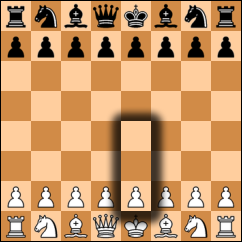
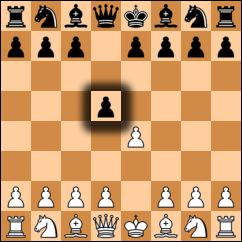
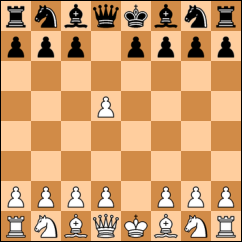
Before we review how the pieces move, we should learn what they're called. It's a knight. Not a horsey. And the castle? That's called a rook. Now on to how the pieces move. We'll start with the lowliest of chess pieces - the pawn. Pawns can only move forward. Although they usually only move one square at a time, pawns can move one or two squares the first time they move. But, and this is a big exception, pawns capture pieces one square diagonally. A pawn cannot capture a piece directly in front of it. Let's take it to the diagram:


How pawn moves in chess board


How pawn moves in chess board


How the pawn moves in a chess board
The Bishop, in contrast, can move as far as it wishes along the diagonals. And for the nits out there, no, it cannot move through pieces.


How the bishop moves in a chess board
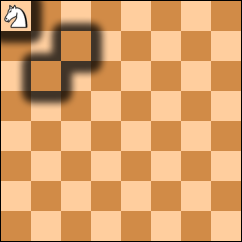
The knight is tricky. Its move looks like an 'L'. The knight moves two squares in any direction and then one square to the left or right. A diagram will make this more clear:


How the knight moves in a chess board
Another note for the nits out there: the knight can hop over pieces, because as everyone knows, knights were known as the jumping warriors of the Middle Ages.
The rook is easy. Rooks move as far as they want horizontally or vertically. Like the Bishop, they cannot jump over pieces.


How the rook moves in a chess board
The queen is a combination of rook and bishop. She can move as far as she wishes diagonally, horizontally, or vertically.


How the queen moves in a chess board
The king is like a hobbled queen. He can move in any direction, but only one square at a time. Of course the king can also castle, but we'll get to that later.


How the king moves in a chess board

The rules of chess

Chess is more straightforward than people realize. Two sides, white and black, try to checkmate each other. Play starts with the white player and the players take turns moving one piece at a time until the game ends. The only exception is castling, when a player can move two pieces in one turn...we'll be discussing that shortly.
The game can end in a draw or a victory:
A player wins when either the opponent concedes or the enemy king is checkmated. Checkmate is when the enemy king is in check (attacked by an enemy piece) and the king cannot escape. The king can escape check by moving to a square not controlled by an enemy piece, by capturing the checking piece, or by blocking the check with a friendly piece. It is important to note that it is illegal for the king to move into check.
The game can end in a draw several different ways, but the two most common ways are for the players to either decide that neither side can win and agree to a draw or for the game to end in stalemate. Stalemate is when one side cannot make any legal moves.
To summarize: Try to checkmate the enemy king, move the pieces how they're supposed to, and don't move into check.
Now for some of the weird rules:
Castling: This is the only time when two pieces can move in a single turn. Castling is done with the king and rook, and is used to evacuate the king from the center. The king can castle with either rook. To castle, the king moves two squares (!) in the direction he wishes to castle, and the rook is placed on the other side. Now there are a few important restrictions. There can't be any pieces between the king and rook. Additionally, neither the king nor rook can have moved previously. And finally, the king cannot castle through check.
Pawn Promotion: When a pawn reaches the other side of the board, it can "promote" and become any other piece. Players generally promote to the best piece, the queen. Polygamy is allowed. I don't understand how all of this fits into the chess as war metaphor, but it's a good thing when you can promote your pawns.
En Passant: This one sounds like it has to be made up. It's not even in English. That's right, en passant is French, the language of love and obscure chess rules. Meaning "in passing," en passant is used when you have a pawn on the fifth rank (three squares ahead of its starting point) and an enemy pawn tries to move two squares past your pawn. Using en passant you are actually allowed to capture the cowardly pawn.


En Passant Rule in Chess


En Passant Rule in Chess
That does it for the rules you absolutely need to play. There are more obscure rules, like the 50 move rule, the insufficient mating material rule, and the infamous "infield fly" rule, but they aren't that important for someone just starting out in chess. Nobody likes a rules lawyer anyways.
Now some basic ideas behind the game!!!
Let's start with the famous quote 
"Checkers is for tramps" - Paul Morphy
If you're a thrill seeker with a paranoid streak, chess may be the game for you. After all, a 2002 study concluded that "unconventional thinking and paranoia" characterize competitive chess players, two attributes the study also noted as characteristic of thrill-seekers like daredevils and skydivers. So remove the tinfoil hat and put away the bungee cord, because it's time to learn how to play chess.
Playing a decent game of chess is easy, once you have some basic knowledge:

1. Know how the pieces move and the rules

I'm going to assume you know these. But do not stop reading just because you've forgotten how the horsey moves, or you don't know what Castling, Pawn Promotion or En Passant are.

2. Know the values of the pieces

You can't play chess unless you know how much your pieces are worth. Once you do, you'll know when to exchange pieces and when to retreat. With the exception of the king, whose life is priceless, all the pieces have a point value. Although these values can change slightly depending on specific circumstances, they're usually accurate. The basis for the value of the other pieces is the pawn, valued at one point. Next come the knight and bishop. In some positions the bishop thrives while in others the knight dominates, but overall, they're worth about three points each. The rook is slightly more valuable, at five points. Finally we have the best piece of all, the queen. She's worth 9 points. Her sentimental value to the king is negligible (win or lose, she always comes back to him).
So we've got pawn = 1, bishop/knight = 3, rook = 5, queen = 9
Whenever you're considering trading pieces, know the values. Don't give up a rook for a bishop or knight. But, if you can get a bishop and two pawns for a rook that's fine ( bishop (3) + two pawns (2) = rook (5)). It's even slightly better since quantity of pieces is a good tiebreaker.
Note: The next three points are general chess principles that all players need to remember.

3. Play to control the center

This is a big one. The "center" refers to the four center squares on a chess-board.


Control the center
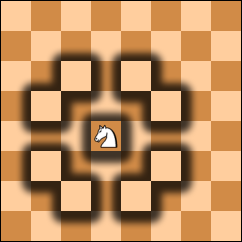
Almost everything that happens on the board will involve traveling through one of these four squares. A player with uncontested control of the center has a huge advantage. You can either occupy this region with pawns or attack it with pieces...it doesn't matter as long as you've got something going on in the middle of the board. To illustrate the importance of the center, compare a knight in the middle of the board with one in the corner. The knight in the corner can only move to two squares, while the one in the center can move to eight.


Knight in the cornerKnight in the middle

4. Develop your pieces

You can't win a game of chess without bringing out your pieces. I often see beginning players develop their most powerful piece, the queen, and shuffle it around, hoping to capture wayward enemy pieces. This is like playing football with only the quarterback...boneheaded. Mobilize your pieces rapidly, especially the bishops and knights. Since they can maneuver through cluttered positions, they function especially well early in the game.

5. Protect the king

This one should be obvious. The game ends if you're checkmated. But how do you protect the king? Well it's easy. Castle. Since everything goes through the center, a king in the center of the board won't survive long. Tuck him away in the corner. Leave the fighting to his better half.
Note: the more of these three rules of thumb you can follow during the opening, the better. Don't play moves that only control the center or blindly develop your pieces. Try to do both at the same time. Even better, control the center, develop your pieces, and protect the king all at once.

6. Take Pieces

Every move, check to see if you can capture any opposing pieces. If you can, consider the point values and choose a course of action. Most people play chess like boobs-they'll put their pieces unprotected where you can take them.

7. Look for Double Attacks

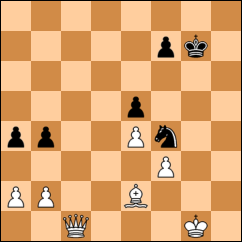
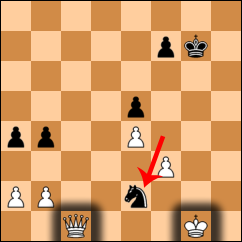
Better players won't just throw their pieces away. You'll have to win them. That's where double attacks come in. Since a player is only allowed to move one piece at a time, meeting two simultaneous threats is very difficult. For this reason, making two threats at once, also known as executing a double attack, constitutes the most basic tactical idea. To illustrate the double attack's power, we'll examine the knight fork:


Look for the knight fork
Here is a successful knight fork
Additionally, double attacks usually revolve around undefended enemy pieces. If you can spot two undefended pieces and attack them at once, you're guaranteed to win one. So when you're considering where to move, watch for undefended pieces.

8. Watch for Checks

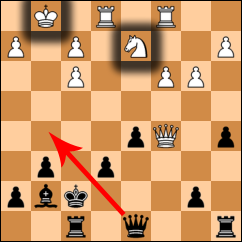
Before moving, look to see if your opponent has potential checks. Since a check is the most forcing move, it can lead to heaps of trouble. If you spot a possible check, make sure it doesn't create a double attack (like checking your king and attacking an undefended piece at the same time) or lead to other trouble.


Avoid leaving your king in a spot where it can be checked like this

Conclusion

If you follow these guidelines, you'll be able to play a decent game of chess. Congratulations, you've just taken the first step on the road to paranoia, misanthropy, and madness.

Subscribe to Chess Blog | The Pulse of Chess     If you liked the article kindly Digg it, Stumble it, Add to Technorati, bookmark it and please consider subscribing through  "Subscribe by Email"  and have articles & a  Everyman Chessbase eBook delivered right to your inbox! OR "Subscribe to Chess Blog Feed" in a Fead Reader of your choice OR Subscribe to "SMS Alerts" & Get Article Headlines & Updates delivered to your Mobile Phone for free.
Thursday, July 17, 2008

Tips For Learning Chess Part 9 - Destroying the Balance

A Lesson in Breaking the Material and Positional Equilibrium

Modern chess not only differs greatly from chess of 19th century, but it also varies from chess played over the past 25 years. If you examine games from the World Championships played over a quarter of a century ago, you will notice a very calm approach to openings and middle game positions. What has caused such a difference between then and the frenzied games of today? Technological progress, such as the availability and number of chess publications as well as the impressive amount of information available on the Internet, can undoubtedly be credited with providing us with high levels of information. Thanks to this hi-tech progress, modern chess masters and grandmasters are able to receive the latest chess information not only from innumerable magazines like “Informant” and “New in Chess”, but also by means of computer databases with unique collections of chess openings as well as middle game and end game keys. Today, it may seem that it is very simple to become a strong chess player: you should just stay current regarding recent games and novelties. However, as it turns out, this is not how it works in the real world of high-level chess.

For a chess player who knows only the material that was played before, it is difficult to count on success. He will never succeed with an experienced opponent who is also knowledgeable about previously played games. It is apparent today, that a base of knowledge in chess openings, middle games and end games is necessary; yet it takes more than this to succeed.
Nowadays , leading grandmasters see the chess struggle from a slightly different point of view. Maybe it sounds strange, but for a chess victory it is not only necessary to wait for your opponent’s mistake, you must also make some of your own “mistakes”. Second World Champion Emanuel Lasker discovered this in the beginning of 20th century. Lasker’s psychological approach to chess was crucial to his success. He understood that “machines” did not play chess. His opponents were people with weaknesses and human imperfections. After analyzing his opponent’s style, Lasker did precise and individual preparation not only in chess openings, but also in the connections between opening to middle game and even middle game to end game. He chose the most unpleasant weapons for use against his adversaries. He frequently made dubious moves, which, in the case of alert opponents, would surely lead to a losing game for Lasker. However, it’s exactly at this point that the human weaknesses of Lasker’s opponents revealed themselves. Lasker’s rivals thought that victory was in their hands, but they were incapable of finding the correct path to victory. Lasker understood this fact. He knew that it was basically impossible for them to switch to the new type of position in the game, and because of that, they would lose. Lasker�s style of playing was incomprehensible and he himself was considered a magician. Lasker always had a bad position during the game, but despite this, he constantly won.
However now we know Lasker’s secret. Moreover, it is the main weapon of the higher chess players. We call this approach destroying the balance.Destruction of balance can include one or more of the following approaches:
1. Destroying the Material Balance: This usually is a sacrifice in the opening, middle game and sometimes even in the end game. The sacrifice may not only be tactical, but also justified by the position itself. There are various goals achieved with the sacrifice. For example, one can sharpen the struggle while defending difficult positions. Also, you can sacrifice during an attack to give your opponent the feeling that he might have some counterplay; but after evaluation your opponent will realize that his compensation will not be enough to win the game. Unquestionably, a chess player who is competent to correctly evaluate the consequence of material sacrifices has an advantage. The ability to make an accurate evaluation may be achieved by understanding both the material and kinetic power of chess pieces, their connection to the position, and the exact difference in the position after the sacrifice.
2. Destroying the Positional Balance: This is expressed not only in typical positions (isolated pawns or castles on opposite sides), but more frequently, you will have positions where it is important to choose a structure that accentuates a dependence on the arrangement of the pieces. You may also have positions where it will be important to take advantage of the particular character and habits of your opponent (this last case is very complicated and not practical to investigate in depth). When trying to destroy the balance of the position, it is necessary to choose which pieces should be sacked — a bishop or a knight, or maybe two pieces for a rook, and then to fully understand the ultimate results of your sacrifice.
Below there are two simple examples for each case with complete explanations.
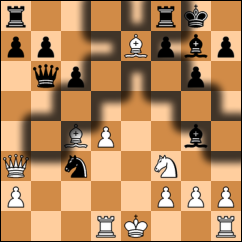
1. Let’s take the position after : 1. d4 Nf6 2. c4 c5 3. d5 b5 4. cxb5 a6 5. bxa6 g6 6. Nc3 Bxa6.


In the opening, Black sacrificed a pawn only for positional compensation. The active bishop placed on a6 prevents e4, and thanks to this, White has to spend precious tempi to castle manually. Meanwhile, Black has an opportunity to finish developing and to begin pressing on the a and b files. White’s plan is therefore limited by these actions. Any break in center with e4-e5 will be difficult for White. Developing and arranging his pieces in active positions will also not be simple. In this position experience shows that even after transition to the endgame, Black’s chances are certainly not worse and frequently they are better White’s. As a result, the Benko gambit is still very popular. Moreover, White often chooses the counter-sacrifice 5. b6! and after this, Black has the inconvenience of attempting to finish developing his pieces on the Queenside while his original plan of attacking the a and b files is not as easy. This plan also allows White’s knight the magnificent square c4.
2. Let's see the position after the first several moves in Nimzovich Defense : 1. d4 Nf6 2. c4 e6 3. Nc3 Bb4. Here White plays 4. Qc2 0-0 5. a3 Bxc3 6. Qxc3.


Now White has two very strong bishops. If White can succeed in finishing development and opening up the position, his advantage will be unquestionable. What will Black have in this position? First of all, there is an advantage in tempi. Obviously, Black will be first to finish developing; he will have castled and he will be attempting to hinder White’s active plans. Obviously, it will be important for Black to try to limit White’s bishops. We see the conflict in this position: there is a static advantage for White and a dynamic initiative for Black. Consequently, the opponent who will better understand the advantages of his own position, as well as exactly where and when it will be necessary to destroy his opponent’s advantage to tip the balance of the game, will be victorious.

As you see, it is important to not only understand chess rules, but also the power of the game. Great chess players must strive for an appreciation of these types of positions and they should enlarge their game experience in positions where they can destroy the material or positional balance.

Subscribe to Chess Blog | The Pulse of Chess     If you liked the article kindly Digg it, Stumble it, Add to Technorati, bookmark it and please consider subscribing through  "Subscribe by Email"  and have articles & a  Everyman Chessbase eBook delivered right to your inbox! OR "Subscribe to Chess Blog Feed" in a Fead Reader of your choice OR Subscribe to "SMS Alerts" & Get Article Headlines & Updates delivered to your Mobile Phone for free.
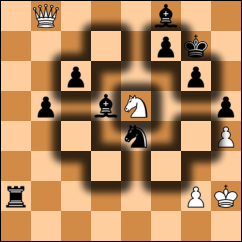
Tips For Learning Chess Part 8 - Endgame Priciples

1.Pair of Bishops is stronger than pair of Knights.
2.Bishop is usually stronger than Knight. Bishops are better than knights in all except blocked pawn positions.
3.Rook and Bishop are usually stronger than Rook and Knight.
4.Queen and Knight are usually stronger than Queen and Bishop.
5.Rooks belong behind passed pawns, of your own or the opponent.
6.A rook on the seventh rank is worth a pawn.
7.The easiest endings to draw are those with opposite colored bishops.
8. When your opponent has a bishop you usually have to put your pawns on the squares of the same color that squares of this bishop. At the same time, when you have bishop, you have to put your pawns on the squares of the color, opposite to the bishop’s squares, no matter if your opponent has bishop or not.
9. In the endgame King becomes an active piece move your King to the Center!
Subscribe to Chess Blog | The Pulse of Chess     If you liked the article kindly Digg it, Stumble it, Add to Technorati, bookmark it and please consider subscribing through  "Subscribe by Email"  and have articles & a  Everyman Chessbase eBook delivered right to your inbox! OR "Subscribe to Chess Blog Feed" in a Fead Reader of your choice OR Subscribe to "SMS Alerts" & Get Article Headlines & Updates delivered to your Mobile Phone for free.
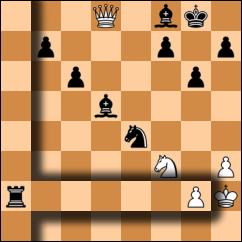
Tips For Learning Chess Part 7 - Positional Principles

1. Pair of bishops is a serious advantage (especially in endgame). If you have pair of bishops - try to open the position. And in opposite if your opponent has it try to close the position.
2. If you have advantage in space - avoid exchanges, which can lead to exemption of the play. When you have advantage in space your opponent’s pieces choke of the lack of space and fetter in maneuvers. That is the reason why you should avoid exchanges in such situation.
3. While you possess the initiative it is better to avoid simplifications. Every exchange should be motivated; it means it should bring some positional or tactical dividends.
Subscribe to Chess Blog | The Pulse of Chess     If you liked the article kindly Digg it, Stumble it, Add to Technorati, bookmark it and please consider subscribing through  "Subscribe by Email"  and have articles & a  Everyman Chessbase eBook delivered right to your inbox! OR "Subscribe to Chess Blog Feed" in a Fead Reader of your choice OR Subscribe to "SMS Alerts" & Get Article Headlines & Updates delivered to your Mobile Phone for free.
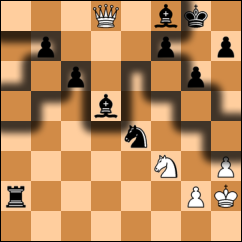
Tips For Learning Chess Part 6 - Pieces

1.Bishop is usually stronger than knight in open positions. Knight is better then bishop in closed positions, when bishop is restricted. In semi open position, when knight has supporting square (reinforced by pawn) in the center, and can’t be attacked with the opponent’s pawn - knight excels bishop and almost equal to a rook.
2.Passed pawns should be advanced as rapidly as possible.
3.Move your rook to the open file.
4.Doubled, isolated and blockaded pawns are weak: avoid them!
Subscribe to Chess Blog | The Pulse of Chess     If you liked the article kindly Digg it, Stumble it, Add to Technorati, bookmark it and please consider subscribing through  "Subscribe by Email"  and have articles & a  Everyman Chessbase eBook delivered right to your inbox! OR "Subscribe to Chess Blog Feed" in a Fead Reader of your choice OR Subscribe to "SMS Alerts" & Get Article Headlines & Updates delivered to your Mobile Phone for free.
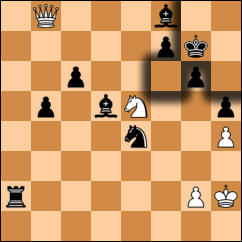
Tips For learning Chess Part 5 - Playing Principles

1.Opening fighting directed to the capture of the center. Pieces control and attack the maximum number of squares from the center. One of the advantages in center possession is in ability to transport the game to the flanks more easily.
2.Development is to be understood as the strategic advance of the troops toward the frontier line (the line between the fourth and fifth ranks). Develop all your pieces rapidly and castle quickly, preferably on the kingside. You can’t attack if your pieces are not out and it is much harder for your opponent to attack you successfully if your king is safely out of the center. There is no time for pawn hunting in the opening, except for centre pawns.
3.To be ahead in development is the ideal to be aimed for. Don’t move the same piece twice in the opening. Develop another piece. A pawn move must not in itself be regarded as a developing move, but merely as an aid to development.
4.Develop harmoniously! Play with all your pieces. Remember that the poor placement of even a single piece may destroy the coordination of the other pieces.
5.Don’t develop your Queen too early, it’s could be an option only when you could achieve a good target.
6.Maintain the balance in the center. This can mean controlling the center with pawns and pieces in the classical style, or by attacking the center with pieces from long distance, called the hypermodern method. The pawn centre must be mobile.
7. Capablanca principle: “Develop knights before bishops” - Knights have relatively obvious squares for their first moves, but a bishop’s best square depends very much on what your opponent does.)
Subscribe to Chess Blog | The Pulse of Chess     If you liked the article kindly Digg it, Stumble it, Add to Technorati, bookmark it and please consider subscribing through  "Subscribe by Email"  and have articles & a  Everyman Chessbase eBook delivered right to your inbox! OR "Subscribe to Chess Blog Feed" in a Fead Reader of your choice OR Subscribe to "SMS Alerts" & Get Article Headlines & Updates delivered to your Mobile Phone for free.
Tips for Learning Chess Part 4 - Opening Principles

1.Opening fighting directed to the capture of the center. Pieces control and attack the maximum number of squares from the center. One of the advantages in center possession is in ability to transport the game to the flanks more easily.
2.Development is to be understood as the strategic advance of the troops toward the frontier line (the line between the fourth and fifth ranks). Develop all your pieces rapidly and castle quickly, preferably on the kingside. You can’t attack if your pieces are not out and it is much harder for your opponent to attack you successfully if your king is safely out of the center. There is no time for pawn hunting in the opening, except for centre pawns.
3.To be ahead in development is the ideal to be aimed for. Don’t move the same piece twice in the opening. Develop another piece. A pawn move must not in itself be regarded as a developing move, but merely as an aid to development.
4.Develop harmoniously! Play with all your pieces. Remember that the poor placement of even a single piece may destroy the coordination of the other pieces.
5.Don’t develop your Queen too early, it’s could be an option only when you could achieve a good target.
6.Maintain the balance in the center. This can mean controlling the center with pawns and pieces in the classical style, or by attacking the center with pieces from long distance, called the hypermodern method. The pawn centre must be mobile.
7. Capablanca principle: “Develop knights before bishops” - Knights have relatively obvious squares for their first moves, but a bishop’s best square depends very much on what your opponent does.)
Subscribe to Chess Blog | The Pulse of Chess     If you liked the article kindly Digg it, Stumble it, Add to Technorati, bookmark it and please consider subscribing through  "Subscribe by Email"  and have articles & a  Everyman Chessbase eBook delivered right to your inbox! OR "Subscribe to Chess Blog Feed" in a Fead Reader of your choice OR Subscribe to "SMS Alerts" & Get Article Headlines & Updates delivered to your Mobile Phone for free.
Tips For Learning Chess Part 3 - How To Annotate Your Own Games?

While everyone prefers to learn from the mistakes of others, this is not very realistic when it comes to chess - Annotate Your Games!
A chessplayer’s strength is measured by his or her successes in tournaments. Sport has a single criterion - the result. Should we disagree with it, or bring in some other criteria, the very essence of sport is nullified. Comments such as this guy is more talented,but :
  • blundered in a time trouble
  • lost a won position
  • incredible error
  • accidentally, etc.
are for the fans (and media ). No “incredible” events occur. If something happened it was possible! It is necessary to try and understand the cause of what happened. You must analyze your own games in greater detail to identify the types of mistakes you made and to find out in which situations you need to improve your decision making process.
From childhood one must get used to analyzing and annotating every game played. Analysis of games, conceptualization of their content, explanation, assessments, motivations behind moves played, threats and what caused them create a powerful incentive for a chessplayer’s growth! Analysis is necessary for rapid chess games as well.
I consider that rapid chess gives even more information about the merits and drawbacks of a chess player. When there is more time to think, these drawbacks can be concealed by longer thinking, whereas in rapid chess and in blitz games all the pros and cons reveal themselves more vividly. A. S. Nikitin, Garry Kasparov’s coach, wrote that the future world champion even annotated his blitz games. Timing is of great help in identifying weaknesses of a chessplayer. It assists in understanding and explaining the chess player’s drawbacks and their causes, and is particularly demonstrative as it rates the time required to make this or that decision.
After each tournament it is necessary to report on all games played by a player in the Chessbase special Database.
Spend 10-15 minutes after each game writing brief notes, including thoughts, variations and assessments that were going through his mind during the play, and compare these with the results of subsequent calm analysis.
The five critical goals that you are trying to accomplish in your deep analyze are: Checking your Opening preparation. The opening part should end with a brief theoretical reference pointing out the best variations for continuing the struggle and with an “exemplary” game of this variation played by grandmasters.
Discovering the turning points and assessing your decisions making at those points. Particular attention should be drawn to the phase when the game passes from the opening to the middlegame, and it is worthwhile showing the extent to which the middlegame events correlate with opening structure logic.
Finding and classifying your own mistakes and other problems (Tactical, strategic, while attacking, defending etc, psychological problems etc); Develop your analyzing skills by uncovering new ideas and better moves, which could have happened if they were played.
The comments of each game should be finalized with an assessment of one’s own play and conclusions (reasons for win or loss, including non-chess factors; what to do in order to avoid these).
Showing your game to the coach for reviewing your analyzes.
Such work on the annotations should last for 4-5 hours. At a higher level, it is useful to annotate other players games, though it is more complicated due to a difficulty of understanding motives behind moves without observing the playing process directly.
Contributed by : A.Vaysman Honored coach of Ukraine
Subscribe to Chess Blog | The Pulse of Chess     If you liked the article kindly Digg it, Stumble it, Add to Technorati, bookmark it and please consider subscribing through  "Subscribe by Email"  and have articles & a  Everyman Chessbase eBook delivered right to your inbox! OR "Subscribe to Chess Blog Feed" in a Fead Reader of your choice OR Subscribe to "SMS Alerts" & Get Article Headlines & Updates delivered to your Mobile Phone for free.
Tips For Learning Chess Part 2 - Playing The Classics

It seems to me that a chess-player should first of all learn to play the classical openings, rather than openings such as the English opening, the Reti opening, Pirc-Ufimtsev Defense – the so-called “anti-openings”. These openings imply that the real combat begins only after the 15th move. You can also regularly provoke some interesting positions when playing these openings (the way M.Botvinnik and V.Smyslov did), but only on condition that you have had a very good practical experience and the knowledge of classical openings.
In some “anti-openings” you can move your pieces “to and fro” with no trouble. Those who like the process of playing chess as sport, rather than studying the theory of openings and the logics of the game, are really fond of playing “anti-openings”.
There is a rule in art: the professionalism of an actor is proved by means of classical, ever-lasting performances. If an actor cannot play a classical role, he is just an amateur. However, if an actor is able to perform classics, but unable to give the role some of his own individuality, the actor is no more than a good professional, but not a creative one.
Mostly the classics are difficult to play because the spectators have already seen them, so that you won’t get them interested by the text or the plot. What they want is to see the way a classical role is played. To arouse the audience’s applause (or win a game of chess) you should find significant nicities of the role, which is impossible if you lack talent.
Chess is an art as well, and so this rule can be applied to it. A chess-player should learn and play classical openings if he wants not only to achieve success as a sportsman, but also to become an artist. THERE IS NO OTHER WAY TO BREAK THROUGH. If you only stick to Ruy Lopez, Scotch Game, Reti Opening or Sicilian Defense, you might make certain progress and then wonder why you are not developing and improving your results. One should acquire a lot of technical skills, study a lot of typical positions to achieve success in classical chess. To master classical chess means to know how to play “right” chess. “Anti-openings” in turn cause a “to-and fro-game”.
A coach who teaches classical chess is supposed to know quite a lot about both classical openings and general culture. If a coach does not meet this requirement, his pupil is bound to study no more than 2 – 3 openings and neglect the theory of openings.
Playing an opening is in many ways like putting on a play. If an opening (or a performance) is badly organized, the actors’ playing won’t help. In that case, excellent moves are very rare and they seem as out of place as a tank at a horse show.
A young chess-player should learn to CREATE complicated positions instead of involving himself in the game where positions of this kind might be created.
It is very boring (especially for the young) to study classical openings, but that is valuable practice. And, as we know, practice makes perfect.
Today it is extremely hard to get even “+/= ” playing an opening, so if you have managed to turn the position to suit your tastes, the opening is considered successful.
Classical openings contain a lot of strategic and tactical approaches, they provide a chess-player with innumerable lines and situations. Nearly every move of classical openings is based on gaining the upper hand. “Anti-openings” are far less interesting. A lot of their moves are deprived of any ideas, because they are not aimed at winning a game. Ruy Lopez resembles in a way a classical waltz, and Reti Opening is very much like a twist, where the partners don’t depend on each other and dance for themselves.
Contributed by : A.Vaysman Honored coach of Ukraine
Subscribe to Chess Blog | The Pulse of Chess     If you liked the article kindly Digg it, Stumble it, Add to Technorati, bookmark it and please consider subscribing through  "Subscribe by Email"  and have articles & a  Everyman Chessbase eBook delivered right to your inbox! OR "Subscribe to Chess Blog Feed" in a Fead Reader of your choice OR Subscribe to "SMS Alerts" & Get Article Headlines & Updates delivered to your Mobile Phone for free.
Tips For learning Chess Part 1 - Talent & Hard Work

The Greatest World Champion Mikhail Botvinnik considered the success in chess as a combination of 4 factors.
* Special Chess Talent
* Good Physical conditions (Health).
* Strong Character
* High working skills
To achieve success in modern chess requires being a universal style chessplayer, playing all stages of a game confidently, and mastering typical positions in various openings.
Such a training program takes several years of strenuous work under the guidance of a qualified and thoughtful coach. For instance, in order to play the ending confidently, it is necessary for a junior player to remember the right way to play thousand typical endgame positions, requiring something like two years of the most arduous study.
First of all, a chessplayer must be able to work hard consistently. How many sparkling talents never made it to the top because of the absence of this skill?
I always remind my pupils: Talent has one advantage the right to work more than the others. A simple reasoning convinces you: Suppose a talented boy needs just ten minutes to master some chess material. A less talented player needs 20 minutes. If the talent will not spend these ten minutes and the other one will spend his 20 minutes, then who will be at an advantage?!
Only those children who are fanatically devoted to chess canbe expected to spend long hours at the chess board at home, reading chess books every day, and solving an enormous number of various tactic or dull endgame positions.
Garry Kasparov once wrote: I perceived all too early that you have to pay for everything in your life. A talented child has just a single thing to pay thats his childhood.
Nobody has ever found any other formula for that of success: TALENT + HARD WORK!
Contributed by : A.Vaysman Honored coach of Ukraine
Subscribe to Chess Blog | The Pulse of Chess     If you liked the article kindly Digg it, Stumble it, Add to Technorati, bookmark it and please consider subscribing through  "Subscribe by Email"  and have articles & a  Everyman Chessbase eBook delivered right to your inbox! OR "Subscribe to Chess Blog Feed" in a Fead Reader of your choice OR Subscribe to "SMS Alerts" & Get Article Headlines & Updates delivered to your Mobile Phone for free.
Don't forget to subscribe to the thread for tracking replies