CHESS QUOTE OF THE DAY

Play Chess & Solve Puzzles

Recent Articles

Loading...

Saturday, December 27, 2008

The Ruy Lopez for White - Open Lopez Part 2

Hello everyone,

Last time we had studied Variation A in the Open Lopez. Hope the main concept of the Open Lopez is clear in your head by now.

We will move forward and today we will study Black's 9th move alternative, Variation B: 9...Be7. Now this Variation has two sub-variation as Black's 12th move alternatives.

Let's start with Variation B1: 12...0-0:

Ruy_Lopez/Variation B1.pgn


Now let's move onto the next reply, Variation B2: 12...Qd7:

Ruy_Lopez/Variation B2.pgn


So, this was Black's second 9th move alternative. Hope you have enjoyed. Next time we will start discussion on Black's third 9th move alternative.

Keep visiting and keep reading. 

Thanks a lot. Enjoy!!
Subscribe to Chess Blog | The Pulse of Chess     If you liked the article kindly Digg it, Stumble it, Add to Technorati, bookmark it and please consider subscribing through  "Subscribe by Email"  and have articles & a  Everyman Chessbase eBook delivered right to your inbox! OR "Subscribe to Chess Blog Feed" in a Fead Reader of your choice OR Subscribe to "SMS Alerts" & Get Article Headlines & Updates delivered to your Mobile Phone for free.

Continue Reading...»
Bookmark | Share This Post
Digg Stumble This Del.icio.us Mixx Furl Propeller Simpy Live Twitthis Add To Slashdot Spurl Google Yahoo Reddit Technorati Blinklist Blogmarks Smarkings Ma.gnolia SphereIt Sphinn Feedmelinks

Saturday, December 20, 2008

The Ruy Lopez for White - Open Lopez Part 1

Hello everyone,

We have completed our study of the Moller and Arkhangelsk Variations in our last post. Hope you have it clear in your head by now.

Today we will start a new chapter in the Ruy Lopez, the Open Lopez. This is a little bit different from what we have seen in Berlin Defence, Deffered Steinitz and the recent Moller and Arkhangelsk Variations. Lets see how it goes:

1 e4 e5 2 Nf3 Nc6 3 Bb5 a6 4 Ba4 Nf6 5 0-0 Nxe4


With 5...Nxe4 Black basically chooses dynamic counterplay over solid defence . He makes space for his pieces to develop onto active posts and squashes any thoughts White might have of applying the 'Spanish Torture' so often seen in the closed defences .

However, there's a certain price to pay for all this activity. The position becomes open quite quickly and in order not to suffer a quick onslaught down the e-file, Black is forced to compromise his pawn-structure someWhat, leaving White with potential targets to exploit in the middlegame. Nevertheless, the Open Defence has Its fair share of supporters. Viktor Korchnoi is probably its most famous adherent, while of the new generation of top players one could point to Vishy Anand, who employed it in his 1995 World Championship clash with Kasparov and has continued to use it since.

The Strategic Starting Position
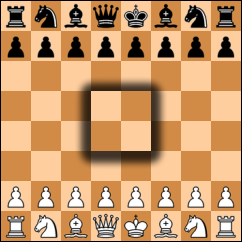
This is the typical position, which is reached after 8 moves of the Open Lopez. The first thing to notice is that Black 's pieces occupy active squares. Given a few free moves, Black would probably continue with ...Bc5, ...0-0 and perhaps ...f6, to create a semiopen f-file and attack the f2-square. It goes without saying that White must act energetically in the diagram position, else Black could easily take over the initiative once he has completed his development. Here I'm advocating the move 9 Nbd2, which was made popular by Anatoly Karpov. One of White's main ideas is to put immediate pressure on Black's strong knight on e4. This pressure can be enhanced with such moves as c3 and Bc2 . Black is asked very early on what to do with this knight.

Black Supports the Knight with ...f5


Black has just played 11...f5, lending support to the under-fire knight. White now has a big decision to make : whether to capture en passant, or to play around the knight and concentrate on the weaknesses in the black camp. On this occasion the main theoretical move is 12 Nb3 (instead of 12 exf6). After 12...Qd7 White can use a tactical trick to justify the move 13 Nfd4. Now 13...Nxe5? 14 f3 Nc5 15 Re1 Nc6 16 Nxc6 Qxc6 17 Nd4 Qd7 18 b4 drops a piece, so the normal continuation is 13...Nxd4 14 Nxd4 c5 15 Nxe6 Qxe6 16 f3 Ng5 17 a4 , when White is slightly better (see the theory section for more on this position).

Black Moves the Knight


On this occasion Black has retreated his knight to c5, where it controls some important squares . One of White's major plans in this position involves the usual knight manoeuvre with (after Re1) Nf1-g3/e3 . White's pieces would then point impressively at the black kingside. In addition, White has the e5-pawn as a spearhead, so it's easy to see that White can often build up a menacing attack against the black king. White also often plays Nb3, challenging the c5-knight. If this is exchanged, it clears the way for the white queen to go to d3, where it sets up a powerful battery with the bishop against the h7-pawn .
For the reasons outlined above, Black often delays castling in favour of first improving the position of his pieces . For example, Black often plays the move ...Bg4, giving White a pin to think about. This bishop can also be re-routed via h5 to g6, in order to blunt White's attack along the b1-h7 diagonal. This also leaves the e6-square vacant for the knight to hop back and completely block the e5-pawn. Another common feature is Black doubling behind the d-pawn with ...Qd7 and ...Rd8. The idea of this is not only to add extra support to the oftenvulnerable d5-pawn, but also to facilitate a possible ,..d4 advance. Of course the strength of this advance is always dependent on the placing of the various pieces, but a successful ...d4 will completely free Black's position .

Now let's move on to the different lines in this Variation. There are typically three different lines revolving around Black's 9th move alternatives, which again have different sub-variations based on Black's 11th and 12th moves.
Let's start with Variation A: 9...Bc5
Ruy_Lopez/Variation A.pgn

This is how it goes. We will study Variation B in our next post.
Keep visiting and keep reading.
Thanks a lot. Enjoy!!
Subscribe to Chess Blog | The Pulse of Chess     If you liked the article kindly Digg it, Stumble it, Add to Technorati, bookmark it and please consider subscribing through  "Subscribe by Email"  and have articles & a  Everyman Chessbase eBook delivered right to your inbox! OR "Subscribe to Chess Blog Feed" in a Fead Reader of your choice OR Subscribe to "SMS Alerts" & Get Article Headlines & Updates delivered to your Mobile Phone for free.

Continue Reading...»
Bookmark | Share This Post
Digg Stumble This Del.icio.us Mixx Furl Propeller Simpy Live Twitthis Add To Slashdot Spurl Google Yahoo Reddit Technorati Blinklist Blogmarks Smarkings Ma.gnolia SphereIt Sphinn Feedmelinks

Monday, December 15, 2008

December 2008 Chess Puzzle Contest

From now on we will be holding "Puzzle Contests" every month. You have to solve the puzzles and comment on relevant posts with the move sequence. Each month we will randomly pick a maximum of 2 commenters with correct solutions who will get a surprise gift delivered to their inbox( you have to leave your email address here ). Now what's the gift? If you are one of our email subscribers then you already got our subscription gift...isn't it? Well the prize for the contests will be something like that ( but not Everyman ebooks). Common solve it & comment & you will know .
Every month's top commenter is also eligible for the prize even if he/she is unable to solve the puzzle.

Lets move on to the puzzle of this month....


December Chess Puzzle Contest


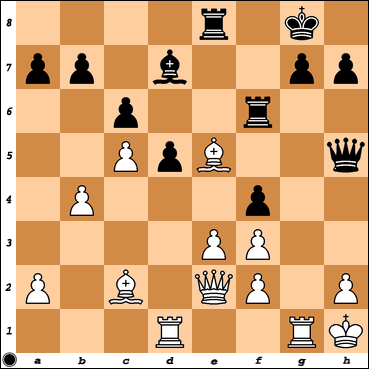
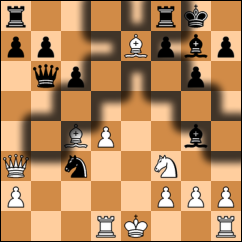
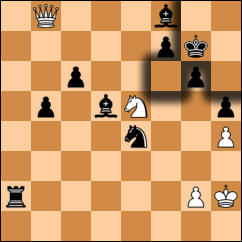
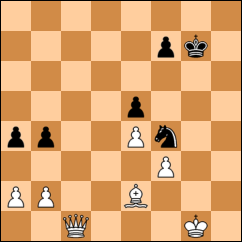
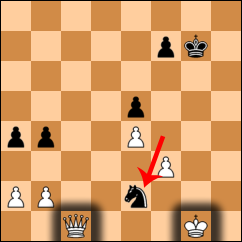
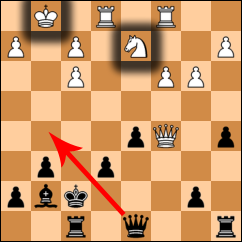
This position is from Burn - Teichmann, Hastings 1895. White's doubled pawns on the f-file hamper him in his attempts to defend his king.How did black exploit this? Black to play.You have to find the best sequence of moves that leads to mate.
Leave you solutions here with your email address. Entries after this month are not eligible for the contest. So what are you waiting for? It's time for your neurons to do some calculations...


Subscribe to Chess Blog | The Pulse of Chess     If you liked the article kindly Digg it, Stumble it, Add to Technorati, bookmark it and please consider subscribing through  "Subscribe by Email"  and have articles & a  Everyman Chessbase eBook delivered right to your inbox! OR "Subscribe to Chess Blog Feed" in a Fead Reader of your choice OR Subscribe to "SMS Alerts" & Get Article Headlines & Updates delivered to your Mobile Phone for free.

Continue Reading...»
Bookmark | Share This Post
Digg Stumble This Del.icio.us Mixx Furl Propeller Simpy Live Twitthis Add To Slashdot Spurl Google Yahoo Reddit Technorati Blinklist Blogmarks Smarkings Ma.gnolia SphereIt Sphinn Feedmelinks

Sexy maths: Skills of a Chess Grandmaster


The 2008 chess Olympiad in Dresden
For a while, the chess Olympiad this year looked like producing a surprise winner but closer inspection of Israel's team sheet revealed that it was pretty much business as usual: half the players were named Boris!
Other than a brief blip in the 1970s, the biennial event has produced remarkably consistent results. From 1952 to 1990, the Soviet Union ruled the contest, and after the superstate's fragmentation either Russia or one of its former union satellites struck gold every time. As it turned out this year, the Soviet diaspora's turn in the spotlight was short-lived and Armenia triumphed for its second successive Olympiad.

Despite being connected by being born under the red flag, those that dominate the game are better categorised by their membership of a different club: the mathematical mafia. Legend has it that the game was invented by a mathematician in India who elicited a huge reward for its creation. The King of India was so impressed with the game that he asked the mathematician to name a prize as reward. Not wishing to appear greedy, the mathematician asked for one grain of rice to be placed on the first square of the chess board, two grains on the second, four on the third and so on. The number of grains of rice should be doubled each time.
The King thought that he'd got away lightly, but little did he realise the power of doubling to make things big very quickly. By the sixteenth square there was already a kilo of rice on the chess board. By the twentieth square his servant needed to bring in a wheelbarrow of rice. He never reached the 64th and last square on the board. By that point the rice on the board would have totalled a staggering 18,446,744,073,709,551,615 grains.
Playing chess has strong resonances with doing mathematics. There are simple rules for the way each chess piece moves but beyond these basic constraints, the pieces can roam freely across the board. Mathematics also proceeds by taking self-evident truths (called axioms) about properties of numbers and geometry and then by applying basic rules of logic you proceed to move mathematics from its starting point to deduce new statements about numbers and geometry. For example, using the moves allowed by mathematics the 18th-century mathematician Lagrange reached an endgame that showed that every number can be written as the sum of four square numbers, a far from obvious fact. For example, 310 = 172 +42 + 22 + 12.
Some mathematicians have turned their analytic skills on the game of chess itself. A classic problem called the Knight's Tour asks whether it is possible to use a knight to jump around the chess board visiting each square once only. The first examples were documented in a 9th-century Arabic manuscript. It is only within the past decade that mathematical techniques have been developed to count exactly how many such tours are possible.
It isn't just mathematicians and chess players who have been fascinated by the Knight's Tour. The highly styled Sanskrit poem Kavyalankara presents the Knight's Tour in verse form. And in the 20th century, the French author Georges Perec's novel Life: A User's Manual describes an apartment with 100 rooms arranged in a 10x10 grid. In the novel the order that the author visits the rooms is determined by a Knight's Tour on a 10x10 chessboard.
Mathematicians have also analysed just how many games of chess are possible. If you were to line up chessboards side by side, the number of them you would need to reach from one side of the observable universe to the other would require only 28 digits. Yet Claude Shannon, the mathematician credited as the father of the digital age, estimated that the number of unique games you could play was of the order of 10120 (a 1 followed by 120 0s). It's this level of complexity that makes chess such an attractive game and ensures that at the Olympiad in Russia in 2010, local spectators will witness games of chess never before seen by the human eye, even if the winning team turns out to have familiar names.
 Article Source : Times Online
Subscribe to Chess Blog | The Pulse of Chess     If you liked the article kindly Digg it, Stumble it, Add to Technorati, bookmark it and please consider subscribing through  "Subscribe by Email"  and have articles & a  Everyman Chessbase eBook delivered right to your inbox! OR "Subscribe to Chess Blog Feed" in a Fead Reader of your choice OR Subscribe to "SMS Alerts" & Get Article Headlines & Updates delivered to your Mobile Phone for free.

Continue Reading...»
Bookmark | Share This Post
Digg Stumble This Del.icio.us Mixx Furl Propeller Simpy Live Twitthis Add To Slashdot Spurl Google Yahoo Reddit Technorati Blinklist Blogmarks Smarkings Ma.gnolia SphereIt Sphinn Feedmelinks

Sunday, December 14, 2008

The Ruy Lopez for White - Moller and Arkhangelsk Variations Part 5

Hello friends,

Today we will conclude our study of the Moller and Arkhangelsk Variations. In the last post we have studied Variation C221: 12...Re8. Today, we will study the remaining two replies by Black, Variation C222: 12...exd4 and Variation C223: 12...Rb8.

So, let's start with Variation C222: 12...exd4

Ruy_Lopez/Variation C222.pgn


Now, let's move on to the remaining Variation C223: 12...Rb8

Ruy_Lopez/Variation C223.pgn


So, friends, this concludes our study of the Moller and Arkhangelsk Variations. It's a bit tricky, but I am sure you will be able to find your way out through it, as shown.

From our next post, we will start a new chapter, The Open Lopez.

So, stay tuned. This is certainly not the end.

Keep visiting and keep reading.

Thanks a lot, Enjoy!!
Subscribe to Chess Blog | The Pulse of Chess     If you liked the article kindly Digg it, Stumble it, Add to Technorati, bookmark it and please consider subscribing through  "Subscribe by Email"  and have articles & a  Everyman Chessbase eBook delivered right to your inbox! OR "Subscribe to Chess Blog Feed" in a Fead Reader of your choice OR Subscribe to "SMS Alerts" & Get Article Headlines & Updates delivered to your Mobile Phone for free.

Continue Reading...»
Bookmark | Share This Post
Digg Stumble This Del.icio.us Mixx Furl Propeller Simpy Live Twitthis Add To Slashdot Spurl Google Yahoo Reddit Technorati Blinklist Blogmarks Smarkings Ma.gnolia SphereIt Sphinn Feedmelinks

Chess and Math: a happy couple?

Chess and math have always slept side by side. But are they a happy couple? I think every chess player has had the experience of someone asking you, in high school, if your math grades were as good as your chess results. Sadly, for me the answer was often ‘no’.      By Arne Moll
In fact, the reason I did so badly in high school math was probably … my chess addiction. I spent so much time on chess that I completely neglected math (and other subjects.) But, as the song goes, old habits die hard. And, of course, it’s not unreasonable to suppose math and chess are related, or that results in both could be correlated. In fact, several peer-reviewed studies have pointed out the advantages of using chess as a teaching method [1]. Recently, a paper by John Buky and Frank Ho was published on the effect on pupil’s math scores using an integrated math and chess workbook [2]. In this article, I will take a look at the results from a chess players perspective, discuss some problems and give some suggestions for further research.

A critical look at the curriculum
The curriculum and the workbook are described in detail on the site of the Chess and Math Academy based in Chicago [3]. Examples are also mentioned in other peer-reviewed articles by Ho [4]. The idea is that learning about, e.g., algebraic notation and pattern recognition can be transferred to math concepts:
"By working on mathematical chess puzzles, students get training on how to transfer chess knowledge to improve math ability. Since chess is a whole number based strategy game so it is important for students to get exposure to computational mathematical chess puzzles. [...] Algebraic notation learned in chess could be transferred to the concepts of coordinates [...]. The King’s triangular shape of movement to create opposition in chess is an example on how the use of a geometrical shape would take a special meaning in chess. [...] One notable math knowledge learning in playing chess but not widely taught is the set theory. Chess players constantly use the concept of Venn diagram to look for interaction among pieces."
The first thing to note is that these relations between chess elements and their supposed mathematical mirror-elements are not intuitive for the chess player. Chess is not mathematics, and they work by different type of rules. Mathematics is rigorous, chess is not. In his classic Secrets of Modern Chess Strategy, John Watson remarks: “In chess, general rules will never have universal application [...]” [5]. In chess, unlike in mathematics, there are no absolute truths, as anyone who has ever tried to calculate a ‘book’ bishop sac on h7 will know. The famous chess grandmaster Richard Reti makes the point in his Modern Ideas in Chess (1922) [6]:
"What is really a rule in chess? Surely not a rule arrived at with mathematical precision, but rather an attempt to formulate a method of winning in a given position or of reaching an ultimate object, and to apply that method to silimar positions."
Although making a link between chess and math teaching is very creative and interesting, it is in a way also slightly suspect. Haven’t we all seen stereotyped commercials in which chess or chess pieces stand for ’strategy’ or ‘cleverness’ (or ‘nerdiness’)? The link is also a bit forced. For instance, although I am familiar with the concept of Venn diagrams, I have, as a chess player, never realized that it could be linked to the interaction among pieces. In fact, even now that I know of a possible relation between the two concepts, I’m not entirely sure how exactly the two can be linked. Should I draw Venn diagrams inside my head next time I’m trying to play a game? Do my chess skills help me understand complex Venn problems better?
I also doubt the author’s assertion that chess is a “whole number based game”. The idea probably stems from the supposed absolute value of the pieces (a Rook is worth 5 pawns, a Knight 3 pawns, etc.). However, it has long been known that this approach is too simplistic. Most strong chess players will probably agree that a bishop is, on average, worth not 3, but 3,5 pawns. A knight is slightly less, perhaps 3, but it all depends on the circumstances. And as every chess player knows, the value of the King in chess is, in a way, “infinite”. In my opinion, the idea that chess is a whole number game is, at best, simplistic. It is certainly confusing.
Buky and Ho are themselves aware of the non-obvious relation between chess and math and the possible effect on pupils. As they say:
"The effect of transferring math knowledge learned in chess will be less significant if the chess teacher does not take the efforts of emphatically point out the math concepts. The task of transferring math knowledge learned in playing chess would be much easier if students are offered the opportunities to work on mathematical chess puzzles."
In other words, although the two concepts may not be grasped intuitively, having a good teacher and by doing ‘mathematical chess puzzles’, the non-intuitiveness of the two concepts could be overcome. The first condition is so obvious it’s strange it’s even mentioned at all, the second sounds plausible, but of course, the puzzles have to be clear enough for pupils to understand the implicit relations between the two. Let’s have a look at an example from the workbook.
Even disregarding the question whether one can simply attach values to chess pieces (in the example, a queen is probably worth 9 ‘pawns’ and a bishop 3), I find this example quite confusing. A first practical question is if should we fill in chess figurines or numbers in the blank boxes? And how are we supposed to interpret the mathematical operations? 12 minus a bishop equals a queen, but what is a queen plus a bishop? These may sound like trivial questions, which can be solved by proper instruction, but if for me, a skilled chess player and a professional IT developer, these puzzles are not clear, then how must these puzzles appear to 4th graders?
Here’s another example where the same question arises:
To be honest, this example baffles me. I just don’t understand what is going, but I realize it could be just me. So I asked IM Maarten Solleveld, who is a professional mathematician at Goettingen University, German, if he understood these examples. He didn’t. Moreover, he thought they were confusing to pupils, especially young ones. He writes:
"I don’t see the use of most of these examples. In fact, I find many of the excercises weak from an educational point of view, or even counter productive. The authors clearly cannot imagine themselves that it’s possible to confuse kids with strange puzzles."
Before moving on to the research done by Buky and Ho, let me give one last example of one of their puzzles.
I think this example is especially noteworthy. In itself, making a link between chess and statistics is very original, although personally, I would rather be interested in a question like ‘What’s the chance my opponent is going to find this accurate reply to my bluff move?” than in the outcome of the probability of two pieces meeting within a certain number of moves. More to the point, it’s hard to imagine what use the excercise is given that fact that in order to get the solution to the problem, the concept of probability has to be taught to pupils anyway - so why involve chess in it? After all, the answer (0) only makes sense if you know the difference between probability 1 and probability 0.5 and probability 0. In other words, what is, in alle these excercises, the added value of adding chess concepts to the puzzles?
The results of the research
This is also my main criticism on the research mentioned in the author’s article. Buky and Ho tested their ideas on 119 pupils using a paried t-test:
"One hundred and nineteen pupils, in grade 1 to grade 8, from five public elementary schools in Chicago, Illinois, USA, participated in the after-school program for 120 minutes, twice a week, for a total of 60 hours of instruction. None of the students has possessed any substantial knowledge in chess. The study began by administering pre-tests in the first week of this study at the beginning of the program on 10/23/06 and a post-test was conducted at the end of the program on 3/28/07.
The test results were encouraging:
Group Group One Group Two
Mean 36.46 55.45
SD 15.82 19.37
SEM 1.45 1.78
N 119 119
t = 12.8729
The results show that pupils performed much better on the second (post-) test, showing they learned a lot (36.46 vs. 55.45) in the period between the two tests (roughly 5 months). The authors conclude:
The results of this study demonstrate that a truly integrated math and chess workbook can help significantly improve pupil’s math scores.
Discussion
This is, of course, good news for the Chess Academy’s teaching method, and for the pupils making use of it. Teaching childeren with the chess and math integrated workbook actually improves their mathematical skills. So far, so good. There is a problem, however. Since Buky and Ho’s emphasis is on the difference between their own method and “traditional computation practices”, it would, in my view, have been much more relevant (and interesting) to do a control test where one group of pupils gets their math lessons by the chess and math method, and the other group gets “normal” after-school math lessons. After all, only by doing a pre- and post-test for both groups, one can establish whether the chess and math method actually works better than the tradional method. This cannot be established with the research done by Buky and Ho.
As far as I can see, we’re still left with several possible explanations for the results they got:


  • Learning how to play chess improves the pupil’s mathematical skills anyway, regardless of the method or the workbook.


  • Since even without learning chess, pupil’s mathematical skills are likely to improve over time, it’s possible that pupils always perform better on the post-test conducted several months later.


  • Since the research was done in an after-school program, the pupils have in the mean time been learning a lot of math during school, making any progress in this area not more than natural.
    -
    What should we make of this? Because the traditional method was not compared to the chess and math method, I think it’s too early to conclude that the new method is actually better than the traditional method. And this ultimately has to be the 64,000 dollar question for the chess and math method. In theory, it’s even possible that while the chess and math method scores well on the test, the traditional method (or no method at all!) would score even better. By that rationale, the current research does not yet show that the method actually does anything at all. [7]
    Also, while it may be true that, according to Buky and Ho, “math and chess integrated work has visual images, chess symbols, directions, spatial relation, and tables; all these are stimuli to kids and keep their interests high while working on computation problems”, it is not clear to me that the stimuli used in the curriculum actually contribute to improving mathematical skills. (Perhaps it was simply the teacher’s explanations that improved their results, not the puzzles themselves.) A small, non-representative poll among chess players and professional scientists does indicate that adults find the puzzles as presented in the curriculum confusing and/or unclear. Perhaps this is simply a matter of insufficient explanation, but in any case, it’s something the authors do not seem to acknowledge in their article. A final point of doubt concerns the benefits to the pupil’s chess abilities, as opposed to the benefits of their math skills. The authors are silent on this. In my opinion, it certainly won’t help childeren applying simplistic rules like ‘a bishop equals 3 pawns’ in chess. Such an approach will most probably backfire. The concept of probabilities, too, can hardly be of use in a practical game. There may be advantages also, but unfortunately, these are not indicated by the authors.
    In the end, we should credit the authors for mentioning the most important aspect of all education: “Children learn best while having fun“. This is definitely true, and when the authors say that the children they work with enjoy their method, there’s no reason to doubt them. Indeed, if we agree that chess is fun (and I hope all readers of ChessVibes will agree on that!), we should perhaps be able to integrate chess in a useful way into any curriculum, be it math or biology or English literature. But chess is surely not unique in stimulating children to perform better in maths. Who knows, draughts may work even better. Or poker. In any case, if they’re confused by exercises, puzzles or chess figurines - even though they may enjoy them visually - it’s perhaps too early to write tradional methods off. In any case, more research is needed.
    And perhaps, math should just be math, and chess should just be chess.
    References
    [1] For a list of popular and scientific publications on chess and teaching, see the Chess Academy website.
    [2] Ho, F., Buky, J. (2008). The Effect of Math and Chess Integrated Instruction on Math Scores. The Chess Academy
    [3] Ho, F. (2006). Chess for Math Curriculum. The Chess Academy
    [4] Ho (2006). Enriching math using chess. Journal of the British Columbia Association of Mathematics Teachers, British Columbia, Canada, Vector. Volume 47, Issue 2.
    [5] Watson, J. (1998). Secrets of Modern Chess Strategy. Gambit Publications (p. 11)
    [6] Reti, R. (1922). Modern Ideas in Chess
    [7]See http://www.encyclopedia.com/doc/1O87-onegrouppretestpsttstdsgn.html for a discussion on the one group pre-test post-test design.

  • This article was orginally written by Arne Moll , one of the authors of Chessvibes .
    You can read the original article here .
    Subscribe to Chess Blog | The Pulse of Chess     If you liked the article kindly Digg it, Stumble it, Add to Technorati, bookmark it and please consider subscribing through  "Subscribe by Email"  and have articles & a  Everyman Chessbase eBook delivered right to your inbox! OR "Subscribe to Chess Blog Feed" in a Fead Reader of your choice OR Subscribe to "SMS Alerts" & Get Article Headlines & Updates delivered to your Mobile Phone for free.

    Continue Reading...»
    Bookmark | Share This Post
    Digg Stumble This Del.icio.us Mixx Furl Propeller Simpy Live Twitthis Add To Slashdot Spurl Google Yahoo Reddit Technorati Blinklist Blogmarks Smarkings Ma.gnolia SphereIt Sphinn Feedmelinks

    Nature: "Cognitive enhancement’ is not a dirty word"

    pills on the chess board?
    Should mind drugs be allowed or forbidden in chess competition? Less than two weeks after super GM Vassily Ivanchuk missed a doping test at the Olympiad, scientists in Nature published an article that says ‘cognitive enhancement’ should be allowed in modern society.
    In their commentary on the website of Nature - one of the most important science magazines in the world - seven prominent neuroscientists and university teachers conclude that we must ‘reject the idea that enhancement is a dirty word’. According to research quoted in Nature,

    "almost 7% of students in US universities have used prescription stimulants (…) and (…) on some campuses, up to 25% of students had used them in the past year. These students are early adopters of a trend that is likely to grow, and indications suggest that they’re not alone."
    Although the authors do not specifically mention chess, it’s obvious that the subject is closely related to our royal game. Indeed, the authors state that
    "in the context of sports, pharmacological performance enhancement is indeed cheating. But, of course, it is cheating because it is against the rules. Any good set of rules would need to distinguish today’s allowed cognitive enhancements, from private tutors to double espressos, from the newer methods, if they are to be banned."
     This is exactly the point that many proponents of drugs in sports have made in the past (and indeed on this website as well): why is some chemical substation more of a ‘drug’ than a private tutor or wealthy parents who can afford to buy lots of chess books?
    The article in Nature explicitly states that ‘mentally competent adults should be able to engage in cognitive enhancement using drugs’, and they support their conclusions with results from peer-reviewed research. They are not blind to possible dangers, however, and they do make an exception for children. Their suggestion that drugs are to be evaluated by an evidence-based approach, and not on irrational sentiments (and most anti-drug sentiments seem to be just that), seems reasonable and wise to us. It’s probably too late for Ivanchuk, but it would be interesting to see FIDE respond to this article.
    You can read the entire commentary here (and more on a similiar piece in Nature from last year here and here). Do let us know what you think in the comments.
    This article was orginally written by Arne Moll , one of the authors of Chessvibes .
    You can read the original article here
    Subscribe to Chess Blog | The Pulse of Chess     If you liked the article kindly Digg it, Stumble it, Add to Technorati, bookmark it and please consider subscribing through  "Subscribe by Email"  and have articles & a  Everyman Chessbase eBook delivered right to your inbox! OR "Subscribe to Chess Blog Feed" in a Fead Reader of your choice OR Subscribe to "SMS Alerts" & Get Article Headlines & Updates delivered to your Mobile Phone for free.

    Continue Reading...»
    Bookmark | Share This Post
    Digg Stumble This Del.icio.us Mixx Furl Propeller Simpy Live Twitthis Add To Slashdot Spurl Google Yahoo Reddit Technorati Blinklist Blogmarks Smarkings Ma.gnolia SphereIt Sphinn Feedmelinks

    Mind Games: Who is Doing the Playing? - A Must Read

    I came across an great article recently. Thought why not share it here. It's a must read. Tell us what you think. So here it is....


    Mind Games: Who is Doing the Playing?
     
    Discoveries on consciousness have inspired the Norwegian philosopher Rune Vik-Hansen to forge a new view on development of chess skills. Challenging the current pedagogical climate, which claims that talent is insignificant and exposure to material a magic formula, he clarifies why blunders in chess are caused by a lack of interplay between consciousness and mind. Treatise with summary.

    Summary/Abstract

    Born out of recent findings from the field of consciousness and mind, the article explains that chess playing is based upon a fine interplay between a mind subconsciously triggering moves, and a well disciplined consciousness knowing what to keep and what to discard. The highly popular opinion that chess playing is done solely by a conscious self is challenged.
    Disputing the concept of “conscious memory”, it is shown that that one cannot remember material by acts of volition, and that development of chess skills cannot be explained by concepts revolving around consciousness.
    The article takes to task the current pedagogical claims that talent is of no significance and that exposure to chess material will bring the aspiring player equally far, and also the prevalent understanding that passion for, taking an interest in and believing in what you do are important components in improvement, chess or otherwise. On the contrary, the text demonstrates the significance of innate ability, and that passion and interest merely can direct our attention towards certain fields of study, but that acquiring skills involves different mental processes than these.
    Avoiding blunders being a major component in development of chess skills, they are here explained as caused by a flawed interplay between consciousness and mind, based upon the distinction between seeing and perceiving. A possible solution to the problem is suggested.
    A closer look is taken at the highly popular concept in chess lingua, “pattern recognition”. By pinpointing functional as well as conceptual problems, it is shown that the concept does not meaningfully lend itself to explain chess playing. Specific idiosyncrasies between patterns and structures are scrutinized to show that the conceptual problems run deeper than mere semantics. The fundamental difference is argued by looking at how these two relate to each other, and how they are expressed in chess discourse and chess literature. Since no formal definition of “pattern” in chess exists, it is impossible effectively to meaningfully communicate “pattern recognition” as a workable concept to explain the development of chess skills. To then explain chess playing and support the claim that the idea of “pattern recognition” is highly problematic, “exformation” is introduced as a new concept to chess discourse, thinking and communication.
    Upon closure, chess playing is compared with judgment in the field of morality, trying to explain that just as in morality, chess players constantly encounter and have to deal with situations (positions) never before encountered.
    Finally, it is offered why many present methods of study will not seriously improve or develop chess skills. In context of the undertaken analysis, Kotov’s method is suggested for chess improvement, and it is explained why it works.


    Development of Chess Skills – A New Understanding

    In light of recent discoveries on consciousness and mind, a whole new framework regarding development of chess skills and chess playing has to be forged, and the present discussion takes as its point of departure Jonathan Rowson’s well written and thought-provoking article from NIC 2008/05. Rowson addresses the role of talent and also the relationship between opening work and general chess ability, explaining it by “conscious memorizing” and the more familiar “pattern recognition”. Our analysis will revolve around these concepts, revealing a different position than Rowson's as quoted later below.

    Introduction

    The premises for challenging Rowson’s point of view are based upon The User Illusion, Tor Nørretranders’ outstanding and still relevant book about consciousness from 1991 and we will first have a look at some basic premises for chess acquisition and learning.
    Research (Kornhuber, Deecke, Libet, later reproduced and published in Brain, 1991) has shown that any apparent act of volition normally begins subconsciously. Experiments have shown that, by changes in electrical fields, the brain prepares actions before we become conscious of them. It takes from a half to a second and a half of cerebral activity (evoked response and Bereitschaftspotenzial and other fancy phenomena) to become conscious of what is going on “back there”. It takes time to create consciousness (to become conscious) just at it takes time to organize the millions of sense impressions, separating the relevant ones from the irrelevant to create our unified and coherent perception of the world and the half second is just enough time to do that. The distinction between what we are conscious of and not might be called “the interface of consciousness” which illustrates the lack of transparency of the human mind. Illustrative might be an analogy from the world of computers; what you see on screen is only a fraction of what is going on beneath the surface.
    Even though we have no idea how immaterial consciousness may arise from material processes, it certainly does, and remains one of the great mysteries, if not the greatest, along with quantum mechanics. We might feel and experience our decisions as conscious but strictly speaking, in the strong sense, they are not, since consciousness itself never triggers impulses but only can relate to impulses triggered by deciding to “veto” them or not. The usual way to go about it is to “veto”, or abort impulses that will lead to unwanted, awkward, unfortunate, embarrassing or immoral actions, thus saving the “free will” in a negative sense since it does not purposefully or intentionally initiate or trigger impulses/actions as traditionally understood.
    The problem with the notion that man consciously can act on will or by volition, is that if one finds oneself in a vacuum, figuratively speaking, it is in principle impossible to stringently give an account of why some actions are to be preferred to others since all possibilities in some sense might be considered equal. This implies that decisions are “conscious” only in a weak sense, meaning that “conscious decisions” exist only in the veto, and not in the triggering.
    People, of course, if perceptive, are consciously aware what impulses are triggered (body language or physical movements), but most of what’s going on inside of us, passes without involving consciousness at all. Consciousness might be said to be in the receiving end, so to speak, of cerebral processes, resembling what our German chess playing friend uses to say. “What have we here?” This also solves the problem of choosing among an infinite number of equally held possibilities; it is far easier to choose among possibilities already presented to consciousness, since we would already have a penchant or be more prone to some than to others. These, apparently, quite abstract findings, certainly have some revolutionary, concrete implications regarding human life in general and chess playing specifically.

    Conscious memory

    Regarding the extent of the relationship between opening work and general chess ability, we begin our discussion by quoting Rowson from p.83-84 (italics ours):
    “You may think you are learning opening moves, but while you are consciously memorizing variations, you are also subconsciously learning new structures, feeling new squares, picking up new patterns and ideas and most of these things probably makes you stronger in a more general sense.”
    There are several quite confusing and problematic issues (see italics) in this quote and to start out; there is no such thing as conscious memorizing, due to the fact that memory and cerebral activity are (subconsciously) independent of consciousness and possible acts of volition. This is the reason why people are hard pressed to explain why they forget something; their consciousness being “denied access” to the processes that makes one forget. Strictly speaking, it is not the “I” that forget but subconscious processes referred to by the pronoun me. Forgetting “on purpose” more resembles repressing or suppressing than forgetting in the strict sense. With regard to memory; nobody forgets things “on purpose”, though many of us probably are familiar with sins of omission. This means neither remembering nor forgetting are controlled by the will, or any other intentional/volitional activity, but that sins of omission are made possible because impulses already subconsciously triggered are thereupon aborted before running to action. When speaking in mentalistic terms, it is of paramount importance to distinguish the different concepts to avoid unfortunate implications later on. What might be meant by “conscious memorizing”, is that one is (intentionally, like “desire”, or “urge”, not necessarily involving some kind of volition,) set on remembering what is read, that one entertains a wish to remember what is studied, however, memory works differently and independently of these kind of mental acts. Purporting that memory is conscious, has some rather serious implications, which Rowson seems to be unaware of. Consciousness is often confused with will, as are desires and urges as well. Contrary to urges and desires, acts of volition are often associated with an agent, who, out of nowhere, is able to act on purpose or intention, implying that if there is something we should remember (opening theory, our loved ones‟ birthdays etc.) there would be no reasons, not to.
    World class chess players are said to have a strong memory but there seems to be no reason to assume that they are more “conscious”, in the sense of being stronger willed to remember, than lesser blessed wood-pushers. Differently put, chess players, irrespective of strength, have the same “level” or “amount” of consciousness, which again, is different from “presence of mind”. A certain Fischer, for example, was renowned for his memory, writing down all of his 22 blitz games at Herceg-Novi in 1970 after playing, and this has nothing to do with him “wanting” to remember, for natural reasons, the games “stuck” in his memory.
    There are, of course, different memory “tricks”, which in their turn, paradoxically enough, also must be remembered, like making up a story or a line of associations, of the things one are to remember, like shopping lists or names, but when it comes to remembering chess theory, main lines, subvariations, all their ramifications, different structures etc. these are simply too ineffective to work properly.
    Memory and the ability to remember are subconscious and take place regardless of our knowing, i.e. consciousness. If memory were conscious, there would be no reason as to why we would have problems remembering our analyses, preparations, openings or the whole  series of Informators, Yearbooks, magazines as well, since “conscious memory” plays on the analogy of a computer, consisting of different partitions with files which our RAM, i.e. conscious (short term) memory, would easily enough access, which is not the case. If memory were conscious, chess playing and acquisition of chess skills would partly be reduced to a mechanic exercise, where the only thing to do was at will to load the memory with chess “stuff” which we thereafter would access “downloading” the relevant files. Also, memory tends to fade with age, which would not be a problem if memory were based on acts of volition, since we at our own will, could reproduce any chess material whatsoever.
    However, we know just too well that repeated studies is necessary to remember games, variations, lines, fragments, themes, bits and piece etc. Very rarely do things immediately stick to memory no matter how strongly we want to remember it all the very first time. So, our first conclusion is that memory works subconsciously.

    Acquisition of Chess Skills

    Moving forward, regarding development of chess ability, Rowson (p.84) goes on to explain Karjakin’s and Magnus Carlsen’s acquisition of chess skill more by their exposure to games, positions, structures etc. than innate talent or ability, which, incidentally, also is in accord with the pedagogic spirit of the times, underestimating the significance of inborn talent.
    Karjakin and Magnus’ talent (i.e. their brains’ ability to absorb and assimilate what it is exposed to) plays a far greater role than Rowson seems to admit. Without the ability to absorb or assimilate what one is exposed to, it does not matter how much or how many times one is exposed to different games, structures etc. Rowson’s point of view reduces chess learning to a rather mechanical exercise and also implies that far more players far more easily would become far stronger than is actually the case, simply by being exposed to chess material. If Rowson is correct, we would be hard pressed to explain how younger players come to be stronger than older ones with far more experience and having had the time to assimilate and absorb infinitely more chess than young prodigies. True, work can do much, but without talent one will forever sing the song of mediocrity. What characterizes talent is a certain ability or capacity to much better exploit, apply and take advantage of a smaller amount of material than lesser gifted players might. Talent is extremely effective use of presented material, and this is why both Karjakin and Magnus are as strong as they are at such a tender  age. What characterizes talent, prodigies and whiz kids, is the ability to absorb and assimilate material amazingly fast upon which the brain generalizes and then produces one brilliant move after another, which is impossible to explain if exposure to chess was the main component. Differently put: full conscious transparency with unlimited access to information would seem to render talent superfluous and unnecessary. Rowson is right when quoted as saying “probably” since nobody knows or has not even the remotest idea about how the brain generalizes or processes the absorbed material for the simple reason that consciousness is “denied access” to these inner processes.

    Who is Doing the Playing?

    Research (Kornhuber, Deecke et.al) showed that thinking, generally and more specifically, is independent of consciousness and acts of volition (not be confused with wishes, urges and desires) and that most of the information passing through our central nervous system is subconscious but we might be able to direct our attention or awareness. The thinking processes, the material and the preparation themselves are all subconscious, i.e. outside our conscious control, with the implication that we cannot think “what we want”, and having access only to the results of these processes (Julian Jaynes &William James). The brain silently works in the background feeding our consciousness with different suggestions, some good, others bad, some brilliant, others just horrible, which is the task of consciousness to keep or to discard. Our brain per se has no notion of quality, consciousness does, which means that chess playing (and human activities in general) is left in the hands of the fine-tuned interplay between conscious and subconscious processes; knowing what to keep and what to dispatch among all the suggestions, whims and ideas the brain comes up with. If this were not the case, we could conjure up brilliances in all walks of life, thinking brilliant thoughts solving all our problems, on and off the board, simply by acts of volition.
    Most of the time when playing, consciousness is not involved at all. If chess playing were conscious, as a logical implication, with all information readily accessible through the eyes that sees the board and the memorizing of chess material and since we would clearly know when we were about to make a bad move or blunder, we would never make mistakes since no-one on purpose, intentionally or wilfully, blunders. Why would they? Simply by acts of volition, we could decide to play the best moves as we would have full overview of what is going on since consciousness is transparent, and the position on the board is there for everyone to see. However, this is not the case as consciousness never triggers moves, the brain does. So, when does consciousness arrive, we hear you ask, since you obviously are aware that you are playing a game of chess. Well, consciousness, humming away in the background, might be said to function as a “blunder-check”, to use Fritz lingua, quite lightly monitoring our play before making a move, making sure that no pieces are left hanging or put en prise.
    Of paramount importance is to recognise the corollary of thinking being subconscious as this seems to undermine the notion and understanding not only of who is doing the playing but also how this playing is explained.
    Traditionally, chess games are explained and moves attempted justified in the analyses after the game where the players try to give reasons or motifs for their choice of moves and this is usually the order of the day; moves first played – and then explained.
    In the light of our new knowledge, doesn’t this strike you as rather peculiar? Strictly speaking, we would think it should be the other way around; first we explain why certain moves are to be played and then the brain triggers the requested moves, right? If we could have an ongoing discussion with ourselves during a game (silently!), explaining what moves to play and which to avoid, we would never make bad, neither dubious moves nor even blunders, why would we? If we could give perfectly viable and reasonable explanations for every move we make, why would our brain then not produce or come up with moves best fitting the explanation? The Russian proverb; “We are all satisfied with our reason, but not with our position”, captures this apparent paradox nicely. Still, our experience is that we quite often make weak moves and even blunder from time to time.
    A problem with our current everyday understanding is that consciousness does not create its own content and therefore needs a source to feed it something it can relate to. The brain is this source and consciousness might then conjure or concoct explanations to moves after being triggered, while logically speaking, the explanation for moves should come first, making chess the rational game it is perceived to be. The brain does actually not need to be able to articulate why certain moves are to be preferred or triggered, the sheer ability to produce moves based on experience and knowledge suffices. In blitz and rapid games, where consciousness is almost absent, these kind of games are merely perception and intuition, this is even more apparent since there is no time during play to ponder possible explanations before a move is to be triggered.

    Who is blundering?

    A “blunder” might be perceived as some sort of spontaneously ill-conceived move- suggestions, impulses to moves which would be detrimental to one’s position if not aborted before running to action. However, we are not talking about strategically weak moves on a general level, like misplacing a piece, which might occur due to lack of general chess ability and understanding. What we are talking about, are moves seemingly, literally, occurring out of nowhere, so to speak, moves there apparently are no sensible reasons to play. The key question is; if consciousness does not do the playing, then, who does the blundering? Someone or something must be responsible for players blundering, and who or what part of us might that be?
    As mentioned earlier, a light consciousness monitors while playing, whereas full consciousness announces itself the moment a chess player blunders, which his/her body language just too well illustrates. Note the order; we never encounter players saying in advance that “in ten moves I will blunder my Rook on c5”. On the other hand, how often do we not hear about the ones that actually did blunder their Rook on c5 and THEN became aware of it? We have seen them, haven’t we? The howlers? Even super-GMs commit them. All of us commit or make blunders, but some seem more prone or liable than others. (No names being mentioned to protect the innocent) So, what are blunders and how to explain them, since nobody blunders on purpose? We have seen them, haven’t we? The amateurs and professionals alike in the aftermath of a game, trying to explain their blunder, shaking their heads in disbelief, scratching their brows, sighing while desperately trying to come up with a rational explanation.
    This time, only briefly can we touch upon the “whys” and the “hows” of blunders but as a general pointer, we might say that blunders occur due to lack of interplay between brain and consciousness and seem to have only three possible explanations:
    1) Taking in only parts of the position due to lack of adequate vision, focussing only on certain parts of the board.
    2) We take in the whole position but something happens while processing the material resulting in apparently spontaneous and inexplicable blunders.
    3) Even when seeing the whole board, our brain does not take it all in.
    The first explanation might be the most clear-cut, implying that inadequate focus is lack of information and thus absence of interplay between the brain and a conscious mind able to abort the impulse before running to blunder, i.e. action. Your brain has not informed you that Rc5 is or will be hanging, you don’t see it and thus blunder. Had you been informed, you would have seen it, and perhaps be able to stop or abort the impulse before blundering.
    Mistakes in this department might be caused both due to fatigue but also due to lack of general chess ability and experience. Differently put: this kind of mistakes might also strike quite strong GMs as well, but still to a lesser degree than amateurs and having more to do with GMs being humans than GMs. GMs might fall victim to this kind of blunders due to fatigue rather than lack of proficiency, while amateurs might suffer from it both because of fatigue and lack of chess skills.
    Regarding the second explanation, blunders are something we try to avoid, so if blunders have anything to do with what we take in, why would the brain process the material in such a way that it leads to blunders?
    This seems to happen only if there is a problem with the “wiring”, so to speak, which is conceivable if not too frequent. An analogy might be when people say one thing and the listener hears something completely different or making highly unlikely or unreasonable interpretations of what is being said. This way of misinterpreting or misprocessing information, has nothing to do with our consciousness; we are in no position to wilfully “choose” to misinterpret or misprocess the information as the information is already misinterpreted by the “wiring” and then informs the consciousness. Consciousness does not create its own content, and its sources are either external (sense impressions) or internal (imagination). Purposefully or intentionally misinterpreting information might make for a brilliant Monty Python sketch but seems too ineffective and tiresome a way of communicating with and relating to other people, not to mention playing chess where the goal is to mate your opponent. Why would you want to cock things up for yourself?
    The plot thickens when arriving at the third explanation, valid for both amateurs and professionals, raising a timely question: how it is possible to blunder when seeing the whole board with our own two eyes, right? Wrong! This reason for blundering is closely connected to our point about the order in which chess is played and explained and research shows that only a fraction of all information passing through our eyes is perceived by consciousness implying that we might see the whole board and still not perceive it. This means that there might be chunks of information your brain does not take in or misses even when your eyes physically are seeing the board. How else to explain blunders when seeing the board knowing perfectly well where the pieces can and cannot go? Amateurs and professionals literally perceive different boards even if they see the same one and a pertinent question is why? The answer is simply that the minds of professionals are trained to perceive more information when they look at positions than amateurs’ minds are. This is so since perception has nothing to do with possible acts of volition. We might direct our attention towards what we want to see, even though wanting is not conscious either, but we are in no position to control what our brain perceives as the brain works independently of what we think it should perceive, think etc. Unforced or unmotivated errors might be described as some kind of “bug” in the “system”, if not a collapse in some quantum mechanic wavelength function, at least it seems that some kind of sudden, spontaneous cerebral short circuit has taken place, and this just happens because chess playing is done subconsciously and humans are still fallible. The more exercised the brain, the more of the position it can take in, and the more is perceived, the smaller is the chance for triggering impulses leading to blunders.
    Blunders happen simply because impulses prove stronger than our ability to abort them and might be said to arise due to lack of interplay between brain and consciousness. Precisely because of the interface of consciousness chess players can be held only partially responsible for their moves, although to what extent is an open question even though there is a widespread misconception of chess being a game without “luck”. In this respect, chess might be said to be a game of metaphysical luck, since chess players, not being responsible for their wiring, neither can know what their brains might come up with on the next move nor if they will be able to stop themselves when about to commit a blunder or a bad move.
    As long as there are factors outside our control, depending on whether they turn out to our advantage or not and as long as these factors cannot definitely be established as lack of chess ability, chess is partially a game of luck. If one blunders because of too narrow a vision, then this faculty needs to be exercised and if blundering does not depend on what is taken in, it is far more difficult to explain but still possible drastically to reduce the blunder rate.
    Towards the end of the article we will discuss a foolproof method for fighting impulsiveness and blunder tendencies.

    Pattern recognition or How is chess played?

    Chess players, chess authors and chess psychologists attempt to explain chess playing by the concept of “pattern recognition” which at first may sound plausible. However, closer examination reveals serious conceptual problems needing to be dealt with.
    We begin by addressing what might be called “functional” issues, i.e. problems linked to constructively applying the concept of “pattern recognition‟ to explain development of chess skills and chess playing. Secondly, we will have a closer look at more pure conceptual problems inherent in the notion of pattern recognition. Hopefully, we will also discover that the functional problems are closely linked to the conceptual problems (If the concept is unclear, how can it be applied?).

    Functional problems

    We are told that GMs need to learn a 100 000 patterns and that familiarity with patterns and the number of patterns known are what distinguishes GMs from IMs, IMs from FMs and FMs from more ordinary players. The number appears to be rather random and why not 50 000, 75 839, 212 576 or 500 001? How are numbers of patterns delimited and measured? Do GMs count each and every pattern learnt? Are number of patterns linked to the GMs rating? Are lower rated GM from 2500-2600 familiar with fewer patterns than GMs from 2600-2850?
    An instructive question is first to ask what a pattern is with the intuitive understanding defining “pattern” as the logical equivalent of “piece configurations” (i.e. “positions”), i.e. how pieces on a board are placed, located or situated which seems to make the acquisition even more problematic: how many patterns does a GM have to acquire a day? A week? A month? A year? How long time to spend on each and every position? Number of patterns a day probably depends on how fast one can set up different positions either manually or on a computer screen. With 10 patterns a day it takes 27 years to acquire 100 000 patterns. With 20 patterns a day we are down to 14 years. This seems to be an impossibly cumbersome way of acquiring GM strength and it also makes it hard to explain how young super-GMs, like Magnus Carlsen, (GM at 13, learning chess at age 8, means 20 000 patterns a year and 55 patterns a day), at such a tender age can be much stronger than older GMs having had much more time to acquire far more patterns or, do different GMS know different sets of pattern,
    some more useful than others reflected in the rating differences? Are there inventory lists of the necessary patterns? Since no human has the full oversight of all possible patterns, how do players know they are acquiring useful patterns and not wasting time? If GMs were better players due to knowing more patterns, logically, the way to beat a GM is to get non-pattern positions on the board, since this will exclude much of what the GM has on his personal “hard drive”.
    If pattern recognition is how chess playing at GM level is done, we are hard pressed how to explain why GMs performance decreases when growing older. One would think that patterns acquired, still are in their brains, so if patterns are a way of playing chess, why wouldn’t GMs bring back every relevant pattern to the game they are playing and thus keeping their performance still at peak, which would be possible if memory were conscious? Why does older GMs‟ performance decrease? Is it because other cerebral factors not accounted for interfere with the GM‟s ability to reproduce relevant patterns during a game? Another problem is that “acquiring patterns” as a means to GM strength, seems to reduce chess to a mechanical exercise making it difficult to explain why not more players become GMs, IMs or FMs? Does the GM-title come as an effect of having an adequate amount of patterns, like a fixed formula: 100 000 patterns = GM?
    This clearly illustrates that chess playing is more than just mechanically reproducing patterns and it is impossible to determine how much of the chess playing is pattern recognition and what is ability to spontaneously produce high quality moves.
    Besides, what is the point of recognizing a pattern if your brain triggers an impulse that blunders your rook on your very next move? Pattern recognition seems to apply only in the moment of seeing something you remember resembling something you have seen earlier, but this is only half the story since you still need to make moves. You cannot lean back on your chair, saying confidently to yourself: “Oh, yes, I have seen this before, the game Krapinshzkavoshvili-Babulovsky, Leningrad ch. 1943”, and settle with that. You still need to make a move, and if your brain triggers a bad move, the value of your pattern recognition is in a split second reduced to zero, which seems to indicate that the brain‟s ability to trigger moves, works independently of the ability to remember patterns. Remembering patterns appears to be a more passive faculty while triggering moves seems the opposite emerging as more important. The brain is able to trigger moves even in positions never before encountered and if recognizing patterns is the key, this would seem impossible as chess is reduced to a game of memory mechanics.
    Finally, there seems to be too many problems linked to the use of the concept of pattern recognition to give it the explanatory force it traditionally is granted.

    Conceptual problems

    The second question concerns what a pattern is, i.e. what defines a pattern and how do we come to know one?
    When teaching children in school the concept of “pattern”, often they are handed sheets with different figures, numbers, images etc. where the point is to teach them to see how these identically repeat themselves infinitely. Other examples of “patterns‟ might be knitting (probably not too many GMs into that!) where the pattern is a motif for a sweater or a pullover. To make something a pattern, repetition seems to be a necessary inherent component, if not, how to tell a pattern from a discrepancy? A key question is if this definition of pattern meaningfully lends itself to understanding chess positions or if we are talking about something different?
    What is striking when using the word “pattern” in connection with chess, is the apparent abyss of discrepancy between the two; Pattern; rigor, order, uniformity, stringency, transparency and discipline; Chess: chaos, obscurity, disorder, havoc, diversity and uniqueness. How to reconcile the two?
    What apparently fascinates people about chess is the endless variety of positions, never encountering the same one. Since when did you encounter two identical positions? The notion of “pattern recognition‟ appears highly problematic when it comes to applying it to chess positions due to the fact that no position repeats itself infinitely and that no player will live long enough to see if a position repeats itself and thus be able to establish a pattern.
    Are we talking about a different pattern for every new position? A single position can never constitute a pattern as long as repetition is an inherent component of the concept, so how can there be anything resembling a pattern as long as every position is uniquely different and diverse from the previous one? Due to the diversity of chess, there will always be a principal problem of formalising a pattern definition comprising the infinitely occurring unique positions while not violating the notion of identical repetition. To make this rather abstract theorising more concrete, let us chip in an example that should be familiar; the fianchetto position; i.e. White King on g1, Rf1, Bg2 and pawns on f2, g3 and h2.
    To many, this configuration of pieces would appear to be a pattern since this specific configuration is known to repeat itself numerous times in different kinds of positions.
    The fundamental problem, of course, is for the sake of the argument, how we come to learn or know when a position contains or makes up what psychologists denominate as a "pattern". Example; you encounter a position for the first time and a GM says to you; "This is a pattern position". You say; "Really, and what exactly constitutes the pattern?" It seems that there must be something going on already before we are to be able to understand or grasp what a pattern is. The GM can point at the pawns, squares etc, telling us that "together...they make up a pattern" ("Together" meaning what?) but, if we have absolutely no idea, what the GM is talking about, how are we mechanically going to understand?
    To understand that isolated pawns constitute a pattern, first we must know that they are both weak and strong simultaneously(!) and only sang-froid would enable us to understand when they are weak and when they are strong and since this may diverse endlessly, there seems to be no way to formalize this as a pattern comprising a definition applicable to all IQP-positions. It is simply impossible, consciously, to sit down at a chessboard and each and every time say: "Okay, this is a pattern. It looks so and so. I have to remember this". Then you encounter another position, completely different from the one just seen. How to generalize this completely different position into the same pattern definition as the previous one, the previous position being different as well? It is impossible, since the positions are uniquely different.
    There are specific problems precisely defining what a pattern is and when a position is said to constitute a pattern. The perceptive reader would have noted the term “pattern” seems to comprise the whole position and not just parts or fragments of it, which makes it difficult to pinpoint when a pattern occurs, since a position might change completely by the simple change of the position of a piece. Moving a pawn results in a completely new position, since the whole position must be considered when evaluating what move to make. Will the change in the position of a pawn imply merely a change in an already existing pattern within a position or are we talking about a completely different pattern due to a completely new position? Where do we draw the line and how to settle this? This exact problem we face when it comes to learning from so called classic games; all chess players are told to study the classic games of the greats, Morphy, Lasker, Capablanca, Alekhine, Botvinnik, Fischer,
    Karpov, Kasparov, Kramnik etc. to “learn” from their games. The only question is what one is to look for and what is one to learn? As the positions constantly change while playing through the games, how or when would we know we have a pattern position before us, if we not already knew what constituted a pattern position? It appears to be some sort of the same paradox we face in one of Plato’s dialogues; How to search when not knowing at all what you are looking for? How to search for something you do not know at all? If finding it, how will you know that this is the thing that you did not know?
    As we have seen, thinking and learning are subconscious and assuming these premises are true, they seem to implicate serious conceptual problems to if the notion of “pattern recognition” holds up or not. Both due to the problem of formalizing an all comprising definition of “pattern” and because the acquisition of chess knowledge is subconscious, as a corollary, there is no way to tell if the brain perceives different positions as patterns or as something else but psychologists try to make it look like a mechanical, conscious process making the acquisition look more straight forward than it actually is. Pattern thinking is a fairly easy and straight forward way to try to explain human behaviour, thinking in categories etc. to make it easier for us to adapt to and orientate ourselves in new (foreign) surroundings but, strictly speaking, it does not explain the real course of events. The only way tentatively to explain a supposed acquisition of patterns is to reverse the process; what is called "pattern" (definition problems aside) is something established only after the so called patterns are learnt, not in advance, like a recipe to be followed. The brain learns chess subconsciously and we rationalize and justify what happens to the best of our abilities to make is possible to make recipes and write instruction works etc. to learn more quickly.
    It is only after a player have become a GM, being presented a number of positions, we can say that "Oh, yes, this is a pattern", but when learning it, we do not know it is a pattern so a pertinent question is; how and when exactly does chaos transform into pattern in the chess mind? If chess learning were conscious, more players than what actually is the case would have been stronger. Learning chess resembles Wittgenstein's idea on how to learn to follow a rule; there must be something going on underlying our ability to understand rule bound instructions before we know the rule, and it is the same with chess.

    Pattern vs. Structure

    Having discussed functional and conceptual problems linked to “pattern recognition” regarding acquisition of chess skills, we arrive at another concept having sneaked into Rowson‟s quote, viz. structure, apparently not adequately distinguishing betwixt the two and we will try to show what the difference might amount to.
    Contrary to “patterns”, “structures” might be defined as something created from a number of interconnecting parts, in this context, pawns, pieces and squares. Usually, when speaking of structures, one does not have in mind positions in their entirety, but a certain smaller configuration or distribution of forces occurring at certain delimited sectors of the board within positions as a whole. Castlings, fianchettos or distribution of pawns (pawn chains) might serve as examples of such structures consisting of interconnected parts being arranged in certain ways irrespective of piece configuration and distribution of forces elsewhere and might recur without positions as surrounding, all comprising contexts identically having to repeat themselves. Even if we have only remnants or fragments of broken or shattered structures, instantly, we recognize the contours of an intact structure within positions as a whole regardless of what the rest of the board looks like.
    In short; structures might repeat themselves from game to game, without the whole context within which they occur having to identically and infinitely repeat itself, which would have to be the case if we were to talk about patterns since patterns more seem to suggest a closed totality delimited by the 64 squares. Chess positions seem too diverse for any regularity in the strict sense and too fluctuating to establish if positions in their entirety will repeat themselves frequently enough for us to know if we can speak of “patterns”. “Patterns” per se, seem to involve something more than just the chunks making up a structure, a sort of framework to fill out or “around” the interconnecting parts constituting structures. The observant reader might by now also have noticed that structures, consisting of smaller parts or fragments within a greater totality, naturally will repeat themselves more often than whole positions which it takes much more to repeat and which do happen extremely rarely.
    In light of the above, we suspect chess psychologists, chess authors and players to confuse “patterns” with structures where the fine distinction lies in the fact that patterns are regularities recurring infinitely while structures might be interconnected parts or elements occurring within the most diverse positions without implying identical repetition as their corollary. In other words, when seeing a broken castled position with pawns on f7, f6 and
    h7/h6, we immediately spot the possibility of a Knight on f5 this having more to do with recognizing a structure on a restricted part of the board rather than an all comprising pattern.
    The practical relevance of this apparent subtle distinction is that chess is a concrete game, each and every single, unique position needs to be approached and addressed on its own accord and not based upon some generalized knowledge of structures. No matter how many structures, themes or motifs you might recognize or are familiar with, the mind still needs to produce moves correctly corresponding to the position on the board. Familiarity with themes, motifs or structures might facilitate the speed of calculation but still, the ability to produce concrete, correct chess moves appears to be more important as otherwise we would be hard pressed to explain how super strong young GMs like Carlsen or Karjakin so well handle and play positions never before encountered having had less time than more experienced (by age) players to be acquainted with all these new structures, motifs and themes. In short: playing chess on autopilot drawing on a database of generalized knowledge is impossible, even in blitz games.
    Another argument undermining the notion of “pattern recognition” as a means of playing and learning chess, is the chess discourse, i.e. the way chess is communicated and talked about. The chess discourse seems to suggest that “pattern recognition” is not the most accurate term when attempting to describe acquisition of chess proficiency as on different DVDS or books (opening, middle game or endgame, periodicals, columns, or yearbooks) we never encounter the term “pattern”, only “structure”, which should make a bell or two ring. We are never “dealing with different/identical patterns”, but with “the different/identical structures”. We “weaken our structure”, not our “pattern”. We “change the structure of the position”, not “the pattern of the position”. We decide “to expand our structure”, not our “pattern” and finally, we are “ruining someone’s pawn structure”, not their “pawn pattern”.
    To round off our discussion of the difference between “patterns” and “structures”, we conclude that due to functional and conceptual problems our analysis seems to suggest that “pattern recognition” more appears to be an idealized simplicity, a mere mental abstraction, rather than a concept apt to explain acquisition of chess skills paving the way for the timely question; how to clearly define what a pattern is and if “structure recognition” is acquired by playing and studying chess, how does “pattern recognition” relate to this?

    Exformation

    To explain chess playing abilities and to show that the notion of pattern recognition is more than just apparently problematic, we will introduce a concept new to chess literature and chess thinking,
    Effective communication might be said to depend on a shared body of knowledge between the persons communicating. In using words, sounds and gestures the speaker has deliberately thrown away a huge body of information, though it remains implied. This shared context is called exformation, a term meaning explicitly discarded information coined by Tor Nørretranders in his book The User Illusion published in English 1998. Exformation is everything we do not actually say but have in our heads when, or before, we say anything at all - whereas information is the measurable, demonstrable utterance we actually come out with. If someone is talking about cows; what is said will be unintelligible unless the person listening has some prior idea what a cow is, what it is good for, and in what context one might encounter one. From the information content of a message alone, there is no way of measuring how much exformation it contains. Thought, argues Nørretranders, is in fact a process of chucking away information, and this detritus (happily labelled exformation) appears instrumental in automatic behaviours of expertise (riding a bicycle, playing the piano), and which is therefore the most precious to us as people.
    Exformation, in our context, might be described as the sum total of chess knowledge in our heads when or before making a move and which is actually not being played out at all though it remains implied. When chess players study games, books, magazines and watch chess DVDS etc. they are building the foundation of chess knowledge upon which exformation is made possible. During play, there is no way of telling how much exformation (i.e. sum total of background information) each and every move contains, i.e. when playing it is impossible from the moves themselves to read off the underlying exformation context, the only thing we can relate to is moves actually made. Effective chess playing and communication might therefore be explained as depending on a shared body of chess knowledge between players, and just as in the example with cows, talk about patterns would be unintelligible if we did not already possess some kind of a prior idea of what a pattern is, what they are good for and in what context they might be encountered. Regarding our previous discussion on how these patterns are to be defined and acquired, this brings us right back to square a1; since no precise   definition exists, it is in principle impossible to meaningfully communicate “pattern recognition” as part of chess players’ shared body of knowledge which further renders the concept even more problematic as a means for producing chess moves.
    Chess thinking and playing might thus be explained as subconscious chucking away information, just like a statue is carved out of a marble block, though in our case the information explicitly discarded leaves us with moves which might be said to arise out of the shared context called exformation. Subconscious chucking away information is exactly what makes automatic behaviour possible since, if brought to the attention of our time consuming consciousness, it would render the activity anything but automatic. Contrary to automatic behaviour, like riding a bicycle or playing the piano, chess might at best be described as semi-automatic as chess players constantly need to consider the moves of their opponent before deciding on what to do next. However, it appears that the extent of automation depends on the resistance although automatic play comes even more to the fore in blitz or rapid games where thinking time is severely limited.

    Judgment

    Not surprisingly, chess playing ability might further be said to have strong similarities to a phenomenon known as moral judgment associated with Aristotle’s discussion of phronesis. Reacting against what he perceived to be Plato’s belief that virtue consists solely in the knowledge of general principles, Aristotle protested that moral action depends on exercise of judgment in applying these principles to particular circumstances. Judgment itself, he stressed, is not an activity governed by general rules; instead, it must always respond to the peculiarities of the given situation. Thus, no one can acquire judgment by being imparted some kind of formal doctrine but can be learned only through practice by doing just actions. The point of judgment (morally and otherwise) is to enable us confidently to encounter situations never before encountered (since it is impossible to practice all kinds of situations one might end up in).
    The perceptive reader will have noticed that due to the diversity of chess, chess players most of the time find themselves in positions or situations never before encountered and the crucial question is how to handle these confidently. Regardless of chess literature studied, chess players still find themselves at a loss when encountering new ground which goes to prove John Watson’s point that chess is a rule independent game and cannot be played according to general rules or principles, i.e. each and every position must be played on its own premises and not somehow based on other (different) positions.
    Moral and chess judgment might be explained as being performed by the interplay between subconscious processes and conscious decision, since, if judgment were fully conscious and transparent, we would never display poor judgment, now, would we?
    Along the lines of morality, we might also say that chess playing ability resembles speaking a language where we somehow are able to understand and utter sentences never before uttered or spoken and Richard Reti’s apt description of chess as Capablanca’s mother tongue still springs to mind.
    Playing on Noam Chomsky’s LAD, or Language Acquisition Device, we might say that chess players are guided and supported by a, perhaps slightly Kantian sounding, CAD; “Chess Acquisition Device, making is possible to display sound chess judgment which foundation is the subtle interplay between knowing what to keep and what to discard among triggered moves and in the final part of this article, we will have a closer look as how to increase and improve our chess judgment to form better decisions over the board.

    Chess Improvement

    Chess players are often encouraged to read chess books and watch DVDs to improve their playing strength. However, most books and DVDs might inspire, motivate and fascinate, but crucially suffer from didactical lopsidedness as they will not genuinely help players improve due to only filling up the players’ RAM i.e. short term memory or consciousness at the time of reading or watching. In other words, most chess books and DVDs might capture players’ attention and imagination by presenting chess as an easily and readily accessible conscious activity but do not seriously improve the ability to generate or produce high quality moves as this is governed by subconscious processes.
    There is, however, a foolproof method for increasing playing strength, improving chess judgment and combat, if not completely eradicate, blunder tendencies and, as rendered in Alexander Kotov’s Think like a Grandmaster, it goes as follows:
    • No matter what position you choose to analyse, opening, middle game or end game, complex or simple; find annotated games from tournament books or magazines and play through them till you to come to the point with the greatest number of variations.
    • Cover up the annotations with a sheet of paper and, without moving the pieces, just like a tournament game, analyse the position from 30 minutes to an hour. If the variations are extremely complex, you might write down your analyses while analysing.
    • When time is out, stop analysing and uncover the annotations in the book or magazine, and compare your notes with the annotator’s.
    When starting out, there might be a great discrepancy between your analyses and the annotators’ but with time, one learns to delineate relevant moves and variations as this training and final comparison will exercise and target the mind’s ability to perceive chess positions and produce high quality moves.
    Strictly speaking, this, and not his highly criticised graphic presentation of tree-analyses, is the Kotov-method. As long as thinking is subconscious, we have no idea what the mind looks like when pondering or producing chess moves or analysing positions. Kotov was merely trying to create some sort of order in an otherwise inaccessible world, but what we do know, is that this method seriously improves our chess playing abilities regardless of whether the mind looks like trees, boats, shoes or penguins. This method simultaneously teaches a whole array of different chess skills even if not targeted individually or specifically. This was the method catapulting Kotov to super GM strength and even if Kotov was unable to, we can partly explain why it works, and in short, it can be put as TWT or “Targeted Wiring Training”.
    Initially, this system of training may appear time consuming and even monotonous, but patience and diligence will return generous rewards since you will:
    • Achieve total mastery of a new and important position
    • Attain absolutely confidence in your ability to play that position against anyone – from either side of the board.
    • Increase your comprehension and enjoyment of published games featuring that position.
    • Learn the various opening lines and move orders which will transpose the game into your position.
    • Broaden your opening repertoire and the theoretical knowledge, while improving your study habits and research techniques.
    • Become better acquainted with positions of similar pawn structures or themes (note; not “pattern”)
    • Absorb motifs and finesses which you can also apply to other positions.
    • Dramatically improve combinative skill.
    • Improve both long and short range planning.
    • Analyse more deeply, accurately and efficiently.
    • Train yourself to think objectively and reduce dependence on dogmatic principles and stereotyped opinions.
    • Heighten your awareness and respect for the myriad possibilities and hidden resources in a given position.
    • Expand your sense of creativity and capacity for discovering original ideas.
    • Discover that your analytical potential is not as limited as you perhaps thought.
    • Increase concentration and attention span.
    • Sharpen board visualisation, and develop a facility for piece coordination and spacial relationship.
    • Develop patience and perseverance, and control impulsive tendencies.
    • Discover the importance of adequate home preparation.
    • Stimulate your appetite for studying and playing chess.
    • Raise your rating and overall playing strength to a much higher level.
    Kudos to Alburt for listing virtues Kotov seems to leave out (“Test and Improve your chess”, pp. 38-39)
    Finally, we might add:
    • Play more resolutely, faster and less indecisively
    • Gain confidence when playing stronger opponents
    • Overcome tendencies of underestimating weaker opponents
    • Increase & trust your intuition and resourcefulness
    • Develop & improve your judgment
    Copyright, Rune Vik-Hansen, 2008-01.12

    About the author

    Born in 1968, Rune Vik-Hansen graduated from the University of Tromsø in 1999 with a thesis on Heidegger's concept of Dasein. Other fields of interests are metaphysics, ontology, theory of science and political ethics.
    Besides having worked as a teacher on different levels, Vik-Hansen also writes philosophical texts, chronicles, papers and essays as well as children’s literature.
    He is currently actively involved as a mentor on writing, philosophy and chess projects with school children in New York City.

    Article Source : Chessbase

    Subscribe to Chess Blog | The Pulse of Chess     If you liked the article kindly Digg it, Stumble it, Add to Technorati, bookmark it and please consider subscribing through  "Subscribe by Email"  and have articles & a  Everyman Chessbase eBook delivered right to your inbox! OR "Subscribe to Chess Blog Feed" in a Fead Reader of your choice OR Subscribe to "SMS Alerts" & Get Article Headlines & Updates delivered to your Mobile Phone for free.

    Continue Reading...»
    Bookmark | Share This Post
    Digg Stumble This Del.icio.us Mixx Furl Propeller Simpy Live Twitthis Add To Slashdot Spurl Google Yahoo Reddit Technorati Blinklist Blogmarks Smarkings Ma.gnolia SphereIt Sphinn Feedmelinks

    Saturday, December 13, 2008

    Reptor - A Free Chess Opening Repetoire

    What's more? From now on we will also keep you informed about free stuffs & goodies that are available on the web.
    Starting for the first time we would like to tell you about "Reptor" , a nice free chess opening repetoire trainer . Reptor is the fast way to learn a new opening. It's a Windows program intended to make learning a new opening in an evening practical. It also allows you to prepare your own content. Reptor now supports other types of chess knowledge training in addition to openings.

    Reptor is designed to help you commit opening lines to memory. Reptor supplements all those books and DVDs that promise to teach you a new opening. The premise of these products is that they will provide you with at least one good choice for any course of action your opponent selects in the opening under consideration. Unfortunately you can't take these books into the playing hall with you, you need a way to remember the lines. Reptor trains you by challenging you to play down the recommended lines. If you need help, Reptor gently shows you the way. In no time you will be playing the lines with confidence.
    Reptor can also be used to learn other types of chess knowledge, including tactics and endgame technique. For this type of training Reptor varies the starting position, but still challenges the user to come up with the right moves in the same way as when learning openings. A good example of this type of content is a lesson that teaches the problematic basic bishop and knight mate.
    The following lessons are included in the Reptor download;
    • Play the Queen's Indian defence.
    • An interesting anti Caro-Kann line.
    • A simple 1.d4 based opening repertoire.
    • Forcing mate with bishop and knight only against a bare king.
    • Learn the Lucena and Philidor positions.
    You can download it here for free.
    OK that's it for today....a new stuff next time..so stay tuned.
    Subscribe to Chess Blog | The Pulse of Chess     If you liked the article kindly Digg it, Stumble it, Add to Technorati, bookmark it and please consider subscribing through  "Subscribe by Email"  and have articles & a  Everyman Chessbase eBook delivered right to your inbox! OR "Subscribe to Chess Blog Feed" in a Fead Reader of your choice OR Subscribe to "SMS Alerts" & Get Article Headlines & Updates delivered to your Mobile Phone for free.

    Continue Reading...»
    Bookmark | Share This Post
    Digg Stumble This Del.icio.us Mixx Furl Propeller Simpy Live Twitthis Add To Slashdot Spurl Google Yahoo Reddit Technorati Blinklist Blogmarks Smarkings Ma.gnolia SphereIt Sphinn Feedmelinks

    Friday, December 12, 2008

    The Ruy Lopez for White - Moller and Arkhangelsk Variations Part 4

    Hi friends,

    I am extremely sorry to be so late in my posts. Actually I was out of station for quite a few days and after I came back, we got this problem with "chesspublisher"!! But my friends, we are back and we are back with a bang!! We have found a really great alternative for the problems, many many thanks to my friend chessyman here. You will enjoy reading much more now, I am sure of it.

    Well, what else! Let's start from where we had left the Moller and Arkhangelsk Variations. We will discuss now, Variation C2: 6...Bb7. It has mainly two sub-variations, Variation C21: 8...0-0 and Variation C22: 8...d6 which revolves round Blacks 8th move alternatives. Variation C22: 8...d6 has again three sub-variations which I will let you know in due course.

    So, let's start with Variation C21: 8...0-0

    Ruy_Lopez/Variation C21.pgn


    Now, we will move on to Variation C22: 8...d6 where there are three sub-variations which revolves around Black's 12th move alternatives. Let's start with the first one Variation C221: 12...Re8

    Ruy_Lopez/Variation C221.pgn


    We will study the remaining two sub-variations of Variation C22: 8...d6 in our next post and that will conclude our study on Moller and Arkhangelsk Variations.

    Hope you have enjoyed.

    Keep visiting and keep reading. There is still lot more to come.
    Thanks a lot. Enjoy!!


    Subscribe to Chess Blog | The Pulse of Chess     If you liked the article kindly Digg it, Stumble it, Add to Technorati, bookmark it and please consider subscribing through  "Subscribe by Email"  and have articles & a  Everyman Chessbase eBook delivered right to your inbox! OR "Subscribe to Chess Blog Feed" in a Fead Reader of your choice OR Subscribe to "SMS Alerts" & Get Article Headlines & Updates delivered to your Mobile Phone for free.

    Continue Reading...»
    Bookmark | Share This Post
    Digg Stumble This Del.icio.us Mixx Furl Propeller Simpy Live Twitthis Add To Slashdot Spurl Google Yahoo Reddit Technorati Blinklist Blogmarks Smarkings Ma.gnolia SphereIt Sphinn Feedmelinks

    Thursday, December 11, 2008

    Chess Publisher is down & We are stuck but Read On!!!

    Chess Publisher(which we have been using to publish games) is down.So we are stuck & haven't been able to publish the opening surveys recently.We will be coming up with a solution that will be much better than Chess Publisher. Probably in a day or two you will see the results. So until then bye,stay tuned & sorry for the delay.

    Continue Reading...»
    Bookmark | Share This Post
    Digg Stumble This Del.icio.us Mixx Furl Propeller Simpy Live Twitthis Add To Slashdot Spurl Google Yahoo Reddit Technorati Blinklist Blogmarks Smarkings Ma.gnolia SphereIt Sphinn Feedmelinks

    Tuesday, December 9, 2008

    Write for Chess Blog

    Have you got an article or tutorial that you’d like to share with our readers? Are you well qualified for the content that you are going to provide?
    If so - then we are ready to provide a platform for your articles in Chess Blog. We are currently looking for guest authors whether they be one off or regular contributors. Contact us via our Contact Us page for more details on how you can be a part of Chess Blog. 
    Please include in your messsage the title of the post you’d like to write and a brief (5-6 sentences) description of what it would be about. I won’t hold you to the title but this will help me get an idea of what direction you’d take the post. If that interests us then we will be informing you to send the full article by email.
    We are particularly looking for helpful tips & tutorials on openings,strategy etc. The more practical and useful your post idea is the better.

    Now why write guest posts for Chess Blog?

    1 - It’s one of the fastest ways to reach a new audience.
    When you write a post for another blog you are getting the opportunity to showcase your knowledge and ability in front of targeted readers. If your blog is on a similar topic as the blog in which your post is published, you stand to gain a lot of new visitors.
    Obviously, the amount of exposure you get will depend on which blog publishes your article. The number of subscribers isn’t the only significant factor. Some blogs have smaller audiences, but their readers are very targeted and very loyal.

    2 - Potential new subscribers.
    If the readers like your post they may be inclined to subscribe to your RSS feed. In this way guest posting can be a very productive source of free advertising. Who doesn’t want more subscribers?
    3 - You’ll get a link to your blog.
    Almost all guest posting arrangements involve a link back to the author’s blog. This not only provides you with potential click-through traffic, but it can help our search engine rankings as well as your Technorati rank, especially if the other blog is a quality, established blog itself. In fact, the link is sometimes the primary interest in guest posts.

    4 - It helps other bloggers.
    Ok, so your primary motivation is not to help other blogs, but this can have big benefits down the road. If you help another blogger, they are likely to remember you and they’ll be more likely to repay the favor or to link to you in the future. Even if they don’t, it’s still nice to know that you can make an impact for others.
    In short by writing guest posts for Chess Blog you’ll be able to quickly reach a lot of new potential readers, grow you name recognition, and get some quality inbound links.
    So what are you waiting for ? 

    Continue Reading...»
    Bookmark | Share This Post
    Digg Stumble This Del.icio.us Mixx Furl Propeller Simpy Live Twitthis Add To Slashdot Spurl Google Yahoo Reddit Technorati Blinklist Blogmarks Smarkings Ma.gnolia SphereIt Sphinn Feedmelinks

    Monday, December 8, 2008

    Join Chess Blog at Google Friend Connect

    Google Friend Connect is awesome. We liked it & you will like it too. As expected, Google Friend Connect is now live at google.com/friendconnect. If you like Chess Blog then please join the  Chess Blog community via Friend Connect, please click the Join This Site button below.


    As a user visiting Google Friend connected sites, you can become members of sites and interact with other members who share your interests. You can also invite your friends from orkut, Google Talk, and other social networks to join the community. No need to create a new account for the site: simply use your Google, Yahoo!, AOL, or other OpenID account.
    To know more, refer to the Friend Connect support site.

    Continue Reading...»
    Bookmark | Share This Post
    Digg Stumble This Del.icio.us Mixx Furl Propeller Simpy Live Twitthis Add To Slashdot Spurl Google Yahoo Reddit Technorati Blinklist Blogmarks Smarkings Ma.gnolia SphereIt Sphinn Feedmelinks

    Saturday, December 6, 2008

    Chess Basics | A Few Things to Keep in Mind

    This article is actaually a contuination of the article "Chess - The Rules & Basic Ideas Behind the Game" intended to novice players. In this article we will be discussing some thumb rules that be kept in mind while.So lets not waste time & dive straight into it.

    "Play the opening like a book, the middlegame like a magician, and the endgame like a machine." - Rudolf Spielmann


    In General:

    When you see a good move, sit on your hands and see if you can find a better one. – Siegbert Tarrasch

    There are exceptions to every general principle and law in chess. Knowing when you can violate them is one of the hallmarks of a strong player.

    Memory should never be a substitute for thought.

    Even when a move seems forced, it is worth taking a few moments to see if there might be a better alternative.

    If a move is absolutely forced, don't waste time calculating it. Make the move and calculate the ramifications on your opponent's time.

    Given the choice of two moves, if you calculate that the first move is clearly losing, and the other is vague and complex, the second move should be played without prolonged calculation. You can calculate the consequences on your opponent's time.

    Don't play a game or even a move if you don't feel like trying your best.

    Attack pinned pieces with pieces worth less than them; never take a pinned piece unless it leads to some sort of tactic or advantage, or you cannot maintain the pin.

    Putting out your hand when you offer a draw is presumptuous; always put it out after the draw is agreed upon, not before.

    Rooks need open and semi-open files. Don't let your opponent control open files with his Rooks.

    When capturing with pawns, it is correct most of the time to capture toward the center. If the result is doubled pawns, this is correct even a higher percentage of the time.

    If you worry about your opponent's rating or play to the level of your competition, then don't look at his rating until after the game.

    If something is happening on your board that is strange or you don't understand, stop the clock and get the tournament director.

    In a Swiss tournament, the most important rounds are the first and the last.

    In chess, if you learn to consistently (each move) do the little things: take your time, count the material effect of your move, and check for basic tactics, you will soon find that these are not so little!

    Move every piece once before you move every piece twice unless there is a clear reason to do so.

    In the opening, if you can drive a Knight out of the center by attacking it with a pawn, it is usually correct to do so.

    If you get way ahead in material, it is more important to use all your pieces, kill your opponent's counterplay, and safeguard your King, than it is to try and get further ahead.

    Having the 'Bishop Pair' - two Bishops when your opponent does not - is worth about half a pawn.

    Don't put your Knight in front of your c-pawn in double d-pawn openings.

    Don't move your f-pawn until you have castled or your opponent's Queen is off the board.

    Don't pin the opponent's King's Knight to the Queen before the opponent has castled.

    Develop the Bishop on the side you wish to castle before the other Bishop.

    When looking for tactics - for either player - look for Checks, Captures, and Threats, in that order - for both players.

    Stay flexible. Always be ready to transform one type of advantage to another, or to switch from tactical to positional play.

    Be especially careful after you've made a mistake. It often happens that one mistake soon leads to another. The realization that something has gone wrong can be a big distraction and lead to a loss of concentration.

    Never, ever assume that your opponent has no threats, even in the most lopsided positions.

    Bold, imaginative play, presenting your opponent all sorts of continuous problems, is likely to be well rewarded.

    Short-term solutions to long-term problems on the chessboard rarely succeed.

    Presenting your opponent with practical difficulties in over the board play, is just as important as obtaining an objective advantage.

    Concentrate. Keep your attention on the board. Don’t let your mind wander and don’t you wander either. Don’t leave the board unless necessary.

    Use your time to think of specifics and to find the best move. Use your opponent’s time to think in generalities and of future possibilities. Always make sure you use your opponent’s time productively.

    Play to win in as few moves as necessary. Don’t waste time gobbling up your opponent’s pawns when you’re well ahead. Go for the safest and most efficient mate.

    If you blunder, don’t resign. Sit back and figure out how to give your opponent trouble. Go down fighting.

    Respect all opponents, but fear none.

    What distinguishes masters and experts from intermediates and novices, is their specialized ability to think effectively about chess positions.

    Until you reach at least master level, playing as error-free as possible is MUCH more effective and important than playing brilliantly, and will win a lot more games for you. One critical error will usually cost you more than a dozen brilliant moves will gain for you. Remember, the first step to mastery, is the elimination of errors.

    To improve your chess game, combine STUDY AND PLAY; study and play, study and play, study and play…

    As you improve, you will learn the value of – and develop skill in exploiting – first pieces, then pawns, and finally squares.

    Always play "touch-move" and never take back a move. It is against the rules of chess and is detrimental to your improvement.

    Avoid having a favorite piece.

    Learn chess notation, then record and review your games.

    Review all your games. This is how you learn to find & eradicate the mistakes from your play.

    Play stronger players frequently, and learn from them. After a loss, ask them to go over the game and point out your mistakes. Playing stronger players strengthens your chess.

    Remain calm and alert throughout a chess game. Take mental breaks to ease the tension.

    Focus on playing your best, rather than on winning. The wins will follow.

    Enjoy your wins and learn from your losses. Learn at least one lesson from each loss. You will learn more from one loss than a dozen wins. Defeats are the greatest teachers.

    After losing a game, especially against a much stronger player, ask them to review the game with you and show you where you went wrong.

    Record each move carefully. The only exception is when you are in time trouble. In that case, at least try to check off each move as it is played. Write down each move before you actually play it on the board, and each of your opponent’s moves before you make your response, even obvious ones.

    Always play touch-move, and call it if your opponent touches a piece. Do not hold a piece in your hand while thinking.

    Focus on the game in front of you, not the one next to you. Good concentration is one of the keys to success in chess.

    Don’t talk to your opponent and don’t allow him to talk to you.

    Don’t play chess between rounds of a tournament. This saps your mental energy. Go for a walk instead.

    Don’t eat a heavy meal before playing. Keep your energy level up by snacking on healthy items like fruit or fruit juice. Avoid junk food or anything with too much sugar.

    If you blunder, don’t immediately resign, and don’t play as if you’re going to lose. Fight on as if the fate of the world depends on it. Quite often after you make a blunder, your opponent will relax and let his guard down, and then make an even bigger blunder himself. If you blunder, take a few minutes to compose yourself and get your head back into the game. Instead of playing aimlessly, as if the game is hopelessly lost, take a few minutes to evaluate the position and figure out a strategy to maximize your chances. Present your opponent with as many problems and difficulties as possible, and make him earn the win. There’s always a best course of action, even when lost. Make sure you find it.

    Expect to win, whenever the opportunity arises – opening, middlegame, or endgame. Win by attack or win by attrition, but win. Remember that checkmate is the goal.

    To find the best moves, and avoid becoming intimidated or overconfident, play the position on the board, not the opponent.

    Stay calm, relaxed, and focused during each game. Tension and panic rout logical thought.

    When even or ahead, play hard. When behind, play harder.

    Use time wisely. Think and plan on your opponent’s time during the game. Avoid time trouble. When in time trouble, try to think and play calmly.

    Do not relax and become overconfident and careless when ahead. Apply the “killer instinct” throughout the game.

    Keep the normal value of the pieces in mind (queen=9, rook=5, bishop=3+, knight=3, and pawn=1), but remember that these values vary according to the position, mobility, and potential of the pieces. Whether attacking or defending, count the number and consider the values of both attackers and defenders on a target piece, pawn or square before exchanging or occupying, to insure against losing material.

    Superior force usually wins, so stay even or ahead in material throughout the game (except for gambits, combinations or sacrifices to force checkmate or a winning endgame).

    Chess is not Solitaire. Sound chess begins with respect for your opponent’s ideas, moves, threats, plans and ability.

    Determine the purpose of each move by your opponent. Ask yourself, “What is the THREAT?” and “What has CHANGED in the position?” after each of your opponent’s moves. Concentrate on offense and attacking, but recognize and answer all threats.

    To win a game of chess, you must first not lose it. Avoid mistakes, such as leaving pieces en prise (unguarded) or exposing your king. Before each of your moves, ask yourself, “DOES THIS MOVE IMPROVE MY POSITION?” and “IS THIS MOVE SAFE?” Avoiding mistakes is the beginning of improvement in chess. THINK before you move!

    Don’t play the first good move you see. Look around for an even better one.

    The two most common (and often fatal) mistakes in chess are moving too fast and overlooking opponent’s threats. Sit on your hands until ready to move.

    If your opponent is in time trouble, don’t rush your moves. Take some time to find surprising moves that force your opponent to think.

    Don’t play a move you know is unsound unless you’re busted. In that case, you have nothing to lose, so look for a sucker punch.

    Don’t be afraid of higher rated opponents. They have more to lose than you do. Have some fun and go for the kill.

    Take no prisoners. Draw only if you must. If offered a draw, make sure you understand what it will mean if you accept it. In general, don’t accept a draw unless you’re losing.

    If you touch a piece and your opponent calls you on it, put the piece back on the board and search for the best move for it. Don’t hold the piece in your hand while thinking.

    Be aggressive, but play soundly. Don’t take unnecessary chances.

    Make sure EVERY move has a purpose.

    If you know your opponent’s style, take advantage of it. But in the final analysis, play the board, not the person.

    Don’t check needlessly. Check only when it accomplishes something useful.

    Answer all threats, but do so while trying to improve your position and/or posing a counter-threat.

    Never play a risky move, hoping the opponent won’t see it, unless you’re already lost and have nothing to lose.

    The goal in chess is to play the best move in every position.

    Winning at chess basically consists of creating and exploiting opponent’s weaknesses.

    Understanding, not memory, is the essential key to chess success. The chess player who understands why will consistently defeat the player who only knows how. Play by sound general principles adapted to the specific requirements (offensive opportunities and defensive necessities) in each position.

    In many cases, it is better to allow an enemy piece to occupy a square and then drive it away, as opposed to preventing him from coming there in the first place. This way, you gain a tempo instead of losing one. That’s a difference of two tempi.

    If your opponent has a well-posted piece, drive it away or exchange it.

    If your opponent controls more space, advance pawns to gain space yourself.

    If your opponent has greater elasticity in his position, loosen your own position, strive for more freedom or flexibility (perhaps by exchanging one or more pieces), then look for your own least active piece or pieces and develop a plan to make it or them active.

    If your opponent controls the center, challenge it with pawns.

    The surest way to consistently win chess games is to anticipate & nullify your opponent’s plans, and to create no weaknesses in your position for your opponent to attack. This has been one of the major keys to Karpov's success. Think and play prophyllactically.

    Play slowly. Haste and carelessness are greater enemies than your opponent. Accuracy, not speed, is essential in chess. Be patient. The reward for speed is a legacy of lost games.

    Be serious while playing. Don’t talk to your opponent during the game. If he or she talks to you, complain. You can socialize after the game, not during it.

    Chess is a creative process. Its purpose is to find the truth. To discover the truth, you must work hard, be uncompromising, and be brave.

    Play as if the future of humanity depends on your efforts. It does.

    Don’t play automatic moves. Make sure you understand the opening before playing it.

    There must be no reasoning from the past moves, only the present position. Logically, the previous moves in a game should not affect one’s play in the slightest, as each move creates a new position.

    A player can get by with a minimum of book knowledge; simply avoid finesse. Play moves that cannot lead to trouble.

    Players usually make their worst oversights in dead won games or in dead lost games. It is surprising how often a mate in one is overlooked when one’s position is already hopeless or when you are winning easily.

    The best practical rule for a winning game: destroy your opponent's counter-chances. It may be slower, but it’s surer.

    When your opponent is short on time, try to continually present him with problems that will require a lot of time to analyze.

    Never take a risk for material when you already have a win.

    The chief factor in chess skill is the storing of patterns in the mind, and the recognition of such patterns in actual play.

    When a move can wait, it is almost always best to let it wait. However, it is nearly always wrong to postpone a must move if you can safely play it at once.

    When forced to choose among moves, play the most necessary one first.

    The closer to the time trouble your opponent is, the more tactical your game should be. This way you will pose the most unpleasant problems for your opponent. He or she is much more prone to miscalculate in such a situation.

    While a stockpile of principles, guidelines, rules, and basic positions can be very useful in any chess player's arsenal, one should never forget that there is no substitute for analysis. A general idea or guideline is not the end, but the means to an end.

    General principles can be a good guide, but there is no substitute for sound analysis based on concrete variations...

    In the next post I will be discussing some Basic Ideas Behing Openings. So until then bye & stay tuned.
    Subscribe to Chess Blog | The Pulse of Chess     If you liked the article kindly Digg it, Stumble it, Add to Technorati, bookmark it and please consider subscribing through  "Subscribe by Email"  and have articles & a  Everyman Chessbase eBook delivered right to your inbox! OR "Subscribe to Chess Blog Feed" in a Fead Reader of your choice OR Subscribe to "SMS Alerts" & Get Article Headlines & Updates delivered to your Mobile Phone for free.

    Continue Reading...»
    Bookmark | Share This Post
    Digg Stumble This Del.icio.us Mixx Furl Propeller Simpy Live Twitthis Add To Slashdot Spurl Google Yahoo Reddit Technorati Blinklist Blogmarks Smarkings Ma.gnolia SphereIt Sphinn Feedmelinks

    Chess - The Basic Rules & Ideas Behind the Game

    We thought why not give an introduction to the game,it's rules & some basic ideas behind it so that starters can benefit from it.After all it's a blog about & for chess isn't it & excluding a  discussing on "How the game is played" would be an injuctice to it .So here it is...

    Before we review how the pieces move, we should learn what they're called. It's a knight. Not a horsey. And the castle? That's called a rook. Now on to how the pieces move. We'll start with the lowliest of chess pieces - the pawn. Pawns can only move forward. Although they usually only move one square at a time, pawns can move one or two squares the first time they move. But, and this is a big exception, pawns capture pieces one square diagonally. A pawn cannot capture a piece directly in front of it. Let's take it to the diagram:


    How pawn moves in chess board


    How pawn moves in chess board


    How the pawn moves in a chess board
    The Bishop, in contrast, can move as far as it wishes along the diagonals. And for the nits out there, no, it cannot move through pieces.


    How the bishop moves in a chess board
    The knight is tricky. Its move looks like an 'L'. The knight moves two squares in any direction and then one square to the left or right. A diagram will make this more clear:


    How the knight moves in a chess board
    Another note for the nits out there: the knight can hop over pieces, because as everyone knows, knights were known as the jumping warriors of the Middle Ages.
    The rook is easy. Rooks move as far as they want horizontally or vertically. Like the Bishop, they cannot jump over pieces.


    How the rook moves in a chess board
    The queen is a combination of rook and bishop. She can move as far as she wishes diagonally, horizontally, or vertically.


    How the queen moves in a chess board
    The king is like a hobbled queen. He can move in any direction, but only one square at a time. Of course the king can also castle, but we'll get to that later.


    How the king moves in a chess board

    The rules of chess

    Chess is more straightforward than people realize. Two sides, white and black, try to checkmate each other. Play starts with the white player and the players take turns moving one piece at a time until the game ends. The only exception is castling, when a player can move two pieces in one turn...we'll be discussing that shortly.
    The game can end in a draw or a victory:
    A player wins when either the opponent concedes or the enemy king is checkmated. Checkmate is when the enemy king is in check (attacked by an enemy piece) and the king cannot escape. The king can escape check by moving to a square not controlled by an enemy piece, by capturing the checking piece, or by blocking the check with a friendly piece. It is important to note that it is illegal for the king to move into check.
    The game can end in a draw several different ways, but the two most common ways are for the players to either decide that neither side can win and agree to a draw or for the game to end in stalemate. Stalemate is when one side cannot make any legal moves.
    To summarize: Try to checkmate the enemy king, move the pieces how they're supposed to, and don't move into check.
    Now for some of the weird rules:
    Castling: This is the only time when two pieces can move in a single turn. Castling is done with the king and rook, and is used to evacuate the king from the center. The king can castle with either rook. To castle, the king moves two squares (!) in the direction he wishes to castle, and the rook is placed on the other side. Now there are a few important restrictions. There can't be any pieces between the king and rook. Additionally, neither the king nor rook can have moved previously. And finally, the king cannot castle through check.
    Pawn Promotion: When a pawn reaches the other side of the board, it can "promote" and become any other piece. Players generally promote to the best piece, the queen. Polygamy is allowed. I don't understand how all of this fits into the chess as war metaphor, but it's a good thing when you can promote your pawns.
    En Passant: This one sounds like it has to be made up. It's not even in English. That's right, en passant is French, the language of love and obscure chess rules. Meaning "in passing," en passant is used when you have a pawn on the fifth rank (three squares ahead of its starting point) and an enemy pawn tries to move two squares past your pawn. Using en passant you are actually allowed to capture the cowardly pawn.
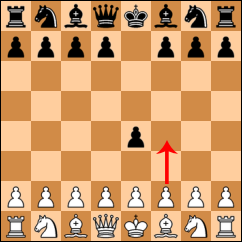
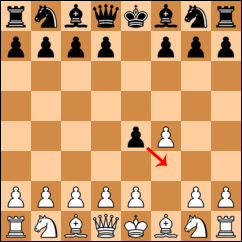
    En Passant Rule in Chess
    En Passant Rule in Chess


    En Passant Rule in Chess
    That does it for the rules you absolutely need to play. There are more obscure rules, like the 50 move rule, the insufficient mating material rule, and the infamous "infield fly" rule, but they aren't that important for someone just starting out in chess. Nobody likes a rules lawyer anyways.
    Now some basic ideas behind the game!!!
    Let's start with the famous quote 
    "Checkers is for tramps" - Paul Morphy
    If you're a thrill seeker with a paranoid streak, chess may be the game for you. After all, a 2002 study concluded that "unconventional thinking and paranoia" characterize competitive chess players, two attributes the study also noted as characteristic of thrill-seekers like daredevils and skydivers. So remove the tinfoil hat and put away the bungee cord, because it's time to learn how to play chess.
    Playing a decent game of chess is easy, once you have some basic knowledge:

    1. Know how the pieces move and the rules

    I'm going to assume you know these. But do not stop reading just because you've forgotten how the horsey moves, or you don't know what Castling, Pawn Promotion or En Passant are.

    2. Know the values of the pieces

    You can't play chess unless you know how much your pieces are worth. Once you do, you'll know when to exchange pieces and when to retreat. With the exception of the king, whose life is priceless, all the pieces have a point value. Although these values can change slightly depending on specific circumstances, they're usually accurate. The basis for the value of the other pieces is the pawn, valued at one point. Next come the knight and bishop. In some positions the bishop thrives while in others the knight dominates, but overall, they're worth about three points each. The rook is slightly more valuable, at five points. Finally we have the best piece of all, the queen. She's worth 9 points. Her sentimental value to the king is negligible (win or lose, she always comes back to him).
    So we've got pawn = 1, bishop/knight = 3, rook = 5, queen = 9
    Whenever you're considering trading pieces, know the values. Don't give up a rook for a bishop or knight. But, if you can get a bishop and two pawns for a rook that's fine ( bishop (3) + two pawns (2) = rook (5)). It's even slightly better since quantity of pieces is a good tiebreaker.
    Note: The next three points are general chess principles that all players need to remember.

    3. Play to control the center

    This is a big one. The "center" refers to the four center squares on a chess-board.


    Control the center
    Almost everything that happens on the board will involve traveling through one of these four squares. A player with uncontested control of the center has a huge advantage. You can either occupy this region with pawns or attack it with pieces...it doesn't matter as long as you've got something going on in the middle of the board. To illustrate the importance of the center, compare a knight in the middle of the board with one in the corner. The knight in the corner can only move to two squares, while the one in the center can move to eight.


    Knight in the cornerKnight in the middle

    4. Develop your pieces

    You can't win a game of chess without bringing out your pieces. I often see beginning players develop their most powerful piece, the queen, and shuffle it around, hoping to capture wayward enemy pieces. This is like playing football with only the quarterback...boneheaded. Mobilize your pieces rapidly, especially the bishops and knights. Since they can maneuver through cluttered positions, they function especially well early in the game.

    5. Protect the king

    This one should be obvious. The game ends if you're checkmated. But how do you protect the king? Well it's easy. Castle. Since everything goes through the center, a king in the center of the board won't survive long. Tuck him away in the corner. Leave the fighting to his better half.
    Note: the more of these three rules of thumb you can follow during the opening, the better. Don't play moves that only control the center or blindly develop your pieces. Try to do both at the same time. Even better, control the center, develop your pieces, and protect the king all at once.

    6. Take Pieces

    Every move, check to see if you can capture any opposing pieces. If you can, consider the point values and choose a course of action. Most people play chess like boobs-they'll put their pieces unprotected where you can take them.

    7. Look for Double Attacks

    Better players won't just throw their pieces away. You'll have to win them. That's where double attacks come in. Since a player is only allowed to move one piece at a time, meeting two simultaneous threats is very difficult. For this reason, making two threats at once, also known as executing a double attack, constitutes the most basic tactical idea. To illustrate the double attack's power, we'll examine the knight fork:


    Look for the knight fork
    Here is a successful knight fork
    Additionally, double attacks usually revolve around undefended enemy pieces. If you can spot two undefended pieces and attack them at once, you're guaranteed to win one. So when you're considering where to move, watch for undefended pieces.

    8. Watch for Checks

    Before moving, look to see if your opponent has potential checks. Since a check is the most forcing move, it can lead to heaps of trouble. If you spot a possible check, make sure it doesn't create a double attack (like checking your king and attacking an undefended piece at the same time) or lead to other trouble.


    Avoid leaving your king in a spot where it can be checked like this

    Conclusion

    If you follow these guidelines, you'll be able to play a decent game of chess. Congratulations, you've just taken the first step on the road to paranoia, misanthropy, and madness.

    Subscribe to Chess Blog | The Pulse of Chess     If you liked the article kindly Digg it, Stumble it, Add to Technorati, bookmark it and please consider subscribing through  "Subscribe by Email"  and have articles & a  Everyman Chessbase eBook delivered right to your inbox! OR "Subscribe to Chess Blog Feed" in a Fead Reader of your choice OR Subscribe to "SMS Alerts" & Get Article Headlines & Updates delivered to your Mobile Phone for free.

    Continue Reading...»
    Bookmark | Share This Post
    Digg Stumble This Del.icio.us Mixx Furl Propeller Simpy Live Twitthis Add To Slashdot Spurl Google Yahoo Reddit Technorati Blinklist Blogmarks Smarkings Ma.gnolia SphereIt Sphinn Feedmelinks
    Related Articles


    Related Article Widget by Hoctro