Loading
Drastically Improve Your Chess
Upgrade to a FileSonic Premium account and download at incredible speed!

This is default featured post 1 title

Go to Blogger edit html and find these sentences.Now replace these sentences with your own descriptions.This theme is Bloggerized by Lasantha Bandara - Premiumbloggertemplates.com.

This is default featured post 2 title

Go to Blogger edit html and find these sentences.Now replace these sentences with your own descriptions.This theme is Bloggerized by Lasantha Bandara - Premiumbloggertemplates.com.

This is default featured post 3 title

Go to Blogger edit html and find these sentences.Now replace these sentences with your own descriptions.This theme is Bloggerized by Lasantha Bandara - Premiumbloggertemplates.com.

This is default featured post 4 title

Go to Blogger edit html and find these sentences.Now replace these sentences with your own descriptions.This theme is Bloggerized by Lasantha Bandara - Premiumbloggertemplates.com.

This is default featured post 5 title

Go to Blogger edit html and find these sentences.Now replace these sentences with your own descriptions.This theme is Bloggerized by Lasantha Bandara - Premiumbloggertemplates.com.

Most In-depth Study ( Must Have )

Friday, March 26, 2010

Rook Endgames - Checking from the Side - Lesson 5

Checking from the Side
Let's look at another important technique available to the rook.
You should recall that two moves into second example of the previous post 'Rook Endgames - Rook Behind Passed Pawns - Lesson 4' we reached the following position:

TIP: Whilst it is usually best to activate a rook from behind, occasionally consider sideways checks.
Attack The King - A Complete Chess Portal
If you liked the article kindly Digg it, Stumble it, Add to Technorati, bookmark it and please consider Subscribing by Email  and have articles delivered right to your inbox! OR Subscribe to Attack the King Feed in a Fead Reader of your choice OR Subscribe to SMS Alerts & Get Article Headlines & Updates delivered to your Mobile Phone for free.

Rook Endgames - Rook Behind Passed Pawns - Lesson 4

Rooks belong behind Passed Pawns
There, I'm even repeating it now so as to help you commit it to memory!
In the following example there is a very dangerous black pawn that is ready to promote. Having spent a lot of time with juniors I notice that they place a lot of comfort value in blocking passed pawns.

NOTE: The underlying theme is that rooks like to be active and they can do that best from behind passed pawns.

Lets move on to the next example.How to stop that pawn?


Now lets continue with the above example.
NOTE: A draw is better than a loss!

Bearing in mind this rather obvious remark, in fact White has numerous ways in which to avoid defeat.Explore it with the following example.


That's it for now.Stay tuned...there is much more to come!


Attack The King - A Complete Chess Portal
If you liked the article kindly Digg it, Stumble it, Add to Technorati, bookmark it and please consider Subscribing by Email  and have articles delivered right to your inbox! OR Subscribe to Attack the King Feed in a Fead Reader of your choice OR Subscribe to SMS Alerts & Get Article Headlines & Updates delivered to your Mobile Phone for free.

Rook Endgames - Limitations of a King - Lesson 3

Every King Should Know its Limitations.
Just as every man must know his limitations (well according to Clint Eastwood), the same must be true of kings. Actually, I guess it is the man (or woman) operating the king that matters.In all endgames it is advisable to get your king into the thick of the action rather than watching from the sidelines. However... Every King Should Know its Limitations but anyway take a look at the next example.

WARNING: The king is a great piece, but it is also a slow one.

Kings really are awesome pieces. Only the queen can control every square within touching distance of itself (as a king does), and thus when it appears on the scene it has a massive impact. The problem invariably is getting it on the scene.
TIP: Centralize your king.
This tip is universal advice to all endgames based on the premise that the king can access any part of the board in the quickest time when positioned here which is depicted in the following example.

TIP: Rooks belong behind passed pawns.
I offer this tip now but I can assure you that it will be a recurrent theme throughout these lessons.
Hope you enjoyed. See you next time. Stay tuned!
Attack The King - A Complete Chess Portal
If you liked the article kindly Digg it, Stumble it, Add to Technorati, bookmark it and please consider Subscribing by Email  and have articles delivered right to your inbox! OR Subscribe to Attack the King Feed in a Fead Reader of your choice OR Subscribe to SMS Alerts & Get Article Headlines & Updates delivered to your Mobile Phone for free.

Rook Endgames - The Monster King - Lesson 2

The ‘Monster’ King

'King and pawn endings, minor piece endings, rook endings, queen endings; what do they all have in common?' I once recall asking a class of juniors. I was prepared for the sarcastic answer 'They're all endings!' but not by the particularly witty response 'They're all boring!' Regarding the latter, some may think that way, but they are usually the individuals who throw away a lot of their hard opening and middlegame work by not making the most of the pieces that remain in the endgame.
The point I was really hoping to make is that all endgames involve kings. Although we spend the early part of the game tucking away our own king into safety and planning devious ways to attack the enemy monarch, there comes a stage in every game where one decides that checkmate is no longer a reality and it could be time for the king to start pulling its weight like every other piece.

'King and pawn endings, minor piece endings, rook endings, queen endings; what do they all have in common?' I once recall asking a class of juniors. I was prepared for the sarcastic answer 'They're all endings!' but not by the particularly witty response 'They're all boring!' Regarding the latter, some may think that way, but they are usually the individuals who throw away a lot of their hard opening and middlegame work by not making the most of the pieces that remain in the endgame. The point I was really hoping to make is that all endgames involve kings. Although we spend the early part of the game tucking away our own king into safety and planning devious ways to attack the enemy monarch, there comes a stage in every game where one decides that checkmate is no longer a reality and it could be time for the king to start pulling its weight like every other piece. Of course an art in itself is knowing exactly when that time is, but in the  subsequent lessons on rook and pawn endgames I can safely say that it's all the time!
See here how both kings are ready to have a field day with the enemy pawns.

Rook_Endgame/the monster king 1.pgn


NOTE: Generally in endgames it is usually deemed a good idea to try and create a passed pawn as soon as possible. The outcome of this particular position depended on the tempi situation and, specifically, whom it was to move. White started and was always favourite in the race to promote a pawn. Note that in accordance with the previous note, Black would have had a better (but still not good!) practical chance with 3...b4 4 axb4 a4. All that is 'king and pawn' endgame territory, where tempi are absolutely vital. Devoid of a rook or two this position is not of so much interest to the following lessons of this  series but I just wanted to make the point that when a king is on the case there are few pieces that are as effective. 
TIP: The king is a tremendous piece. Use it!

In all endgames it is advisable to get your king into the thick of the action rather than watching from the sidelines. However every king should know its limitations. And what that means will be dealt in the next lesson. I urge followers to leave their views on the limitations of a king. 
Hope you enjoyed. Stay tuned for more...

Attack The King - A Complete Chess Portal
If you liked the article kindly Digg it, Stumble it, Add to Technorati, bookmark it and please consider Subscribing by Email  and have articles delivered right to your inbox! OR Subscribe to Attack the King Feed in a Fead Reader of your choice OR Subscribe to SMS Alerts & Get Article Headlines & Updates delivered to your Mobile Phone for free.

Rook Endgames - Lesson 1 - Introduction

There is no doubt that rook and pawn endings are a useful part of the game for every player to get to grips with. I often criticize juniors for castling in the opening but then not bothering to activate their rooks in the middlegame. Their assumption always seems to be that the minor pieces will do battle early on, and if the game is still going, then the rooks will come out to play later. Of course they should be trying to create ‘pawn breaks’ from the opening onwards in order to activate the ten-points-worth of firepower, but sometimes it’s like talking to a brick wall! Perhaps I’m being a bit harsh, but the fact still remains that at lower levels rooks are generally under-achievers in the middlegame and, with this non-confrontational approach, they are naturally the survivors. Hence rook endings tend to be the most common endgame type to arise.

By the way, that’s just single rook endings (or rook versus pawns). I haven’t said much on double rook endgames, partly because they are so rare and partly because the same principles apply, but twofold! Joking aside, the one assumption I have made for this series of tutorials is that the reader knows how to deliver checkmate with a king and rook against a bare king. With two rooks apiece the main difference is that the partnership is able to deliver checkmate without the aid of its monarch. They provide twice as much firepower and thus frequently enjoy doubling on the seventh rank and open files. Regarding the latter, that’s where more typically one pair is exchanged off, thus returning to the realms of these lessons.

There is a famous saying that ‘all rook endings are drawn’. This generalization is highly dubious, but as you work your way through the chapters you will begin to understand its basis. The fact is that, next to opposite-coloured bishop endings, your best chance for a share of the points when you are a pawn down is in a rook endgame. Indeed, that is reflected in the many examples that I use in which the defender salvages a draw thanks to active play and overall employment of the basic ideas I put forward. It’s probably true that the majority of rook endings do finish as draws but it’s one thing ‘knowing that’ and another ‘knowing how to’!

And at this point I suggest that you ‘get knowing’! Please work your way through the lessons and upon completion you will be armed with the required techniques to handle rook and pawn endgames. Then you can start out in something else!

Good luck!
Attack The King - A Complete Chess Portal
If you liked the article kindly Digg it, Stumble it, Add to Technorati, bookmark it and please consider Subscribing by Email  and have articles delivered right to your inbox! OR Subscribe to Attack the King Feed in a Fead Reader of your choice OR Subscribe to SMS Alerts & Get Article Headlines & Updates delivered to your Mobile Phone for free.

Thursday, January 1, 2009

Search Results


Saturday, December 27, 2008

The Ruy Lopez for White - Open Lopez Part 2

Hello everyone,

Last time we had studied Variation A in the Open Lopez. Hope the main concept of the Open Lopez is clear in your head by now.

We will move forward and today we will study Black's 9th move alternative, Variation B: 9...Be7. Now this Variation has two sub-variation as Black's 12th move alternatives.

Let's start with Variation B1: 12...0-0:

Ruy_Lopez/Variation B1.pgn


Now let's move onto the next reply, Variation B2: 12...Qd7:

Ruy_Lopez/Variation B2.pgn


So, this was Black's second 9th move alternative. Hope you have enjoyed. Next time we will start discussion on Black's third 9th move alternative.

Keep visiting and keep reading. 

Thanks a lot. Enjoy!!
Subscribe to Chess Blog | The Pulse of Chess     If you liked the article kindly Digg it, Stumble it, Add to Technorati, bookmark it and please consider subscribing through  "Subscribe by Email"  and have articles & a  Everyman Chessbase eBook delivered right to your inbox! OR "Subscribe to Chess Blog Feed" in a Fead Reader of your choice OR Subscribe to "SMS Alerts" & Get Article Headlines & Updates delivered to your Mobile Phone for free.

Saturday, December 20, 2008

The Ruy Lopez for White - Open Lopez Part 1

Hello everyone,

We have completed our study of the Moller and Arkhangelsk Variations in our last post. Hope you have it clear in your head by now.

Today we will start a new chapter in the Ruy Lopez, the Open Lopez. This is a little bit different from what we have seen in Berlin Defence, Deffered Steinitz and the recent Moller and Arkhangelsk Variations. Lets see how it goes:

1 e4 e5 2 Nf3 Nc6 3 Bb5 a6 4 Ba4 Nf6 5 0-0 Nxe4


With 5...Nxe4 Black basically chooses dynamic counterplay over solid defence . He makes space for his pieces to develop onto active posts and squashes any thoughts White might have of applying the 'Spanish Torture' so often seen in the closed defences .

However, there's a certain price to pay for all this activity. The position becomes open quite quickly and in order not to suffer a quick onslaught down the e-file, Black is forced to compromise his pawn-structure someWhat, leaving White with potential targets to exploit in the middlegame. Nevertheless, the Open Defence has Its fair share of supporters. Viktor Korchnoi is probably its most famous adherent, while of the new generation of top players one could point to Vishy Anand, who employed it in his 1995 World Championship clash with Kasparov and has continued to use it since.

The Strategic Starting Position


This is the typical position, which is reached after 8 moves of the Open Lopez. The first thing to notice is that Black 's pieces occupy active squares. Given a few free moves, Black would probably continue with ...Bc5, ...0-0 and perhaps ...f6, to create a semiopen f-file and attack the f2-square. It goes without saying that White must act energetically in the diagram position, else Black could easily take over the initiative once he has completed his development. Here I'm advocating the move 9 Nbd2, which was made popular by Anatoly Karpov. One of White's main ideas is to put immediate pressure on Black's strong knight on e4. This pressure can be enhanced with such moves as c3 and Bc2 . Black is asked very early on what to do with this knight.

Black Supports the Knight with ...f5


Black has just played 11...f5, lending support to the under-fire knight. White now has a big decision to make : whether to capture en passant, or to play around the knight and concentrate on the weaknesses in the black camp. On this occasion the main theoretical move is 12 Nb3 (instead of 12 exf6). After 12...Qd7 White can use a tactical trick to justify the move 13 Nfd4. Now 13...Nxe5? 14 f3 Nc5 15 Re1 Nc6 16 Nxc6 Qxc6 17 Nd4 Qd7 18 b4 drops a piece, so the normal continuation is 13...Nxd4 14 Nxd4 c5 15 Nxe6 Qxe6 16 f3 Ng5 17 a4 , when White is slightly better (see the theory section for more on this position).

Black Moves the Knight


On this occasion Black has retreated his knight to c5, where it controls some important squares . One of White's major plans in this position involves the usual knight manoeuvre with (after Re1) Nf1-g3/e3 . White's pieces would then point impressively at the black kingside. In addition, White has the e5-pawn as a spearhead, so it's easy to see that White can often build up a menacing attack against the black king. White also often plays Nb3, challenging the c5-knight. If this is exchanged, it clears the way for the white queen to go to d3, where it sets up a powerful battery with the bishop against the h7-pawn .
For the reasons outlined above, Black often delays castling in favour of first improving the position of his pieces . For example, Black often plays the move ...Bg4, giving White a pin to think about. This bishop can also be re-routed via h5 to g6, in order to blunt White's attack along the b1-h7 diagonal. This also leaves the e6-square vacant for the knight to hop back and completely block the e5-pawn. Another common feature is Black doubling behind the d-pawn with ...Qd7 and ...Rd8. The idea of this is not only to add extra support to the oftenvulnerable d5-pawn, but also to facilitate a possible ,..d4 advance. Of course the strength of this advance is always dependent on the placing of the various pieces, but a successful ...d4 will completely free Black's position .

Now let's move on to the different lines in this Variation. There are typically three different lines revolving around Black's 9th move alternatives, which again have different sub-variations based on Black's 11th and 12th moves.
Let's start with Variation A: 9...Bc5
Ruy_Lopez/Variation A.pgn

This is how it goes. We will study Variation B in our next post.
Keep visiting and keep reading.
Thanks a lot. Enjoy!!
Subscribe to Chess Blog | The Pulse of Chess     If you liked the article kindly Digg it, Stumble it, Add to Technorati, bookmark it and please consider subscribing through  "Subscribe by Email"  and have articles & a  Everyman Chessbase eBook delivered right to your inbox! OR "Subscribe to Chess Blog Feed" in a Fead Reader of your choice OR Subscribe to "SMS Alerts" & Get Article Headlines & Updates delivered to your Mobile Phone for free.

Monday, December 15, 2008

December 2008 Chess Puzzle Contest

From now on we will be holding "Puzzle Contests" every month. You have to solve the puzzles and comment on relevant posts with the move sequence. Each month we will randomly pick a maximum of 2 commenters with correct solutions who will get a surprise gift delivered to their inbox( you have to leave your email address here ). Now what's the gift? If you are one of our email subscribers then you already got our subscription gift...isn't it? Well the prize for the contests will be something like that ( but not Everyman ebooks). Common solve it & comment & you will know .
Every month's top commenter is also eligible for the prize even if he/she is unable to solve the puzzle.

Lets move on to the puzzle of this month....


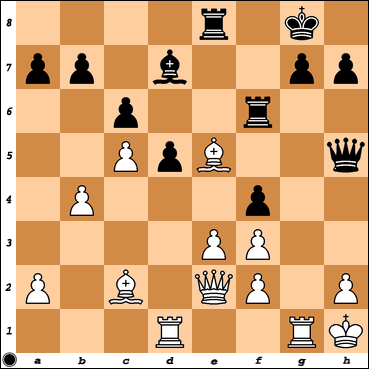
December Chess Puzzle Contest


This position is from Burn - Teichmann, Hastings 1895. White's doubled pawns on the f-file hamper him in his attempts to defend his king.How did black exploit this? Black to play.You have to find the best sequence of moves that leads to mate.
Leave you solutions here with your email address. Entries after this month are not eligible for the contest. So what are you waiting for? It's time for your neurons to do some calculations...


Subscribe to Chess Blog | The Pulse of Chess     If you liked the article kindly Digg it, Stumble it, Add to Technorati, bookmark it and please consider subscribing through  "Subscribe by Email"  and have articles & a  Everyman Chessbase eBook delivered right to your inbox! OR "Subscribe to Chess Blog Feed" in a Fead Reader of your choice OR Subscribe to "SMS Alerts" & Get Article Headlines & Updates delivered to your Mobile Phone for free.

Don't forget to subscribe to the thread for tracking replies