Go to Blogger edit html and find these sentences.Now replace these sentences with your own descriptions.This theme is Bloggerized by Lasantha Bandara - Premiumbloggertemplates.com.
Go to Blogger edit html and find these sentences.Now replace these sentences with your own descriptions.This theme is Bloggerized by Lasantha Bandara - Premiumbloggertemplates.com.
Go to Blogger edit html and find these sentences.Now replace these sentences with your own descriptions.This theme is Bloggerized by Lasantha Bandara - Premiumbloggertemplates.com.
Go to Blogger edit html and find these sentences.Now replace these sentences with your own descriptions.This theme is Bloggerized by Lasantha Bandara - Premiumbloggertemplates.com.
Go to Blogger edit html and find these sentences.Now replace these sentences with your own descriptions.This theme is Bloggerized by Lasantha Bandara - Premiumbloggertemplates.com.
Openings Encyclopedia 2010 is an excellent tool for studying the openings, building opening repertoire and fast 4,200,000 games database searching.
This excellent program for learning chess openings includes theoretical material on every opening, a user-friendly and detailed classification of variations, a quick search option and an option for analyzing games and positions.
There are two ways of studying an opening: by looking through encyclopedic tables for chosen openings or variations and by moving along a Chess Tree displaying expert evaluations of a current position.
The material on openings is based upon about 500 000 of expert evaluations, 8000 annotations to key moves by Grandmaster Kalinin, about 40 million of evaluations obtained in the course of analysis of key positions by Rybka program, and a base of 4,2 million games as of April 1, 2010. A Rybka 2.3 program is integrated into the Encyclopedia with a possibility of simple connection to Rybka 3 and 4 or other UCI and Winboard engines. A powerful system of search according to player’ name, position, positional element, motif and material correlation is supported.
A test of opening mode will allow you to test your knowledge and your skill of playing in your chosen opening against the program and to obtain recommendations automatically.
Language versions: English, German, Spanish, French, Italian, Russian
System requirements: PC, 128 MB RAM, 2.5GB of free disk space, Windows 7/XP/Vista/2000.
Features
Extensive Opening Databases
Openings Encyclopedia 2010 has all the data needed to support your opening studies right at your fingertips:
* A game database with 4.2 million games.
* Over 8,000 text annotations from GM Kalinin
* Over 500,000 expert evaluations of key opening positions.
* Over 40 million opening positions analyzed by Rybka.
Opening Tables Opening tables are a powerful tool, which complements the move tree and present the theory in a familiar format. As the opening tables are dynamically generated, you can create a table for any position. You can add your own moves, variations and annotations to opening tables.
Opening Classifiers: Overview of Openings and Variations Classifiers allow you to view the variations covered by Openings Encyclopedia 2010 through a Windows Explorer style interface. If you want to study a particular variation, just double click on its folder in the classifier.
Tree Display Openings Encyclopedia 2010 also uses position databases, which has several advantages over traditional game databases. A tree representation gives you an overview of the current positions, which moves have been played or analyzed in the position and performance statistics. The tree catches all transpositions.
If you liked the article kindly Digg it, Stumble it, Add to Technorati, bookmark it and please consider Subscribing by Email and have articles delivered right to your inbox! OR Subscribe to Attack the King Feed in a Feed Reader of your choice OR Subscribe to SMS Alerts & Get Article Headlines & Updates delivered to your Mobile Phone for free.
A few days ago Vishy Anand was interviewed on Playchess after his successful retention of World Chess Title in Sofia against Veselin Topalov. Short transcripts of the interview was published by Chessbase in two parts which you can read here & here.
The team of World Championship challenger Veselin Topalov reportedly spent a large sum of money to secure a 112 core computer cluster running at mind boggling speed. "How did the reigning champion counter this awesome hardware advantage," when asked Anand answered this question in a candid and very detailed interview broadcast Playchess. He used a human cluster!
We now bring you whole interview in video format which is only available to premium members on Playchess.
If you liked the article kindly Digg it, Stumble it, Add to Technorati, bookmark it and please consider Subscribing by Email and have articles delivered right to your inbox! OR Subscribe to Attack the King Feed in a Feed Reader of your choice OR Subscribe to SMS Alerts & Get Article Headlines & Updates delivered to your Mobile Phone for free.
Rybka 4 Aquarium Opening Book provides latest chess theory approved on millions of advanced chess games and matches of top human players. It includes over 18,000,000 positions.
Rybka 4 Aquarium Opening Book is a thoroughly researched and up to date collection of modern opening lines. It can be used as an opening book in chess engine matches, an opening guide in correspondence chess, as well as a source for general opening studies and tournament preparation by players at all levels.
The author of the book, Jiri Dufek, is one of Veselin Topalov's seconds in his world championship match against Viswanathan Anand (Sofia 2010). He is one of the top freestyle players in the world, and an International Master of correspondence chess.
The opening book is based on a careful selection of the most important theoretical games, both by human players and chess engines. All variations were carefully reviewed and moves were classified and color coded with green color (recommended moves), red (not recommended), blue (recommended for human tournaments but not computer tournaments) and black (neutral moves). If you want to build a successful opening repertoire, based on active but solid lines, this is the opening book for you!
As a special bonus from ChessOK, the book includes chess trees (positional databases) containing computer evaluations of the moves in the book and statistics showing their popularity in human games and in correspondence play. The trees also show changes to the popularity of moves in the past year.
The book is specially designed to use all the advantages of navigation in multi-column tree view of Rybka Aquarium GUI.
In the following interview published at Chesscafe Jiri Dufek talks about his book.
These are exciting announcements for Rybka and Aquarium users. It has been a long wait for Rybka 4, but it will be worth it. With Aquarium now being used at the highest levels of chess competition, it is bound to catch the attention of many new players. However, the subject of this column is the Rybka 4 Aquarium opening book, which was prepared by Rybka team member Jiri Dufek.
Jiri Dufek
Jiri has been playing chess since the age of six, when his grandfather taught him how to play. He holds a title of national master, as well as being an international master of correspondence chess. His hobbies include computer chess and collecting chess books. He has authored the opening books for Rybka's official competitions where his choice of solid but active repertoire, often involving little explored lines, proved to be a great success. He has also been very successful in freestyle chess, with his latest triumph being a victory in the Mundial Chess tournament earlier this year. Jiri wrote the book Bijte francouzskou! (Beating the French) along with his friend and long-time associate IM Roman Chytilek. Jiri no longer plays over-the-board chess, but focuses instead on opening analysis and chess analysis in general. Jiri is an IT system administrator by profession. With this background, and his obvious passion for chess, Jiri is clearly an ideal team member of any chess or computer-chess team.
Jiri was kind enough to answer some questions regarding the new Rybka 4 opening book, but I couldn't resist also asking him about his work for Veselin Topalov in the world championship match against Viswanathan Anand and the analysis tools he used in the match.
Dadi Jonsson: You are in the enviable position of being a member of the Rybka team, as well as Topalov's analysis team. Additionally, you are the only new member of the Topalov team in his match against Anand. What is the story behind you joining the Topalov team?
Jiri Dufek: As a reward for my result in the Mundial Chess freestyle tournament, I was invited to the Linares tournament site to play a game against Veselin Topalov. During my stay in Linares, I met Veselin's seconds – Jan Smeets and Erwin l'Ami. After my game against Topalov, which ended in a draw, I also got a chance to speak to the master himself.
Veselin Topalov vs. Jiri Dufek
Veselin Topalov vs. Jiri Dufek
We discussed chess in general, openings, chess engines and the differences between human chess and the world of chess engines. Shortly after I returned home, I recieved an invitation from Silvio Danailov to join Topalov's team for his match against Vishy Anand.
DJ: I am sure that your expert opening knowledge played a big role in Topalov's decision to ask you to join his team. However, knowledge of computers and advanced analysis methods plays a larger role now than in any previous world championship match. Do you think that your extensive experience and knowledge in these areas also factored in Topalov's decision?
JD: This question is more complicated than it looks at first sight. Firstly, Topalov and grandmasters in general have their own ideas on how to play the openings. Their priorities are completely different from those normally applied when preparing opening books for chess engine matches. There is no interest at all in long lines that may lead to a draw after dozens of precise moves. Memorizing lines is difficult and time-consuming, with little hope of practical reward. It is simply a bad investment of match preparation time. Therefore, a good chess engine book author is not automatically a good assistant for human opening preparation. He must be flexible and adapt to the different requirements.
Secondly, I often checked existing analysis, looking for improvements or used "my methods" to analyze lines, which were considered important for the match. In each instance my conclusions agreed with the analysis of the other team members. The quality of opening analysis at this level is extremely high, but of course every team member makes an important contribution to the preparations. I have the greatest respect for the other team members. They have proven time and again that they are second to none in opening preparations and more than once they have stunned the chess world with their opening novelties.
Thirdly, my computer background has allowed me to provide IT support for our team. You could say that I have been the team's "IT Department."
Veselin Topalov and Jiri Dufek
DJ: Your Rybka 4 Aquarium opening book will be released soon. It is clear that you put a huge amount of work into the book.
JD: Yes, I put a lot of work into it. It helps that I find it really interesting to analyze unknown positions and ideas from chess books, chess practice, and computer games to find my own solutions. Today's opening preparation is very deep. In some cases players know their lines from the opening all the way to the endgame. A less prepared opponent will probably lose his way somewhere in the middlegame against such preparation. Things are looking even worse in computer games – long lines, often fifty moves or more, leading to a draw are similar to pre-arranged draws in human games.
The technical advances mean that opening analysis is very different from a few years ago, not to mention a few decades ago. However, even with today's amazing computer tools, the work of the modern opening book author is still very demanding.
My method of creating a strong opening book consists of several steps. Assuming you already have a good database, the first step is the selection of games. Making a good hand-typed book is impossible. The selected games serve as the "raw material," and generate the initial version of the book. This step may only require a few hours of work. The next step is to fine-tune the move priorities. This is a very time consuming task, and in the case of the Rybka Aquarium book, it took a few weeks.
Testing the book is an independent process. First you run a test, then you look at the results, and try to find weak points in the book. After further analysis, you may find some improvements, which require updates to the book and another test cycle must be run. This process will take a few days.
Last, but not least is the creative phase of making an opening book. Here you need to find new ideas and get a deeper understanding of the lines in the book. One recurring question in this phase is why engines give a low evaluation, or play poorly in positions that are very good according to my own understanding of the position. This phase is not only very time consuming, it also needs a lot of creativity and manual interaction and guiding of the engine analysis.
DJ: You made a very successful opening book for Rybka-Cluster. Did some secrets from that book make it into the Rybka Aquarium opening book?
Rybka Cluster currently runs on 13 powerful computers
JD: Yes, I moved priorities from the tournament book that I used with Rybka-Cluster to the Aquarium book. It is safe to say that the Aquarium book includes around ninety-five percent of the Rybka-Cluster book that I used in official tournaments. However, the Aquarium book is much larger and contains a lot of new material and analysis, up-to-date games, etc.
DJ: How would you describe your opening book? Is it a "narrow" book, covering a few selected openings deeply or is it a "wide" book containing most openings that arise in practice?
JD: Generally, the book is relatively wide, covering many openings and variations. I wanted to offer two different ways of playing every opening, but sometimes I ended up with only one, because I felt that it was the best way to handle the position.
A narrow book might score pretty well in the short term, and I would have chosen that path if a high score in engine matches was my only goal. However, I wanted the Rybka Aquarium book to address the needs of a much wider audience, which means that a much greater number of openings must be covered. This is why I added many openings that are popular in human play. The variations are color coded with green color (recommended moves), red (not recommended), blue (recommended for human tournaments, but not computer tournaments) and black (neutral moves). Aquarium allows users to juggle the move priorities based on the color codes, so it is easy, for instance, to use the book as a "tournament book" in chess engine matches.
Although I have a wide range of users in mind for this opening book, I am not sure that it will suit everyone. The first group I am targeting is, of course, Rybka users and chess engine fans in general. They will find up-to-date information about their openings. The second group would be everyone who wants something new, be it new opening ideas or new opening setups. Last, but not least, I tried to make it a thoroughly researched and up-to-date general opening guide for the tournament player. Though I think it might even be useful for grandmasters, I think they haven't caught on to the opening developments in the chess engine world and still prefer their current methods of opening preparation. On the other hand, I would be extremely interested in getting feedback from grandmasters. Perhaps it will be useful for my next opening book.
From the white side, the main repertoire of the Rybka Aquarium book is based on the Sicilian Najdorf Variation with 6.Be2/h3/Be3/Bg5, Caro-Kann with 3.e5, Ruy Lopez, French with 3.Nc3 and 3.e5, Catalan, classical King's Indian Defense with 9.Ne1 and 10.Be3, the Exchange Variation of the Grünfeld Defense, Nimzo-Indian Defense with 4.f4, etc.
For black there is the Sicilian Kan Variation (e6+a6), which proved to be very successful for Rybka-Cluster in official tournaments, the Sicilian Najdorf Variation and the Rauzer Variation with Bd7, Caro-Kann and Ruy Lopez (Berlin Wall and Jaenisch). After 1.d4, there is the Grünfeld Defense and a lot of Slav Defense (Chebanenko 4...a6) and Semi-Slav analysis as well as the Nimzo-Indian Defense – where I used my openings from the Rybka-Cluster opening book.
DJ: When Jeroen Noomen's opening book for Aquarium was released he said that "IDeA is the best opening book tool at this moment." Do you use IDeA in your opening analysis?
JD: Yes, for opening analysis there is no better solution, because it allows you to find some very interesting, "non-human" continuations that would be hard to find otherwise. I emphasize quality over quantity, so I prefer to give the engines a longer time for the analysis of each position – this mean that I use automatic IDeA tree expansion, and, as the analysis progresses, I check analysis tree, compare the results with my own notes and decide which positions are important and analyze them more deeply. For analyzing the middlegame I still use my own, much simpler methods, to decide which move to play, but my IDeA analysis is constantly running.
DJ: Do you use the new features of IDeA in Aquarium, such as remote engines?
JD: I really like the option to use remote chess engines. It is small revolution for IDeA and it really works! For critical positions I run the analysis from my PC connected to approximately forty remote engines, located in four different places of the world. For smaller projects I often use slower computers with only local engines.
DJ: Did you develop the Rybka 4 Aquarium book using the opening book tools of Aquarium itself?
JD: I use Aquarium both because it allows very fast addition and editing moves in the book and while I am doing that I can have chess engines analyzing one or more positions in the background. Aquarium has many advantages and useful features for the serious player, such as for analyzing individual positions or whole games; it is also good for basic work with databases and of course the option to use remote engines for analysis. On the other hand, features such as playing against the engine are of no use to me, regardless of the GUI (smile).
DJ: Which opening line did you spend the most time on?
JD: It is very difficult to answer. Probably the Sicilian Najdorf was the most time consuming, but still I am not one hundred percent sure about truth in this opening. I probably got the biggest kick out of analyzing the Jaenisch Gambit in the Ruy Lopez, because very often the best moves according to the chess engine are not really the best.
But this is not all. I added about 700 variations to the book in different openings, many of which are seldom seen in tournament books. The main purpose was to make the Rybka Aquarium book more useful for players. In other words, there are continuations of sidelines that improve existing theory or recent games – look and you will see!
DJ: Can you show us a few interesting novelties from the book?
JD: Sure. There are many to choose from, but I'll start by showing my oldest novelty, which dates all the way back to 2004.
I am a very big proponent of the Benoni, but now the only top player who likes it is GM Gashimov. There is a recent theoretical book about interesting ideas in the Benoni and I checked a few of them. However, let's first look at a very aggressive line:
And now the rook lift 14.Ra3! looks very unpleasant for black.
[B80] Sicilian Defense
I wanted to skip the Sicilian Najdorf, but it was not possible, of course. It was really torture for me. In the end, I found a totally new way of playing one of the main lines, which is now under extreme pressure.
I am a big fan of the French Defense. However, in recent months Black's life has not been so simple. Here is another source of worry for Black: a little bishop move and Black has problems to solve.
The Rybka Aquarium book includes full coverage of the Jaenisch Gambit – everything is engine-checked and I made a lot of new analysis to support this interesting opening. Here are some "normal" (remember that this is the Jaenisch!) positions covered by the book:
With compensation.
Equal.
Large advantage to Black.
[C92] Ruy Lopez. Zaitsev Variation
From time to time I tested my book on Playchess. I was surprised, when I found the following line to be very popular.
This looks pretty dubious for Black. However, Black scored about sixty-six percent after the "normal" continuation 19.Nf1 f5!. When I first saw this method of playing, I felt that there had to be a simple countermeasure. I think that I succeeded in finding a simple solution, although finding it took more time and effort than I had expected.
19.Nh2! c4 20.Rg3! with very strong attack, but you can check the full analysis after 19.Nh2 in the book.
[D27] Queen's Gambit Accepted
The Queen's Gambit Accepted is very popular nowadays, and often white players choose strange sidelines, because the mainline is holding for Black. This is not true after
Here White has the subtle move 16.Rfd1! and you can check the Rybka Aquarium book to see that life is very hard for Black after 13.Ng5.
[D44] Semi-Slav, Botvinnik Variation
The Botvinnik system has been a popular opening for the last thirty years. The theoretical debate is very, very deep and it looks like it will soon end in a simple endgame. The Rybka Aquarium Book includes the latest development of this line. After the moves
1.d4 d5 2.c4 c6 3.Nf3 Nf6 4.Nc3 e6 5.Bg5 dxc4 6.e4 b5 7.e5 h6 8.Bh4 g5 9.Nxg5 hxg5 10.Bxg5 Nbd7 11.g3 Bb7 12.Bg2 Qb6 13.exf6 O-O-O 14.O-O c5 15.d5 b4 16.Na4 Qb5 17.a3 Nb8 18.axb4 cxb4 19.Qg4 Bxd5 20.Rfc1 Nc6 21.Bxd5 Rxd5 22.Rxc4 Rxg5 23.Qd4 Kb8 24.Rxc6 Rxg3+ 25.fxg3 Qxc6 26.Rd1 Qc7 27.Kf1 Rh5 28.Qd8+ Qc8 29.b3 Rd5 30.Rxd5 exd5 31.Qxd5 Qa6+ 32.Kg2 Qe2+ 33.Kh3 Qf1+ 34.Kg4 Qe2+ 35.Kg5 Qe3+ 36.Kh4 Qh6+ 37.Kg4 Qg6+ 38.Kf3 Qxf6+ 39.Ke4 Bd6, your engine will probably show something around 0.00, but do you really want to play this position as black over-the-board?
[D85] Grünfeld Defense, Exchange Variation
The system with Rb1 and Be2 in the Grünfeld is still very dangerous for Black. Many theoreticians have liked the system with Be5-c7-a5. However, in the recent months Black has faced a lot of trouble here. I did my best to revitalize this line.
However, White now has a devastating continuation.
20.Bg2! Nb4 21.Ke2!! +/-
[E04] Catalan Opening
The Catalan is very popular nowadays. After the world championship match between Anand and Topalov, it will get even more supporters! The Rybka Aquarium book contains many ideas and novelties in this opening, one of them being
The old Petrosian recipe for handling the Queen's Indian Defense is not popular nowadays, but from time to time Black tries too hard to win against this solid system and risks too much. This is line is an example:
After 14.h3 exd5 15.Bd3 Bxa1 16.Bxe4 dxe4 17.Bf4 0-0 18.Nh2!, Black is lost.
We bring you this revolutionary book which was released recently for free!!!. The following package includes the necessary installation instructions. If you need any help then leave a comment here. We are always there to help you. Cheers!!!
If you liked the article kindly Digg it, Stumble it, Add to Technorati, bookmark it and please consider Subscribing by Email and have articles delivered right to your inbox! OR Subscribe to Attack the King Feed in a Feed Reader of your choice OR Subscribe to SMS Alerts & Get Article Headlines & Updates delivered to your Mobile Phone for free.
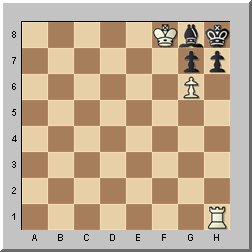
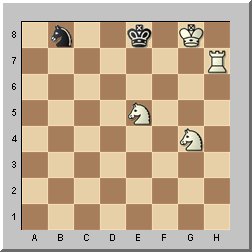
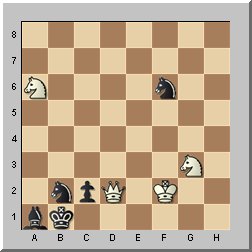
The action on the chessboard is in the moves and chess players are eager to make them. But sometimes they would rather stay put, skip a move, go for a walk and never come back. The dreaded word "zugzwang" crosses their mind and they know they are in trouble. GM Lubomir Kavalek demonstrates three beautiful examples of zugzwang in chess problems. Solutions next week.
By GM Lubomir Kavalek
Zugzwang is a German word and, according to chess historians, it was introduced into English in 1904 by the world champion Emanuel Lasker. What does it mean being in zugzwang? In simple terms, you have to move and you don't want to. Every move you make leads to a worse position and often to an outright disaster. You see it mostly in the endgame, sometimes in the middlegame and never in the opening. It flourishes in chess compositions – in chess problems and endgame studies. We give three examples of the zugzwang theme. Try to solve them! We will publish the solutions next week.
The first example is a chess problem, in which White mates in two moves. It is attributed to Paul Morphy, an American genius who conquered the chess world in the late 1850s.
Paul Morphy White mates in two moves
One clear rule of chess is that king against king, with no other pieces, is a draw. It is still a draw if you add two knights to one side. Or is it? The French poet, novelist and playwright, Alfred de Musset (1810-1857), played chess with passion, fantasy and temperament in the Cafe de la Regence in Paris. He became famous, but not as a chess player.
In 1849 he composed and published a wonderful chess problem that turned the theory about two knights upside down, as if to prove that almost every strategical and tactical rule in chess has its exception. The solution to his three-mover, based on zugzwang, is remarkable.
Alfred de Musset White mates in three moves
The theme of dominating knights appeared in the work of the Latvian chess composer Johann Sehwers (1868-1940), also known as Janis Zevers. He was a prominent linguist and literary historian and his collection of 64 endgame studies, "Endspielstudien," was published in Germany in 1922. Try to find out how white wins in Sehwers's amusing study.
Johann Sehwers White wins
To all those, who welcomed me back, many, many thanks! We plan to run the column twice a month. Chess puzzles will appear separately every two weeks.
If you liked the article kindly Digg it, Stumble it, Add to Technorati, bookmark it and please consider Subscribing by Email and have articles delivered right to your inbox! OR Subscribe to Attack the King Feed in a Feed Reader of your choice OR Subscribe to SMS Alerts & Get Article Headlines & Updates delivered to your Mobile Phone for free.
The Rykba 3 Book by Jeroen Noomen The Rybka 3 opening book is a high-class compilation of opening theory. It was developed for the world’s strongest chess program Rybka 3 and will maximize the program’s playing strength. The choice of variations in the book is well suited to the style of the program, and the book has been fine-tuned and checked in thousands of games.
The Rybka Book has high value outside computer chess. It reflects the state of current opening knowledge as played in master, correspondence and 100,000 top computer games (up to June 2008). And this is only the starting point: the value of the book lies in its deep original analysis and move choices, which lead to a re-evaluation in many critical points of modern theory. This makes it useful for tournament and correspondence players alike. The book contains a lot of computer-checked analysis never published anywhere before.
The author of the Rybka 3 book is Jeroen Noomen, one of the world’s leading experts in computer opening theory. Jeroen Noomen has been on the Rybka team since the very start, and his preparation is used in all official events, including the World Championship 2007 which Rykba won. In his long career as an opening analyst he has achieved many fine novelties in top computer chess events. Number of positions in the Rybka 3 book: 3,387,966.
Size 260 MB. The book runs on any recent ChessBase software.
If you liked the article kindly Digg it, Stumble it, Add to Technorati, bookmark it and please consider Subscribing by Email and have articles delivered right to your inbox! OR Subscribe to Attack the King Feed in a Feed Reader of your choice OR Subscribe to SMS Alerts & Get Article Headlines & Updates delivered to your Mobile Phone for free.
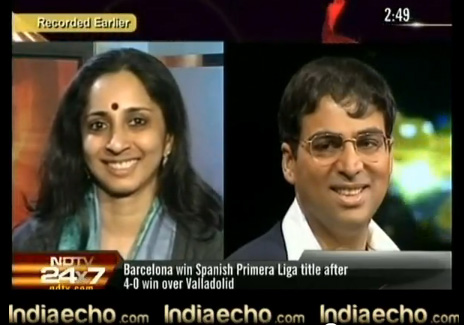
It was conducted before his successful World Championship defence, and affords some new insights into the life of India's sporting hero Viswanathan Anand, who touches on the important milestones in his chess career. The most enchanting bit: when Anand is joined by wife Aruna, who asks some of the questions. Like whether it was good for his career always being Mr Nice Guy..
NDTV Interview with Viswanathan Anand
This interview with World Champion Viswanathan Anand was conducted by India Echo and Indian NDTV before the start of the match in Sofia against Veselin Topalov.
In part one Anand talks about important milestones in his chess career, his habits, refreshments during the game, chess boxing, and other things. He answers questions posed by young chess enthusiasts and by fellow grandmaster Parimarjan Negi.
There is a cute story in the interview, one that is true (Vishy told it to us ages ago): when traveling in a train he was asked by a passenger what he did for a living. When he said chess the passenger said "Yes, but you can't live from that! If you were Viswanathan Anand maybe, but I would advise you to keep a fall-back position..."
Anand is clearly most gratified that a lot of kids are picking up chess due to his successes. He talks about the NIIT Mind Champions Academy, where chess is being introduced in schools and reaching regions of the country where it had no foothold so far.
There are also some interesting pieces of advice that Anand gives Parimarjan Negi and the other fans who call in with questions. For instance he tries to work out in the gym after every game. "I have found that when I have time to sit around and do nothing, that time gets occupied with worrying about all the things that can go wrong. If you go to the gym you will sleep better and have less time to worry. I know players who wake up just one hour before the game, just so that they have not had any time to worry before the game." Anand also speaks about chocolate (some players use it to raise their blood sugar after some hours at the board) and replies to a question by a very youthful viewer on how to get out of zugzwang with this little gem:" The best way to get out of zugzwang is not to get into it."
Anand also gets a question from world middle-weight boxing champion Vijender Singh (in Urdu, which Anand does not actually speak) and, at the end of the above clip, speaks about the sport of chess boxing. "It's tricky, because you have to finish the chess game before you go for the boxing, otherwise the boxer usually wins, because you cannot come back to the game." Which reminds us: we have a new chess boxing article up for publication – maybe later today.
In part two Anand is quizzed by... his wife Aruna! In addition Anand's mother and father are interviewed.
The best part is when Anand is joined by his wife Aruna, who was in Chennai at the time. She asks him about his propensity for being "Mr Nice Guy" and whether this has been very expensive for his career, or whether it is a pragmatic decision he wishes to continue. Anand says it is just his way of avoiding conflict ("and I'm sorry if I haven't managed with you very often"), although every once in a while he finds he has to stick out his neck and hit back.
Aruna narrates what it is like to be Anand's shield, which is a very high-pressure job. "Normally when he has a bad game you can never do the correct thing. Once when he lost a game I kept quiet, because I knew if I said something I would get some choice words. After five minutes he tells me 'Don't you have anything to say? Say anything stupid, but tell me something!' So I said something and he got angry, and we both laughed it off. The thing is that when you have a bad result you know there is someone waiting for you, and their life is dependent on your result, so in a way you feel bad for them. Most spouses of sports persons go through this on a daily basis. But the wins more than compensate for the bad moments. Thankfully, married to Anand we have had a lot of happy moments."
In the final section Anand is joined by his parents Viswanathan and Susheela – the lady to whom we have to be eternally grateful since she introduced the young lad to the game. The champ tells us how he got hooked on the game and how school did not interfere too much with his passion. "Very often after a long spell at school I would do very well in my first tournament, mainly because the enthusiasm to get out of school and back at the chess board compensates for any lack of practice."
If you liked the article kindly Digg it, Stumble it, Add to Technorati, bookmark it and please consider Subscribing by Email and have articles delivered right to your inbox! OR Subscribe to Attack the King Feed in a Feed Reader of your choice OR Subscribe to SMS Alerts & Get Article Headlines & Updates delivered to your Mobile Phone for free.
The Rybka Aquarium project is rapidly advancing on several exciting fronts. The latest addition is the first professionally prepared opening book in the native Aquarium format has been released just recently.
The Rybka Aquarium opening book focuses on popular variations and covers all the latest theory. It’s an opening book no strong player can afford to miss!
Prepared by a leading opening expert
The Rybka Aquarium book was prepared by Jeroen Noomen, a Rybka team member who is responsible for Rybka’s opening book in its official competitions, including the World Computer Chess Championship which has been won by Rybka for two years running. Jeroen is a leading expert on opening theory, and his imaginative opening innovations have secured Rybka many critical wins. His research methods and analysis tools ensure that his opening books are of great interest to all chessplayers, from the club player to the strongest grandmasters.
High-quality up-to-date games and analysis
The book focuses on the best games of the top GM’s (2600 elo or more) in the past two years, as well as the best computer games of the past two years. Additionally, the Rybka Aquarium book is strongly supported by computer checked analysis, and will give you fresh and new ideas that are not published in any openingbook yet and can give you a clear edge in opening preparation compared to chess players that do not have this opening information available.
The secrets of human and computer games!
Most opening book authors ignore the vast number of available computer games, although they are high quality games and opening theory is developing rapidly in the computer chess circles. Since computer chess is Jeroen’s specialty he is in a unique position to combine the best of both worlds – human chess and computer chess – into a single opening book as he has done with the Rybka Aquarium book. For over the board players, correspondence chess players etc. this means that they will discover lines and analysis that is not available in any other book.
The statistics
The Rybka Aquarium book consist on 11.5 million positions. It’s size on disk is 323 MB, which is surprisingly small for a book with this number of positions. If we compare this with a printed opening book containing 1000 positions on each page, you would need 11,500 pages to cover the number of positions in the Rybka Aquarium book.
The bonus
Together with Rybka Aquarium book you will also receive the latest CAP analysis files with more than 21 million Rybka analyzed positions. Its size on disk is 359 MB. CAP simplifies making a move choice and discovering weak moves. The CAP data covers some openings more extensively, especially those not explored heavily in the book.
The classifier
Rybka Aquarium book contains the classifier that allows quick navigating through book lines and getting additional information from it.
To use CAP Tree extract the contents to the installation folder "Aquarium >> ATrees. Overwrite if there is another CAP Tree(which comes with the program & is much smaller).
To use Hugestatistics extract the contents to Aquarium\ATrees\statistics folder & overwrite.
To use Hugebase create a directory in named "Hugebase" or whatever you like in Aquarium\ABases\CABases and extract the content to the same.
If you liked the article kindly Digg it, Stumble it, Add to Technorati, bookmark it and please consider Subscribing by Email and have articles delivered right to your inbox! OR Subscribe to Attack the King Feed in a Feed Reader of your choice OR Subscribe to SMS Alerts & Get Article Headlines & Updates delivered to your Mobile Phone for free.
Chess TV World Chess News Video Episode 299 covering chess news from around the world of the period 24.05.10-30.04.10. Enjoy !
English Version
Swedish Version
If you liked the article kindly Digg it, Stumble it, Add to Technorati, bookmark it and please consider Subscribing by Email and have articles delivered right to your inbox! OR Subscribe to Attack the King Feed in a Feed Reader of your choice OR Subscribe to SMS Alerts & Get Article Headlines & Updates delivered to your Mobile Phone for free.