Loading
Drastically Improve Your Chess
Upgrade to a FileSonic Premium account and download at incredible speed!

This is default featured post 1 title

Go to Blogger edit html and find these sentences.Now replace these sentences with your own descriptions.This theme is Bloggerized by Lasantha Bandara - Premiumbloggertemplates.com.

This is default featured post 2 title

Go to Blogger edit html and find these sentences.Now replace these sentences with your own descriptions.This theme is Bloggerized by Lasantha Bandara - Premiumbloggertemplates.com.

This is default featured post 3 title

Go to Blogger edit html and find these sentences.Now replace these sentences with your own descriptions.This theme is Bloggerized by Lasantha Bandara - Premiumbloggertemplates.com.

This is default featured post 4 title

Go to Blogger edit html and find these sentences.Now replace these sentences with your own descriptions.This theme is Bloggerized by Lasantha Bandara - Premiumbloggertemplates.com.

This is default featured post 5 title

Go to Blogger edit html and find these sentences.Now replace these sentences with your own descriptions.This theme is Bloggerized by Lasantha Bandara - Premiumbloggertemplates.com.

Most In-depth Study ( Must Have )

Saturday, December 27, 2008

The Ruy Lopez for White - Open Lopez Part 2

Hello everyone,

Last time we had studied Variation A in the Open Lopez. Hope the main concept of the Open Lopez is clear in your head by now.

We will move forward and today we will study Black's 9th move alternative, Variation B: 9...Be7. Now this Variation has two sub-variation as Black's 12th move alternatives.

Let's start with Variation B1: 12...0-0:

Ruy_Lopez/Variation B1.pgn


Now let's move onto the next reply, Variation B2: 12...Qd7:

Ruy_Lopez/Variation B2.pgn


So, this was Black's second 9th move alternative. Hope you have enjoyed. Next time we will start discussion on Black's third 9th move alternative.

Keep visiting and keep reading. 

Thanks a lot. Enjoy!!
Subscribe to Chess Blog | The Pulse of Chess     If you liked the article kindly Digg it, Stumble it, Add to Technorati, bookmark it and please consider subscribing through  "Subscribe by Email"  and have articles & a  Everyman Chessbase eBook delivered right to your inbox! OR "Subscribe to Chess Blog Feed" in a Fead Reader of your choice OR Subscribe to "SMS Alerts" & Get Article Headlines & Updates delivered to your Mobile Phone for free.

Saturday, December 20, 2008

The Ruy Lopez for White - Open Lopez Part 1

Hello everyone,

We have completed our study of the Moller and Arkhangelsk Variations in our last post. Hope you have it clear in your head by now.

Today we will start a new chapter in the Ruy Lopez, the Open Lopez. This is a little bit different from what we have seen in Berlin Defence, Deffered Steinitz and the recent Moller and Arkhangelsk Variations. Lets see how it goes:

1 e4 e5 2 Nf3 Nc6 3 Bb5 a6 4 Ba4 Nf6 5 0-0 Nxe4


With 5...Nxe4 Black basically chooses dynamic counterplay over solid defence . He makes space for his pieces to develop onto active posts and squashes any thoughts White might have of applying the 'Spanish Torture' so often seen in the closed defences .

However, there's a certain price to pay for all this activity. The position becomes open quite quickly and in order not to suffer a quick onslaught down the e-file, Black is forced to compromise his pawn-structure someWhat, leaving White with potential targets to exploit in the middlegame. Nevertheless, the Open Defence has Its fair share of supporters. Viktor Korchnoi is probably its most famous adherent, while of the new generation of top players one could point to Vishy Anand, who employed it in his 1995 World Championship clash with Kasparov and has continued to use it since.

The Strategic Starting Position


This is the typical position, which is reached after 8 moves of the Open Lopez. The first thing to notice is that Black 's pieces occupy active squares. Given a few free moves, Black would probably continue with ...Bc5, ...0-0 and perhaps ...f6, to create a semiopen f-file and attack the f2-square. It goes without saying that White must act energetically in the diagram position, else Black could easily take over the initiative once he has completed his development. Here I'm advocating the move 9 Nbd2, which was made popular by Anatoly Karpov. One of White's main ideas is to put immediate pressure on Black's strong knight on e4. This pressure can be enhanced with such moves as c3 and Bc2 . Black is asked very early on what to do with this knight.

Black Supports the Knight with ...f5


Black has just played 11...f5, lending support to the under-fire knight. White now has a big decision to make : whether to capture en passant, or to play around the knight and concentrate on the weaknesses in the black camp. On this occasion the main theoretical move is 12 Nb3 (instead of 12 exf6). After 12...Qd7 White can use a tactical trick to justify the move 13 Nfd4. Now 13...Nxe5? 14 f3 Nc5 15 Re1 Nc6 16 Nxc6 Qxc6 17 Nd4 Qd7 18 b4 drops a piece, so the normal continuation is 13...Nxd4 14 Nxd4 c5 15 Nxe6 Qxe6 16 f3 Ng5 17 a4 , when White is slightly better (see the theory section for more on this position).

Black Moves the Knight


On this occasion Black has retreated his knight to c5, where it controls some important squares . One of White's major plans in this position involves the usual knight manoeuvre with (after Re1) Nf1-g3/e3 . White's pieces would then point impressively at the black kingside. In addition, White has the e5-pawn as a spearhead, so it's easy to see that White can often build up a menacing attack against the black king. White also often plays Nb3, challenging the c5-knight. If this is exchanged, it clears the way for the white queen to go to d3, where it sets up a powerful battery with the bishop against the h7-pawn .
For the reasons outlined above, Black often delays castling in favour of first improving the position of his pieces . For example, Black often plays the move ...Bg4, giving White a pin to think about. This bishop can also be re-routed via h5 to g6, in order to blunt White's attack along the b1-h7 diagonal. This also leaves the e6-square vacant for the knight to hop back and completely block the e5-pawn. Another common feature is Black doubling behind the d-pawn with ...Qd7 and ...Rd8. The idea of this is not only to add extra support to the oftenvulnerable d5-pawn, but also to facilitate a possible ,..d4 advance. Of course the strength of this advance is always dependent on the placing of the various pieces, but a successful ...d4 will completely free Black's position .

Now let's move on to the different lines in this Variation. There are typically three different lines revolving around Black's 9th move alternatives, which again have different sub-variations based on Black's 11th and 12th moves.
Let's start with Variation A: 9...Bc5
Ruy_Lopez/Variation A.pgn

This is how it goes. We will study Variation B in our next post.
Keep visiting and keep reading.
Thanks a lot. Enjoy!!
Subscribe to Chess Blog | The Pulse of Chess     If you liked the article kindly Digg it, Stumble it, Add to Technorati, bookmark it and please consider subscribing through  "Subscribe by Email"  and have articles & a  Everyman Chessbase eBook delivered right to your inbox! OR "Subscribe to Chess Blog Feed" in a Fead Reader of your choice OR Subscribe to "SMS Alerts" & Get Article Headlines & Updates delivered to your Mobile Phone for free.

Monday, December 15, 2008

December 2008 Chess Puzzle Contest

From now on we will be holding "Puzzle Contests" every month. You have to solve the puzzles and comment on relevant posts with the move sequence. Each month we will randomly pick a maximum of 2 commenters with correct solutions who will get a surprise gift delivered to their inbox( you have to leave your email address here ). Now what's the gift? If you are one of our email subscribers then you already got our subscription gift...isn't it? Well the prize for the contests will be something like that ( but not Everyman ebooks). Common solve it & comment & you will know .
Every month's top commenter is also eligible for the prize even if he/she is unable to solve the puzzle.

Lets move on to the puzzle of this month....


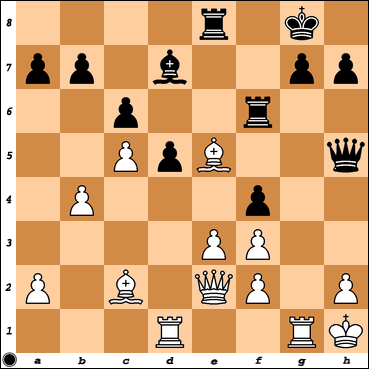
December Chess Puzzle Contest


This position is from Burn - Teichmann, Hastings 1895. White's doubled pawns on the f-file hamper him in his attempts to defend his king.How did black exploit this? Black to play.You have to find the best sequence of moves that leads to mate.
Leave you solutions here with your email address. Entries after this month are not eligible for the contest. So what are you waiting for? It's time for your neurons to do some calculations...


Subscribe to Chess Blog | The Pulse of Chess     If you liked the article kindly Digg it, Stumble it, Add to Technorati, bookmark it and please consider subscribing through  "Subscribe by Email"  and have articles & a  Everyman Chessbase eBook delivered right to your inbox! OR "Subscribe to Chess Blog Feed" in a Fead Reader of your choice OR Subscribe to "SMS Alerts" & Get Article Headlines & Updates delivered to your Mobile Phone for free.

Sexy maths: Skills of a Chess Grandmaster


The 2008 chess Olympiad in Dresden
For a while, the chess Olympiad this year looked like producing a surprise winner but closer inspection of Israel's team sheet revealed that it was pretty much business as usual: half the players were named Boris!
Other than a brief blip in the 1970s, the biennial event has produced remarkably consistent results. From 1952 to 1990, the Soviet Union ruled the contest, and after the superstate's fragmentation either Russia or one of its former union satellites struck gold every time. As it turned out this year, the Soviet diaspora's turn in the spotlight was short-lived and Armenia triumphed for its second successive Olympiad.

Despite being connected by being born under the red flag, those that dominate the game are better categorised by their membership of a different club: the mathematical mafia. Legend has it that the game was invented by a mathematician in India who elicited a huge reward for its creation. The King of India was so impressed with the game that he asked the mathematician to name a prize as reward. Not wishing to appear greedy, the mathematician asked for one grain of rice to be placed on the first square of the chess board, two grains on the second, four on the third and so on. The number of grains of rice should be doubled each time.
The King thought that he'd got away lightly, but little did he realise the power of doubling to make things big very quickly. By the sixteenth square there was already a kilo of rice on the chess board. By the twentieth square his servant needed to bring in a wheelbarrow of rice. He never reached the 64th and last square on the board. By that point the rice on the board would have totalled a staggering 18,446,744,073,709,551,615 grains.
Playing chess has strong resonances with doing mathematics. There are simple rules for the way each chess piece moves but beyond these basic constraints, the pieces can roam freely across the board. Mathematics also proceeds by taking self-evident truths (called axioms) about properties of numbers and geometry and then by applying basic rules of logic you proceed to move mathematics from its starting point to deduce new statements about numbers and geometry. For example, using the moves allowed by mathematics the 18th-century mathematician Lagrange reached an endgame that showed that every number can be written as the sum of four square numbers, a far from obvious fact. For example, 310 = 172 +42 + 22 + 12.
Some mathematicians have turned their analytic skills on the game of chess itself. A classic problem called the Knight's Tour asks whether it is possible to use a knight to jump around the chess board visiting each square once only. The first examples were documented in a 9th-century Arabic manuscript. It is only within the past decade that mathematical techniques have been developed to count exactly how many such tours are possible.
It isn't just mathematicians and chess players who have been fascinated by the Knight's Tour. The highly styled Sanskrit poem Kavyalankara presents the Knight's Tour in verse form. And in the 20th century, the French author Georges Perec's novel Life: A User's Manual describes an apartment with 100 rooms arranged in a 10x10 grid. In the novel the order that the author visits the rooms is determined by a Knight's Tour on a 10x10 chessboard.
Mathematicians have also analysed just how many games of chess are possible. If you were to line up chessboards side by side, the number of them you would need to reach from one side of the observable universe to the other would require only 28 digits. Yet Claude Shannon, the mathematician credited as the father of the digital age, estimated that the number of unique games you could play was of the order of 10120 (a 1 followed by 120 0s). It's this level of complexity that makes chess such an attractive game and ensures that at the Olympiad in Russia in 2010, local spectators will witness games of chess never before seen by the human eye, even if the winning team turns out to have familiar names.
 Article Source : Times Online
Subscribe to Chess Blog | The Pulse of Chess     If you liked the article kindly Digg it, Stumble it, Add to Technorati, bookmark it and please consider subscribing through  "Subscribe by Email"  and have articles & a  Everyman Chessbase eBook delivered right to your inbox! OR "Subscribe to Chess Blog Feed" in a Fead Reader of your choice OR Subscribe to "SMS Alerts" & Get Article Headlines & Updates delivered to your Mobile Phone for free.

Sunday, December 14, 2008

The Ruy Lopez for White - Moller and Arkhangelsk Variations Part 5

Hello friends,

Today we will conclude our study of the Moller and Arkhangelsk Variations. In the last post we have studied Variation C221: 12...Re8. Today, we will study the remaining two replies by Black, Variation C222: 12...exd4 and Variation C223: 12...Rb8.

So, let's start with Variation C222: 12...exd4

Ruy_Lopez/Variation C222.pgn


Now, let's move on to the remaining Variation C223: 12...Rb8

Ruy_Lopez/Variation C223.pgn


So, friends, this concludes our study of the Moller and Arkhangelsk Variations. It's a bit tricky, but I am sure you will be able to find your way out through it, as shown.

From our next post, we will start a new chapter, The Open Lopez.

So, stay tuned. This is certainly not the end.

Keep visiting and keep reading.

Thanks a lot, Enjoy!!
Subscribe to Chess Blog | The Pulse of Chess     If you liked the article kindly Digg it, Stumble it, Add to Technorati, bookmark it and please consider subscribing through  "Subscribe by Email"  and have articles & a  Everyman Chessbase eBook delivered right to your inbox! OR "Subscribe to Chess Blog Feed" in a Fead Reader of your choice OR Subscribe to "SMS Alerts" & Get Article Headlines & Updates delivered to your Mobile Phone for free.

Saturday, December 13, 2008

Reptor - A Free Chess Opening Repetoire

What's more? From now on we will also keep you informed about free stuffs & goodies that are available on the web.
Starting for the first time we would like to tell you about "Reptor" , a nice free chess opening repetoire trainer . Reptor is the fast way to learn a new opening. It's a Windows program intended to make learning a new opening in an evening practical. It also allows you to prepare your own content. Reptor now supports other types of chess knowledge training in addition to openings.

Reptor is designed to help you commit opening lines to memory. Reptor supplements all those books and DVDs that promise to teach you a new opening. The premise of these products is that they will provide you with at least one good choice for any course of action your opponent selects in the opening under consideration. Unfortunately you can't take these books into the playing hall with you, you need a way to remember the lines. Reptor trains you by challenging you to play down the recommended lines. If you need help, Reptor gently shows you the way. In no time you will be playing the lines with confidence.
Reptor can also be used to learn other types of chess knowledge, including tactics and endgame technique. For this type of training Reptor varies the starting position, but still challenges the user to come up with the right moves in the same way as when learning openings. A good example of this type of content is a lesson that teaches the problematic basic bishop and knight mate.
The following lessons are included in the Reptor download;
  • Play the Queen's Indian defence.
  • An interesting anti Caro-Kann line.
  • A simple 1.d4 based opening repertoire.
  • Forcing mate with bishop and knight only against a bare king.
  • Learn the Lucena and Philidor positions.
You can download it here for free.
OK that's it for today....a new stuff next time..so stay tuned.
Subscribe to Chess Blog | The Pulse of Chess     If you liked the article kindly Digg it, Stumble it, Add to Technorati, bookmark it and please consider subscribing through  "Subscribe by Email"  and have articles & a  Everyman Chessbase eBook delivered right to your inbox! OR "Subscribe to Chess Blog Feed" in a Fead Reader of your choice OR Subscribe to "SMS Alerts" & Get Article Headlines & Updates delivered to your Mobile Phone for free.

Friday, December 12, 2008

The Ruy Lopez for White - Moller and Arkhangelsk Variations Part 4

Hi friends,

I am extremely sorry to be so late in my posts. Actually I was out of station for quite a few days and after I came back, we got this problem with "chesspublisher"!! But my friends, we are back and we are back with a bang!! We have found a really great alternative for the problems, many many thanks to my friend chessyman here. You will enjoy reading much more now, I am sure of it.

Well, what else! Let's start from where we had left the Moller and Arkhangelsk Variations. We will discuss now, Variation C2: 6...Bb7. It has mainly two sub-variations, Variation C21: 8...0-0 and Variation C22: 8...d6 which revolves round Blacks 8th move alternatives. Variation C22: 8...d6 has again three sub-variations which I will let you know in due course.

So, let's start with Variation C21: 8...0-0

Ruy_Lopez/Variation C21.pgn


Now, we will move on to Variation C22: 8...d6 where there are three sub-variations which revolves around Black's 12th move alternatives. Let's start with the first one Variation C221: 12...Re8

Ruy_Lopez/Variation C221.pgn


We will study the remaining two sub-variations of Variation C22: 8...d6 in our next post and that will conclude our study on Moller and Arkhangelsk Variations.

Hope you have enjoyed.

Keep visiting and keep reading. There is still lot more to come.
Thanks a lot. Enjoy!!


Subscribe to Chess Blog | The Pulse of Chess     If you liked the article kindly Digg it, Stumble it, Add to Technorati, bookmark it and please consider subscribing through  "Subscribe by Email"  and have articles & a  Everyman Chessbase eBook delivered right to your inbox! OR "Subscribe to Chess Blog Feed" in a Fead Reader of your choice OR Subscribe to "SMS Alerts" & Get Article Headlines & Updates delivered to your Mobile Phone for free.

Thursday, December 11, 2008

Chess Publisher is down & We are stuck but Read On!!!

Chess Publisher(which we have been using to publish games) is down.So we are stuck & haven't been able to publish the opening surveys recently.We will be coming up with a solution that will be much better than Chess Publisher. Probably in a day or two you will see the results. So until then bye,stay tuned & sorry for the delay.

Tuesday, December 9, 2008

Write for Chess Blog

Have you got an article or tutorial that you’d like to share with our readers? Are you well qualified for the content that you are going to provide?
If so - then we are ready to provide a platform for your articles in Chess Blog. We are currently looking for guest authors whether they be one off or regular contributors. Contact us via our Contact Us page for more details on how you can be a part of Chess Blog. 
Please include in your messsage the title of the post you’d like to write and a brief (5-6 sentences) description of what it would be about. I won’t hold you to the title but this will help me get an idea of what direction you’d take the post. If that interests us then we will be informing you to send the full article by email.
We are particularly looking for helpful tips & tutorials on openings,strategy etc. The more practical and useful your post idea is the better.

Now why write guest posts for Chess Blog?

1 - It’s one of the fastest ways to reach a new audience.
When you write a post for another blog you are getting the opportunity to showcase your knowledge and ability in front of targeted readers. If your blog is on a similar topic as the blog in which your post is published, you stand to gain a lot of new visitors.
Obviously, the amount of exposure you get will depend on which blog publishes your article. The number of subscribers isn’t the only significant factor. Some blogs have smaller audiences, but their readers are very targeted and very loyal.

2 - Potential new subscribers.
If the readers like your post they may be inclined to subscribe to your RSS feed. In this way guest posting can be a very productive source of free advertising. Who doesn’t want more subscribers?
3 - You’ll get a link to your blog.
Almost all guest posting arrangements involve a link back to the author’s blog. This not only provides you with potential click-through traffic, but it can help our search engine rankings as well as your Technorati rank, especially if the other blog is a quality, established blog itself. In fact, the link is sometimes the primary interest in guest posts.

4 - It helps other bloggers.
Ok, so your primary motivation is not to help other blogs, but this can have big benefits down the road. If you help another blogger, they are likely to remember you and they’ll be more likely to repay the favor or to link to you in the future. Even if they don’t, it’s still nice to know that you can make an impact for others.
In short by writing guest posts for Chess Blog you’ll be able to quickly reach a lot of new potential readers, grow you name recognition, and get some quality inbound links.
So what are you waiting for ? 

Don't forget to subscribe to the thread for tracking replies