Loading
Drastically Improve Your Chess
Upgrade to a FileSonic Premium account and download at incredible speed!

This is default featured post 1 title

Go to Blogger edit html and find these sentences.Now replace these sentences with your own descriptions.This theme is Bloggerized by Lasantha Bandara - Premiumbloggertemplates.com.

This is default featured post 2 title

Go to Blogger edit html and find these sentences.Now replace these sentences with your own descriptions.This theme is Bloggerized by Lasantha Bandara - Premiumbloggertemplates.com.

This is default featured post 3 title

Go to Blogger edit html and find these sentences.Now replace these sentences with your own descriptions.This theme is Bloggerized by Lasantha Bandara - Premiumbloggertemplates.com.

This is default featured post 4 title

Go to Blogger edit html and find these sentences.Now replace these sentences with your own descriptions.This theme is Bloggerized by Lasantha Bandara - Premiumbloggertemplates.com.

This is default featured post 5 title

Go to Blogger edit html and find these sentences.Now replace these sentences with your own descriptions.This theme is Bloggerized by Lasantha Bandara - Premiumbloggertemplates.com.

Most In-depth Study ( Must Have )

Monday, October 20, 2008

World Chess Championship 2008 | Anand vs. Kramnik, Round 4 - Game Analysis

WCC R04: Draw in 29 moves

 
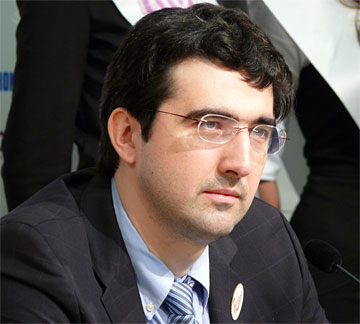
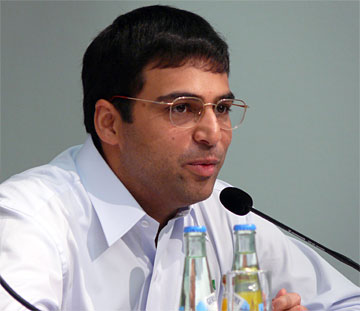
Vladimir Kramnik solved all opening problems posed by Anand in this Queen's Gambit Declined, and then, with his position basically safe, undertook some tentative attacking attempts. But Anand's position was also secure and so the players agreed that there was nothing left in the position to play for. The draw came after 29 moves.


Vladimir Kramnik in the press conference after round four

Vishy Anand giving his take of the game
Subscribe to Chess Blog | The Pulse of Chess     If you liked the article kindly Digg it, Stumble it, Add to Technorati, bookmark it and please consider subscribing through  "Subscribe by Email"  and have articles & a  Everyman Chessbase eBook delivered right to your inbox! OR "Subscribe to Chess Blog Feed" in a Fead Reader of your choice OR Subscribe to "SMS Alerts" & Get Article Headlines & Updates delivered to your Mobile Phone for free.

Sunday, October 19, 2008

World Chess Championship 2008 | Anand vs. Kramnik, Round 3 - Game Analysis

WCC R03: Anand wins with black


First blood. World Champion Vishy Anand played a daring new idea in the Slav, put pressure on his opponent, and wound down to an endgames where he had a tremendous attack in return for two pawns. Both players were down to minutes on their clocks, but made the time control, after which Vladimir Kramnik resigned

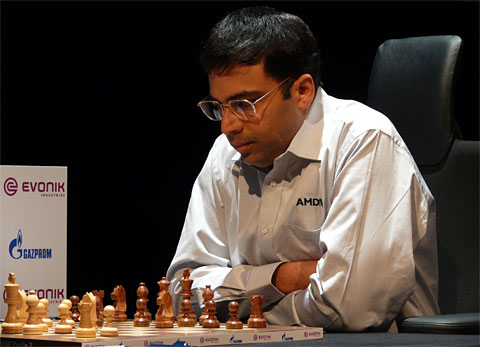
Vishy Anand going for complications and aggressive lines

Kasparov's take on the game

"Great choice by Vishy! [With 8..a6] he dragged Kramnik into this nightmare instead of allowing him to play slowly. It was good preparation and also good psychology to kick some sand in Kramnik's face and show him he wasn't afraid. I didn't see the whole thing, but when I came back from a meeting and saw the position after 22..Rg7 I thought Kramnik had had it. At first glance it looks like the game was well played by both players. Just looking at it I'm not sure why Kramnik couldn't play 33.Kb3. Maybe he can give up his queen and still draw with the a-pawn." On-the-fly comments from Garry Kasparov, recorded by Mig Greengard.

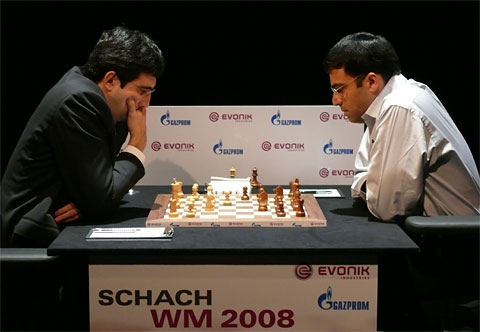
And game three is under way


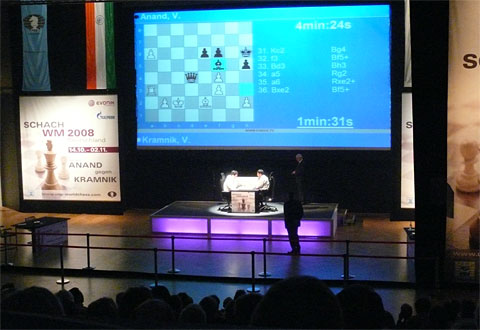
At move 36 Kramnik has just 1 min 31 sec left, Anand 4 min 24 sec


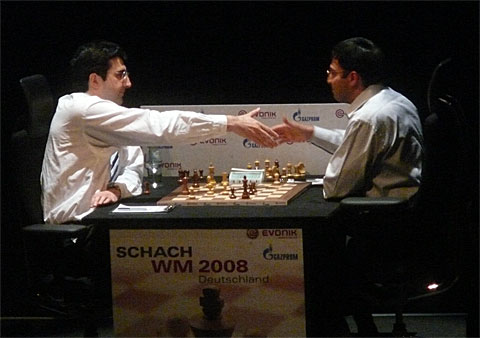
And after 41 moves Kramnik sticks out his hand in resignation


Subscribe to Chess Blog | The Pulse of Chess     If you liked the article kindly Digg it, Stumble it, Add to Technorati, bookmark it and please consider subscribing through  "Subscribe by Email"  and have articles & a  Everyman Chessbase eBook delivered right to your inbox! OR "Subscribe to Chess Blog Feed" in a Fead Reader of your choice OR Subscribe to "SMS Alerts" & Get Article Headlines & Updates delivered to your Mobile Phone for free.

World Chess Championship 2008 | Anand vs. Kramnik, Round 2 - Game Analysis

WCC R02: Anand plays 1.d4, game drawn after 32 fighting moves

Vishy Anand surprised his opponent Vladimir Kramnik – and the world – with the move 1.d4 in his first white game of the World Championship in Bonn. The position became complicated and Anand started pressing for a win. However in time trouble the Indian GM decided to accept his Russian opponent's draw offer.

GM Levon Aronian's take on game two


What a wonderful day! Of course we all can pretend that it was an "expected surprise" and that Anand's choice of opening did not make us believe, for one moment, that there is something wrong with the live broadcast. But reality is: Anand has come to Bonn to win, and he is willing to take risks by employing lines he never did before. And he was close to success today.
Kramnik's choice to play Nimzovitsch defence was dictated by simple logic. There was no point for him to play the Slav Defence when Anand has clearly spent ages preparing it before the match, even though for the opposite color. Anand in return answered with a rare and daring line! He played something that would be considered the least likely line to be played in a World Championship match. His intention to confuse his antagonist worked perfectly, as Kramnik, who was trying to avoid an opening trap, tried to come up with new ideas (which is a hard task in such sharp positions), and found himself in an unpleasant endgame. And from that moment on we saw a totally different Kramnik! With brilliant maneuvers he manager to get enough counterplay for a lost pawn, and the position where players agreed to draw seem to be double edged. Of course chess fans around the globe would have liked to see the game continue, but understandably the players did not want to take risks in the time trouble. A very impressive game by two giants, and possibly an invitation for a full contact fight?
Subscribe to Chess Blog | The Pulse of Chess     If you liked the article kindly Digg it, Stumble it, Add to Technorati, bookmark it and please consider subscribing through  "Subscribe by Email"  and have articles & a  Everyman Chessbase eBook delivered right to your inbox! OR "Subscribe to Chess Blog Feed" in a Fead Reader of your choice OR Subscribe to "SMS Alerts" & Get Article Headlines & Updates delivered to your Mobile Phone for free.

World Chess Championship 2008 | Anand vs. Kramnik, Round 1 - Game Analysis


WCC R01: Draw in 32 moves

The World Championship in Bonn started with an Exchange Slav in which Challenger Vladimir Kramnik was a pawn up, but the World Champion Viswanathan Anand had plenty of counterplay and held the draw in what seemed to be a fairly effortless first game.

Game one Kramnik-Anand drawn

The World Chess Championship started at 15:00h in Bonn with a brief opening ceremony and national anthems. Vladimir Kramnik played a solid Exchange Slav and was soon a pawn up, but Vishwanathan Anand had plenty of counterplay and held the draw in what seemed to be a fairly effortless first game.

GM Levon Aronian's take on the game

Not again! The excitement and anticipation of chess fans was met by a cold hearted opening response from Vladimir Kramnik. Only a handful of maestros in fact understand that it is just a tactical decision. Kramnik wanted to show that he is going to try and torture the Tiger from Madras. We have seen similar approach in Kramnik's match against Leko in Brissago 2004. But I am convinced that such attempts have limited chances of success, and in the upcoming games where Kramnik will again sport the white pieces, I expect a string of explosions. After all the press, the sponsors and the chess world deserve some entertainment.
So, what will the white pieces be serving us next? Tomorrow Anand will be moving first – and I expect him to scare his Russian Petrov-playing adversary. In the past, the Petrov defence has proven to be fertile ground for opening novelties and hotly disputed variations. Surely, the battle for the world title will bring fresh opening revelations (in the Petrov?) and not continue in the same vein that we have witnessed so far.
Kramnik,V (2772) - Anand,V (2783) [D14]
WCh Bonn GER (1), 14.10.2008 [ Game Analysis ]


Subscribe to Chess Blog | The Pulse of Chess     If you liked the article kindly Digg it, Stumble it, Add to Technorati, bookmark it and please consider subscribing through  "Subscribe by Email"  and have articles & a  Everyman Chessbase eBook delivered right to your inbox! OR "Subscribe to Chess Blog Feed" in a Fead Reader of your choice OR Subscribe to "SMS Alerts" & Get Article Headlines & Updates delivered to your Mobile Phone for free.

Saturday, October 11, 2008

The Ruy Lopez for White - Berlin Defence Part 2

In the introductory discussion on Berlin Defence, we saw different structural patterns that might arise as a result of this defence by Black. Hope those features are clear in your head now.

Without wasting any time, we will start our study of different variations. The Main Variations in this defence revolves around Black's fifth move alternative, mainly Variation A: 5...Be7 and Variation B: 5...Nd6.

Let's start with Variation A: 5...Be7. Follow carefully:
Well, the next one, Variation B: 5...Nd6 is the most widely played response by Black under these circumstances. So let's see what it has in store for White. Pay very very serious attention. This variation will demand a pretty lengthy discussion owing to the fact that it has a lot of sub-variations. For convenience, we will study it in parts. Sub-variations involve Black's 7th and 9th move alternatives.


Variation B1: 7...Ne4!?
Pretty interesting, isn't it? The truth is, White can always find ways to keep an advantage. Important is to play cautiously.

We will study Variation B2 (much more preferred by Black) in my next post. Hence, it will be much more interesting for White to refute and will have much more options open for both sides.

Stay tuned. We will be back shortly.

Keep visiting and keep reading. Thanks a lot. Enjoy!!
Subscribe to Chess Blog | The Pulse of Chess     If you liked the article kindly Digg it, Stumble it, Add to Technorati, bookmark it and please consider subscribing through  "Subscribe by Email"  and have articles & a  Everyman Chessbase eBook delivered right to your inbox! OR "Subscribe to Chess Blog Feed" in a Fead Reader of your choice OR Subscribe to "SMS Alerts" & Get Article Headlines & Updates delivered to your Mobile Phone for free.

Friday, October 10, 2008

The Ruy Lopez for White - Berlin Defence Part 1

Before We Start

Hello Chesslovers,

It's time to get very very serious now. 

Until now, we have been discussing those variations in the Ruy Lopez which are now less encountered in real games. The reason being the continuous improvements that has taken place due to the hard work and dedication of great players and masters in this opening. Somehow, both sides was able to find refutations and there was a need for improvement. So, improvement has taken place.......

From now on Ruy Lopez will not be just fun!, it will be full concentration + tremendous brainstorming + very hard work + complete dedication + an open mind, and all these will generate fun in the end. Because at the end of the day, if you want to generate something of very high quality, you have to bind yourself with these parameters.  Every chapters discussed from now on, will be the most adored variations in the Ruy Lopez and there is every possibility that you will turn up facing one of them everytime you go for this opening.

For those, whose chess ideas are like parts of their body they are reluctant to give up, it's time to change your views because now you will come to know what "keeping an open mind" means.

My first and last warning to you will be "do not try to memorize moves". Remember, when we study an opening, we do not study moves, but ideas.

Welcome, all of you, to the deepest and the most wonderful journey in the jungles of Ruy Lopez. Be serious.

The Ruy Lopez - Berlin Defence

We will start with the Berlin Defence, recognized by Black's third move, 3...Nf6. The Berlin Defence is an opening which demands that you should understand certain things first before going for further analysis:
1 e4 e5 2 Nf3 Nc6 3 Bb5 Nf6


The Berlin Defence is one of Black's most solid and reliable ways of meeting the Ruy Lopez . Recently it has found its way into the repertoires of some of the world's leading young players, including Alexei Shirov and Vladimir Kramnik, while it has also been a long-time favourite of Britain's first grandmaster, Tony Miles . Being such a solid defence, there is the drawback that Black finds it difficult to create winning chances if White is content to play for a draw, but of Course, this accusation could be levelled at most black defences .

The Berlin Endgame

The main line of the Berlin Defence gives rise to an endgame after the moves 1 e4 e5 2 Nf3 Nc6 3 Bb5 Nf6 4 0-0 Nxe4 5 d4 Nd6 6 Bxc6 dxc6 7 dxe5 Nf5 8 Qxd8+ Kxd8. After White's most flexible move, 9 Nc3, we reach the following position.


At first glance the pawn-structure seems to give White a persistent advantage. After all, White has a healthy 4-3 majority on the kingside, while Black should find it difficult to create a passed pawn from his own queenside majority, due to the doubled pawns. However, there are also some factors favouring Black. For example, White's advanced pawn on e5 presents Black with squares on f5 and d5 . The e5pawn could actually become quite weak if it's not well supported. Another plus for Black is that he possesses the bishop-pair.

In fact, White's best chance for an advantage lies in the slightly vulnerable position of the black king, which has lost the right to castle and prevents the black rooks from connecting. White must play actively and attempt to exploit this temporary disharmony in the black position in order to create a concrete positional or tactical advantage.

The ...Bb4xc3 Exchange

This surprising exchange is one of Black 's most potent weapons in the Berlin Endgame. At first sight, it appears a little strange just to give away the advantage of the bishop-pair, but following the trade, the presence of opposite-coloured bishops considerably eases Black's defensive task. Light-square control on the kingside makes it very difficult for White to mobilize his pawn majority, while it's also possible that White's pawns can end up as targets .


White Plays Ng5xBe6

Similarly, this exchange is one of White's weapons


Play continued 12 Nxe6! fxe6 13 Ne4 and we can see that the exchange has favoured White. Black no longer possesses the bishop-pair, and White can still advance his pawn majority on the kingside. Another point is that White's e5-pawn is less vulnerable, as Black no longer has the long-term option of ...Ke6 to attack it.


The Main Ideas


Since Black will find it difficult to connect rooks, he often tries to activate them on their original squares. In such cases it's common for Black to play ...a5-a4 to activate his a8-rook. Sometimes Black may even play ...h5-h4 to give the h8-rook some scope. It could then go to h5, where it could attack the e5-pawn. Black normally develops his bishops on e6 and b4 and often leaves the e7-square free for a possible knight retreat.

White's main plan will be to try to activate his kingside pawn majority. Hence the need for moves such as h3, which supports a later g4. The f3-knight will want to move so White can create a pawn roller with f4. Normally the bishop goes to b2, but on occasions it can also go to f4, perhaps dropping back to g3 or h2, from where it can support White's pawn advance.

The structural patterns and the main ideas leading to them are the most important thing in the Berlin Defence to understand.

Next post onwards, we will study different variation in this defence. And that will be a very very deep study indeed!! Preparation should be at it's best. Otherwise, refutations will come from Black side pretty fast.

Keep visiting and keep reading. We have just begun.

Thanks a lot. Enjoy !!
Subscribe to Chess Blog | The Pulse of Chess     If you liked the article kindly Digg it, Stumble it, Add to Technorati, bookmark it and please consider subscribing through  "Subscribe by Email"  and have articles & a  Everyman Chessbase eBook delivered right to your inbox! OR "Subscribe to Chess Blog Feed" in a Fead Reader of your choice OR Subscribe to "SMS Alerts" & Get Article Headlines & Updates delivered to your Mobile Phone for free.

Thursday, October 9, 2008

The Ruy Lopez for White - Classical Variation Part 2

Hello and welcome everybody.
Today we will study the two remaining variations on the Classical variation of the Ruy Lopez and we will see how White can gain advantage from the position that arrives during the course of play.
Last time we discussed Black's first fourth move alternative, 4...Nge7.
Now we will study another reply from Black, Variation B: 4...Nd4. Pay attention:
So the position still favours White!!

Now let's move on to the next possible reply from Black, Variation C: 4...Nf6:
Variation C: 4...Nf6 is the most critical in the Classical Variation of the Ruy Lopez and the most obvious reply for Black too. White has to play cautiously when faced with this variation. Even without the queen on the board, White can snatch an advantage, and there is a lot of ways to convert this advantage into a victory.

Go through the sub-variations again and again and you will be able to recognize certain patterns that tells you how to gain an advantage.

This was all about The Classical Variation. Hope you liked it throughout.....
From my next post we will start discussion on one of the most famous, critical  and widely played variation of the Ruy Lopez which, if studied well, will completely change your views and approach towards the game (in case you do not play Ruy Lopez or in case you are not comfortable with this opening).

So friends, stay tuned for one of the most respected opening in chess history, the famous Berlin Defence. Believe me, it will be fabulous to get lost in the jungles of this opening.
Until then, bye and take care. 
Keep visiting, keep reading and keep learning.

Thanks, .....Enjoy!
Subscribe to Chess Blog | The Pulse of Chess     If you liked the article kindly Digg it, Stumble it, Add to Technorati, bookmark it and please consider subscribing through  "Subscribe by Email"  and have articles & a  Everyman Chessbase eBook delivered right to your inbox! OR "Subscribe to Chess Blog Feed" in a Fead Reader of your choice OR Subscribe to "SMS Alerts" & Get Article Headlines & Updates delivered to your Mobile Phone for free.

Wednesday, October 8, 2008

Alexandra Kosteniuk, New Women's World Champion | Recent Interview

Interview With New Women's World Champion, Alexandra Kosteniuk
By Jerry Hanken   
September 24, 2008
alexlead250.jpg
GM Alexandra Kosteniuk. Photo Vladimir Shirokov
Grandmaster Alexandra Kosteniuk just captured her first Women's World Championship title in Nalchik, Russia over 14-year-old GM elect Hou Yifan of China. In a CLO exclusive, Chess Journalists of American president Jerry Hanken interviews the champion, mediaqueen, runner and mother about her road to the title, her plans as the champ and how to attract more women to chess. 

Jerry Hanken (JH) : How did it feel in the moment you made the draw and clinched your first Women World Championship title?
GM Alexandra Kosteniuk (AK): I was so tired, the world championship seemed eternal, and we were in Nalchik almost one full month.  In the knockout system you always have another match to play after you win. I am not even sure I understood totally that it was over and there would not be another game the next day. Well in fact of course I was also so happy, I had finally reached my goal. What a relief, I was waiting for this moment for such a long time, probably since I missed my chance in 2001...

JH: Can you comment on your young opponent's play in the final match?
AK: I must say that Hou Yifan is absolutely amazing. She is incredibly gifted. In the past I was often the youngest or among the youngest in tournaments, in fact in my last try at the World Championship Finals in 2001, I was only 17 and it was a sensation, well now I was shocked to see that while I am still pretty young at 24, Hou Yifan is a full ten years younger than me! When I prepared for my match against her, the earliest game I could find in the database for her was in 2003... About her play, I can say she has a keen sense when trying to get the initiative, when to open the center, how to complicate matters. She calculates variations very well. The areas where I may have some edge would be the strategic moments where experience is beneficial, for example in openings like the Ruy Lopez where it takes years to get a good feeling of how to play the middle game correctly. Taking into consideration Hou Yifan's age, it seems clear to me that she is in a very strong position to become women's world champion one day.

HouKosteniuk.jpg
Kosteniuk with her final match opponent, GM-elect Hou Yifan. Photo courtesy chesspics.com.


JH: Please share with our readers your journey to the Championship, the format and the steps you took to get you where you are now.
AK: I always say that chess is a "fair game" in the sense that it gives back to you what you give to it. The more you study chess, the better you will become, and that's a fact proven over and over again. When I looked at my games 2-3-4 years ago, I had many problems in the openings, so I went about the study of openings very seriously, expanded my repertoire (for example I started playing the Ruy Lopez, before I only played the Sicilian), and against 1.d4 I started playing new lines. With White also, I have alternate lines that I play now. That makes it much more difficult for opponents to prepare against me. While openings are important, it's equally important to study the middle game, endgame, and chess studies. While I was pregnant with my baby Francesca, I did a lot of work and read many chess books I never had a chance to finish before. Then this year, I started training since February at home in Miami, running each morning 5 kilometers, participating in races, and studying chess like never before. I wanted to see if I could come back as strong as before, I made it a point I wanted to prove to myself I could do it. The world championship was announced in Argentina in June, but was later moved to Russia in August. This actually turned out quite good for me, because it gave me two additional months to train, and the home crowd certainly also helped, especially at the end when I became the last player from my country. In short, it's hard work and good physical form that pushes you to the top.

pregnant.jpg
Alexandra, alomst seven months pregnant in Miami,
Photo courtesy Pierre W. Henry and chesspics.com

 
JH: When Bobby won the World Championship in 1972, he promised he would be a playing Champ but was the opposite. Do you intend to be a "playing" Champion?
AK: I certainly feel a great responsibility as world champion, and will play and promote chess as much as I can during my tenure. I have already agreed to play in the Chess Olympiad in November, and in just one week I will be flying to China to participate in the First Mind Sports Games, which may be the key to bringing chess to the Olympic Games. I will continue as hard or even harder in my web activities , for example adding many episodes to my ChessQueen YouTube channel, as well as my free podcasts Chess is Cool and Chess Killer Tips.

JH: Did you have any one moment of doubt after your nice first game victory when you felt the pressure?
AK: It was important for me to win the first game against Hou, especially in a nice style with Black in the Ruy Lopez. That made it quite difficult for Hou to select a good line for the third game with White. But in chess one can never be sure of anything... in the second and third games I was close to winning but let my advantage slip away.

JH: Tell us your thoughts as you played the last game.. Some say you could have won that game easily but took the draw to clinch the title. Is that so?
AK: My last game was very difficult. Normally with White it should be possible to draw without problems, there are many opening variations that give forced draws, unavoidably. However, if one player wants to complicate matters, it usually is possible to do so. I wanted to play quietly, but Hou played very well, she countered with a good ...b5 and that led to great complications, in which we both had only moves to play or face possible defeat. At the end I had survived all her tries, and even had a winning continuation, but I was not looking to humiliate my opponent, all I needed was to win the match, and a draw was all I wanted. As soon as I saw the perpetual check I took it, I did not even think twice.
costume.jpg
Alexandra in her World Women's Championship gear, Photo courtesy chesspics.com.

  JH: On a more general level, who taught you most about chess-anyone living or long dead?  If you had to choose one player of the past or present to spend an afternoon with on a social  as well as a chess basis, who would it be?  
AK: That is always a very difficult question to answer. I try to learn from all great players, not from only one. I admire all world champions, who, having reached their goal, continue to search for better play. I have studied in great detail most classics, like Bobby Fischer's 60 memorable games, the matches of Botvinnik and Tal, among others, Kasparov's books, and they all have contributed to my learning. I'm not sure with whom I'd like to spend an afternoon...well, actually, I have often met with Kramnik while in Paris, he is a very nice person, and I hope he will win his next match against Anand next month. Kramnik was one of the first people to call me on the phone after I won the world championship title.

JH: Tell us a little about your husband Diego, and what part he plays in your current chess career. I know Diego is a fine photographer. In what other areas does he put in his time and energy, if any?
AK: I met Diego at a chess simul in Switzerland, he was on a trip in between the USA and Russia. Two years after that we got married in St. Petersburg. Diego helps me so that I can train on chess without thinking of anything else. He works also on the web sites, and he puts together my podcasts and other videos.

JH: Can you articulate for our readers your chess philosophy?  Is it an art, as the late Eduard Gufeld held, or science, a view strongly espoused by the great chess writer and IM John Watson and the current US Senior Champion IM Larry Kaufman?
AK: For the moment I feel chess is mostly a sport. It's very competitive and you need to be in good physical form to play well. Furthermore, it is an unending source of joy for the beautiful wins it provides. It is also an unending source of self-improvement, since any loss is purely due to your own mistakes, and one can learn from one own's mistakes. Chess also lets you search for perfection, and you can take a try at it in each and every game, which is something very difficult to do in other areas of life. Chess is the coolest of games, that's for sure!

JH: Please tell our readers, if you kindly will, which activities outside of chess things interest you?
AK: I try to do as many things as possible outside of chess. Now that I have my wonderful little baby Francesca, of course I take time with her, play with her and see her grow. I also meet with my friends, several of whom also are young mothers, such as French champion Almira Skripchenko. I also like to do many kinds of sports, like playing tennis, skiing, bicycling. I like to go to the movies, I read a lot. Life is so short and there are so many things to do, I usually accept new challenges, I like to do things I've never done before. Of course that's when I have time over after the 6+ hours of chess I train each day...

alexalmiraweb.jpg
Kosteniuk with her friend, IM Almira Skripchenko, Nevada, 2006,  Photo courtesy chesspics.com.


JH: Here in the US, female players are relatively scarce. The USCF has only about five percent of membership and this has held steadily for many years. I don't know the stats of other countries but in America, I see this as a vast untapped market.  What suggestions or ideas do you have to reach out to this market?
AK:  I think that chess is a very good game for young girls. At the learning stage there is no difference between boys and girls, and so chess  shows girls they can be the leaders. Girls have no reason to be afraid of boys, intellectually certainly. And chess is a tool where they can prove objectively that they are smart. Young girls should see examples of other young girls who are successful at chess, and for whom chess has been a blessing. Chess lets you make friends, chess helps you travel, chess proves to everybody you're smart. And if you're smart for chess, chances are that you are smart for other things too.

alexsimulcolumbia.jpg
GM Alexandra Kosteniuk at her April 08 simul at Columbia University. Here  she is facing Anna Ginzburg. Photo courtesy chesspics.com.


JH: You are an award-winning member of the Chess Journalists of America(CJA). Tell us your thoughts on this organization and how it has been part of your chess writing, a separate area in which you excel?
AK: I am proud of being a member of the CJA, I think it is very important to write about chess and to get the word out that it's a wonderful game. Every member of the CJA is doing a great job of promoting chess, and they do it in a variety of ways. Nowadays it's no longer only writing in newspapers and magazines, all kinds of journalism activities are needed, from radio to video podcasts to blogs to chess photography. All these varieties of chess journalism make our game grow more popular, and I am glad the CJA is evolving with our times. I wish more people who have chess blogs and promote chess in schools and on the web would join the CJA, as the more we are, the more effect we can make in the world to show how wonderful chess really is.

medal.jpg
The champ with her medal, Photo courtesy chesspics.com.

Article Source : Chess Life Online
Subscribe to Chess Blog | The Pulse of Chess     If you liked the article kindly Digg it, Stumble it, Add to Technorati, bookmark it and please consider subscribing through  "Subscribe by Email"  and have articles & a  Everyman Chessbase eBook delivered right to your inbox! OR "Subscribe to Chess Blog Feed" in a Fead Reader of your choice OR Subscribe to "SMS Alerts" & Get Article Headlines & Updates delivered to your Mobile Phone for free.
Fashion Model and Grandmaster, and Now World Champion | Alexandra Kosteniuk


Alexandra Kosteniuk can no longer be called the Anna Kournikova of chess.
For years, Kournikova, the tennis player, was more noted for her looks than her accomplishments on the court. Although she won two women’s grand slam doubles titles, she never won a singles championship.Like Kournikova, the 24-year-old Kosteniuk, a Russian grandmaster, has traded on her looks, modeling for fashion magazines like the European editions of Vogue and Marie Claire, and selling bikini-clad images of herself through her Web site. Kosteniuk, however, bristles at comparisons with Kournikova. “I think I’ve won enough chess competitions not to be compared to her,” Kosteniuk said in a telephone interview on Wednesday.

Her argument is now beyond doubt. That interview took place barely an hour after she became the 14th women’s world champion by winning a tournament in Nalchik, Russia.
Kosteniuk’s victory was a bit of a surprise. She had not played much since giving birth to a daughter two years ago. “I wanted to have some time,” she said.
Kosteniuk did not model during her layoff. Chess, she said, had provided her modeling opportunities. “When you stop playing for a while, people tend to forget about you,” she said. “You have to win something for people to think about you.”
She also sounded ambivalent about modeling: “I have never been a professional model; I have had some modeling sessions.”
In an interview three years ago, she was more enthusiastic about modeling, saying that it was “interesting and fun.” She boasted at the time about being featured in an advertising campaign for LG computers and in a Russian film called “Bless the Woman.”
If Kosteniuk’s enthusiasm for modeling has waned, it may be because the challenges posed by her goals in chess, particularly after becoming a mother, were enough. And Kosteniuk said that when she decided to return to tournament play, she found it difficult to regain her competitive form.
She started working with four grandmasters, she said. The work paid off. Kosteniuk, who is ranked No. 10 among active women players, played exceptionally well during the championship, beating Pia Cramling of Sweden, No. 6 among women, in the semifinals and Hou Yifan of China, No. 4, in the final.
Kosteniuk said that Hou, a 14-year-old, was her most dangerous opponent and a “great talent.” Kosteniuk said she was afraid of how strong Hou would become in a few years, and predicted that Hou would soon dominate women’s competitions.
Hou certainly learned some valuable lessons in her match with Kosteniuk, who had the upper hand in every game. Still, she only managed to win the first game; the other three ended in draws.Lets take a look at that game.

In that first game, Hou played 8 a3 in order to avoid the Marshall Attack, which arises after 8 c3 d5. The problem with Hou’s move is that it is easy for Black to equalize. The position remained fairly balanced until Hou lashed out with 17 g4, an impetuous move; 17 Ng3 would have been more circumspect. Kosteniuk immediately took advantage, launching an attack with 17 ... h5.
Hou managed to hold on until Kosteniuk broke through, first with 33 ... Nd3 and then 36 ... Nf3 and 37 ... Bg4. The point was that White could not play 38 Qg4 because of 38 ... Qg4 39 Ng4 d1Q, while 38 Ng4 would lose to 38 ... Qf3 39 Kf3 d1Q.
Hou resigned after 48 ... fxg3 because she faced certain checkmate.

Article Source : NewYork Times
Subscribe to Chess Blog | The Pulse of Chess     If you liked the article kindly Digg it, Stumble it, Add to Technorati, bookmark it and please consider subscribing through  "Subscribe by Email"  and have articles & a  Everyman Chessbase eBook delivered right to your inbox! OR "Subscribe to Chess Blog Feed" in a Fead Reader of your choice OR Subscribe to "SMS Alerts" & Get Article Headlines & Updates delivered to your Mobile Phone for free.
Don't forget to subscribe to the thread for tracking replies